Island Film Comes Of Age
pp. 22-23 · Read in the full issue
The Arts
By Ed Rampell
The Hawaii Film Festival in focus.
£ £ HE Hawaii International Film I Festival is perhaps the only one that’s suitable to the Pa cific perspective... The concept is terrific .. . The desperate thing island filmmak ers need is a chance to meet,” declares Barry Barclay, the director of Ngati , first feature film to be directed by a Maori.
The East-West Centre’s Seventh An nual Hawaii International Film Festival (HIFF) may not have the glitz of the Cannes gala or the glamour of Holly wood’s Academy Awards, but it certainly has a unique diversity all of its own. The HIFF is one of the rare film fetes to be hosted by an academic institution and, more importantly, to bring moviemakers together from Oceania, Asia and Amer ica. With its recurring theme of “When Strangers Meet”, the festival’s greatest sig nificance for islanders is its distinction as the only major global forum zooming in on South Seas cinema.
With numerous motion pictures about, and made by, Pacific islanders, the HIFF put Polynesia, Micronesia, and Melanesia in close up. Films and videos depicting New Zealand, Hawaii, Samoa, the Cooks, French Polynesia, Palau, the Marshalls, West Papua (Irian Jaya), Australia, and more were screened extensively. A total of
150 films were seen by 60,000 cinema goers during the free festival. However, it was the Maoris, who stole the show.
This could be because although native
filmmakers have shot documentaries be fore, the premiere of Ngati marks the de but of what may not only be the first Maori movie directed by an indigenous islander, but perhaps the first full-length fictional film to be directed by a Polynesian, Mi cronesian, or Melanesian. Barry Barclay directed from a script by fellow Maori Tama Poata.
Ngati portrays life in a remote, post-war Aotearoa village from a distinctly Pacific perspective. In the film, South Seas cel luloid stereotypes are gone with the trade winds, as Polynesians are portrayed as real people with dignity and humanity. Ngati stresses the Pacific values of tribal collec tivism, as villagers unite and take over the operation of a factory previously owned by Pakehas.
The Maoris also made a big impression with another feature called Kingpin and the New Zealand Film Archives’ presentation of the McDonald Films, the most exten sive movie record of traditional Maori culture. Filmed between 1919 and 1923 by museum staffers with Maori assistance, the rare footage reveals the disappearing daily life and customs of aboriginal Aotea roa. The documentaries were presented by the archives’ director Jonathan Dennis and Maori elder Witarini Harris, who her self starred in a Hollywood silent flick shot back in the late ’2os on location in New Zealand.
Hawaii’s offerings were all documen-
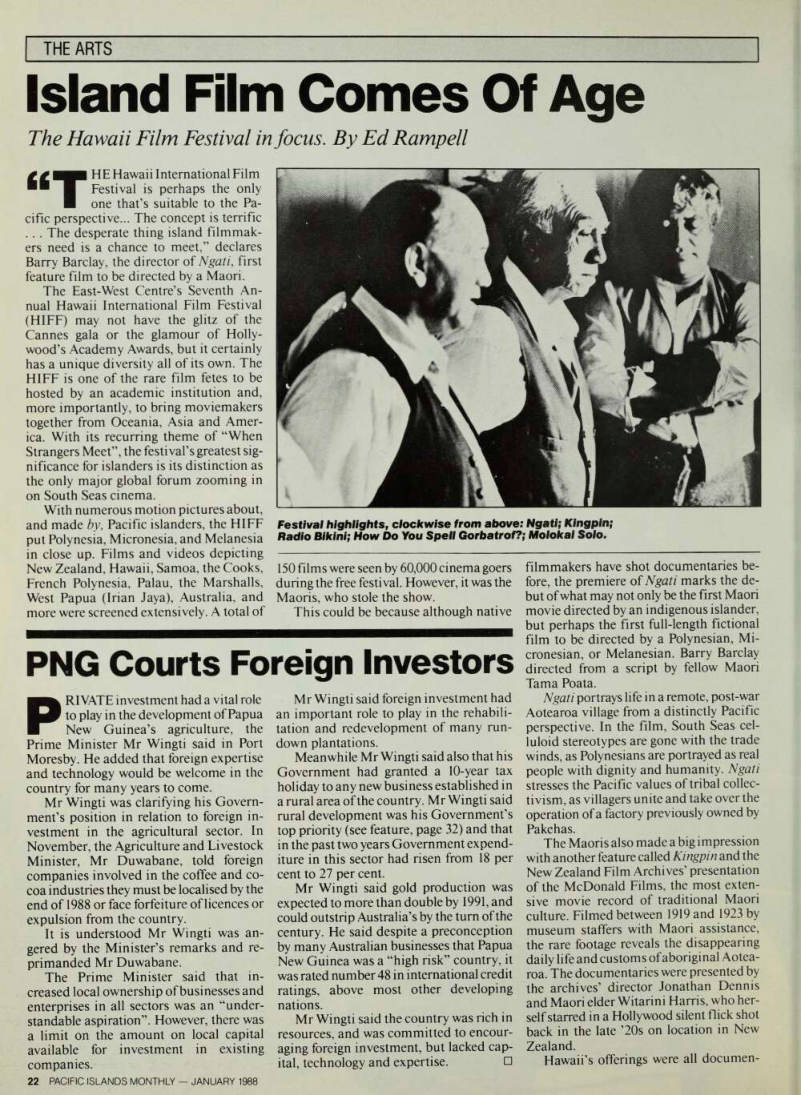
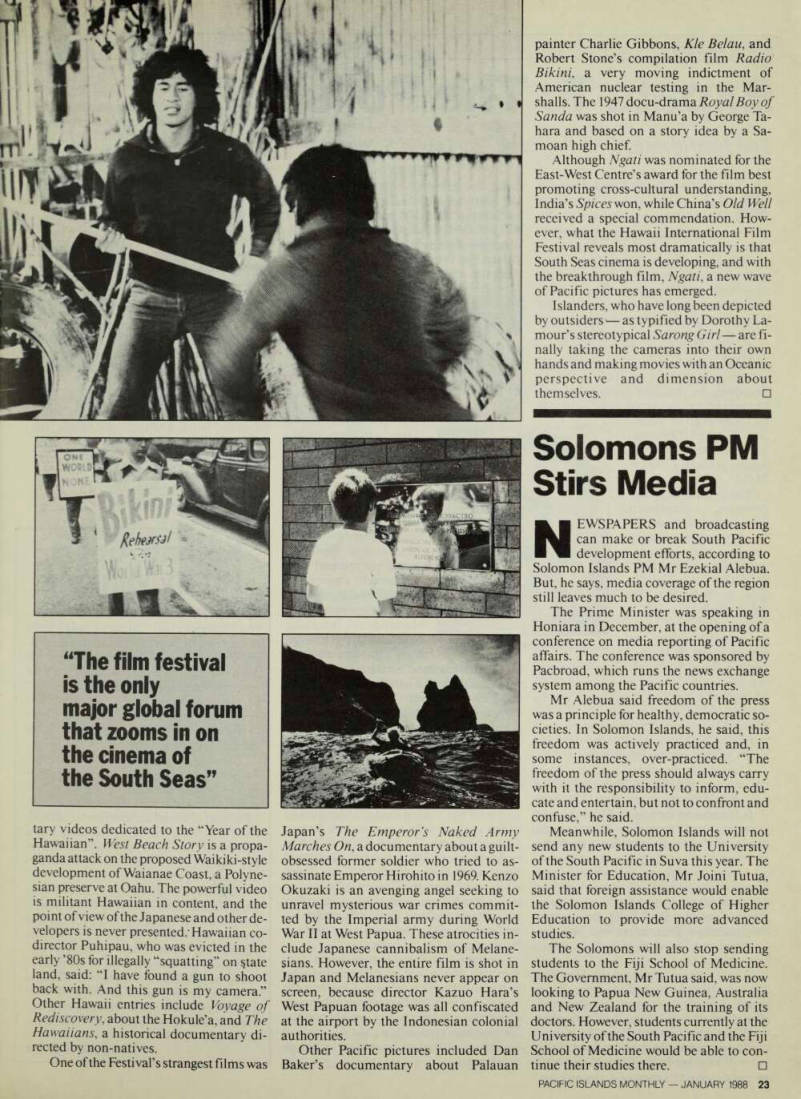
Festival highlights, clockwise from above: Ngati; Kingpin; Radio Bikini; How Do You Spell Gorbatrof?; Molokai Solo.
“The film festival is the only major global forum that zooms in on the cinema of the South Seas"
tary videos dedicated to the “Year of the Hawaiian”. West Beach Story is a propaganda attack on the proposed Waikiki-style development of Waianae Coast, a Polynesian preserve at Oahu. The powerful video is militant Hawaiian in content, and the point of view of the Japanese and other developers is never presented; Hawaiian codirector Puhipau, who was evicted in the early ’Bos for illegally “squatting” on state land, said: “I have found a gun to shoot back with. And this gun is my camera.”
Other Hawaii entries include Voyage of Rediscovery, about the Hokule’a, and The Hawaiians, a historical documentary direeled by non-natives.
One of the Festival’s strangest films was
Japan’s The Emperor’s Naked Army Marches On, a documentary about a guilt obsessed former soldier who tried to as sassinate Emperor Hirohito in 1969. Kenzo Okuzaki is an avenging angel seeking to unravel mysterious war crimes commit ted by the Imperial army during World War II at West Papua. These atrocities in elude Japanese cannibalism of Melane sians. However, the entire film is shot in Japan and Melanesians never appear on screen, because director Kazuo Hara’s West Papuan footage was all confiscated at the airport by the Indonesian colonial authorities.
Other Pacific pictures included Dan Baker’s documentary about Palauan
painter Charlie Gibbons, Kle Belau, and Robert Stone’s compilation film Radio Bikini, a very moving indictment of American nuclear testing in the Mar shalls. The 1947 docu-drama Royal Boy of Sanda was shot in Manu’a by George Ta hara and based on a story idea by a Sa moan high chief.
Although Ngati was nominated for the East-West Centre’s award for the film best promoting cross-cultural understanding, India’s Spices won, while China’s Old Well received a special commendation. How ever, what the Hawaii International Film Festival reveals most dramatically is that South Seas cinema is developing, and with the breakthrough film, Ngati , a new wave of Pacific pictures has emerged.
Islanders, who have long been depicted by outsiders— as typified by Dorothy La mour’s stereotypical Sarong Girl —are fi nally taking the cameras into their own hands and making movies with an Oceanic perspective and dimension about themselves. □