Back From The Brink
pp. 10-12 · Read in the full issue
Fiji
Democracy and economic recovery are at last in sight.
FIJI HAS a civilian government once more, after the military, which seized power in May, decided to hand back power to former Governor- General Ratu Sir Penaia Ganilau who be comes the first President of the Republic of Fiji.
The change was the last link in a dra matic chain of events and top level dis cussions between military leader and head of the military government Brigadier Si tiveni Rabuka, Ratu Sir Penaia and for mer Prime Minister Ratu Sir Kamisese Mara.
Ratu Sir Penaia had earlier expressed his willingness to accept the President’s
position provided he was satisfied that the new Constitution, which will replace the 1970 Inde pendence Constitution, adequately protected the rights of all people in Fiji.
Brigadier Rabuka had officially offered the post to Ratu Sir Penaia; Ratu Sir Kamisese Mara had also accepted the Prime Ministership provided he had a free hand to se lect his own ministers and to set a time frame of two years to get the coun try back to parliamen tary democracy.
On December 5 the very day the execu tive council of the mili tary Government was to meet to discuss the two drafts of the new Consti
tution Brigadier Rabuka announced that he was abdicating and handing power back to the Governor General, whom he had now appointed as the first President of the Republic of Fiji. The surprise an nouncement shocked most ministers, and the brigadier was reportedly almost per suaded to change his mind.
All 22 ministers in the military admin istration have been given 10 months’ sal ary in compensation. The four newly appointed supreme court judges have also had their appointments terminated and have been paid three months’ salary in compensation. This is designed to give Ratu Sir Kamisese a free hand in putting in place an independent judiciary: the magistracy is also likely to be reorganised.
Brigadier Rabuka and Ratu Sir Penaia both addressed the nation in a radio
broadcast that night, outlining their rea sons for stepping down and for accepting new positions.
Brigadier Rabuka explained that from the very beginning he had made it clear he had no intention of keeping political power himself: he said his men and officers had supported him to “prevent what we had seen over the past few years; the gradual erosion of the Fijian way of life with threats to the customs and traditions of the Fijian people.”
In his address, the Brigadier also made it clear that the Bavadra win in the April election was not the beginning but “the moment when the threats became intol
erable”. He said the 1970 Constitution was “inad equate to protect the val ues and principles and way of life of the Fijian people”, particularly when a political party not predominantly Fijian was in power.
Ratu Sir Penaia said he and the Brigadier had agreed that Fiji should have the best Constitu tion that could be de vised. They were also in agreement on the maxi mum requirements that will be needed to protect the interests of indige nous Fijians: require ments that may eventually be reflected “in a number of ways”.
The leaders of Fiji, he said, desired a return to
parliamentary democracy and the re-es tablishment of links with the Crown.
Reaction locally was positive, and was hailed as a move in the right direction.
However, foreign governments, especially those of Australia and New Zealand, were reserved in their initial responses. New Zealand Foreign Minister Russell Mar shall said the changes were a substantial step forward and could lead to an increase in his country’s level of recognition of Fiji.
Australia also said it looked forward to seeing details of the new Constitution.
Australia’s acting Foreign Minister, Mi chael Duffy, said the appointments of Ratu Sir Penaia and Ratu Sir Kamisese indi cated an early return to a truly civilian government was now possible.
In a national radio broadcast, the newly appointed Prime Minister pleaded with
the people of Fiji to cast aside enmity and hatred and to put the past behind them.
He appealed for co-operation and prom ised in turn to do “everything possible” to put Fiji back on a sound footing as soon as possible.
Ratu Mara emphasised that his Government was only an interim govern ment and asked for everyone’s support to pave the way for general elections as soon as possible. He also took the opportunity of once again categorically denying that he was in any way involved in the two mili tary coups. “I say in all honesty and sin cerity that I was not a party to them, either prior to or after,” he said. “My action in becoming an adviser in previous admin istrations was motivated solely by my de sire to help my country in a time of need; a country for which I have sacrificed the greater part of my life.”
In his address to his cabinet ministers, Ratu Mara called on them to build bridges of understanding and co-operation be tween the people and the Government.
“The people of this country are looking to us for help and the world is looking at us with interest,” he said. “We cannot fail; we should not fail. If we do, we ourselves are failures.”
Observers in Fiji say the change was necessary to save the country from eco nomic ruin. Investor confidence has eroded to a level where even the most at tractive packages are not having the de sired effect of luring foreign investors.
Locally, no new investment is being made and the building and construction indus try has almost come to a halt. Indians in both professions and business are leaving the country, inflation is on the increase and unemployment is also rising. To restore confidence and win back the goodwill of the business community (and particularly of its Indian members), it was necessary to put in command a leader who has the image of a “saviour”.
The NFP/Labour coalition, deposed Government of Dr Timoci Bavadra, has made no official comment on the changes in leadership and the handing of power from a military to a civilian government.
In a letter to the Fiji Times, Dr Ba vadra explained that he was monitoring the situation closely and said “the public can accurately judge things for them selves.” However, he made it clear that “neither I nor my party were consulted about the composition of the interim government and have not to date been in vited to discuss any aspects of the newl
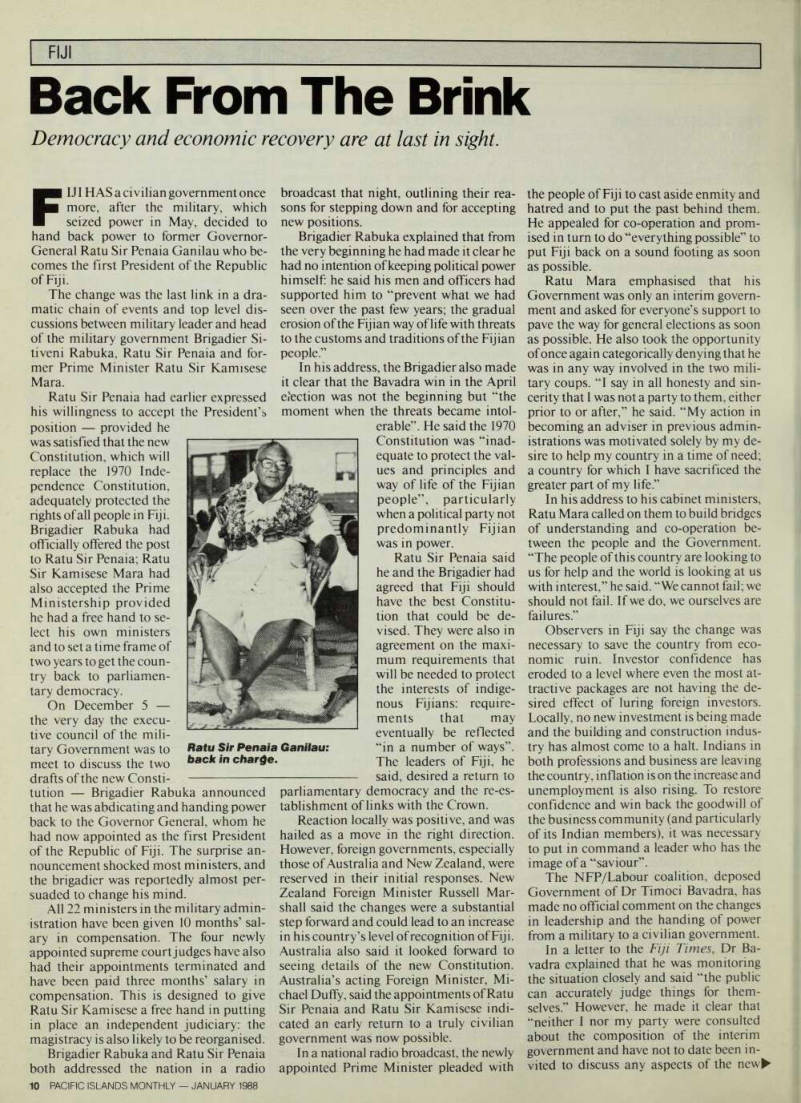
Ratu Sir Penaia Ganilau: back in charge.
Austral International
Constitution which, I understand, is to be promulgated some time soon.”
The deposed Prime Minister also said that while he was glad to note that the President and the Prime Minister in their statements had said they were not sub jected to military pressure in choosing the new civilian administration, he was puz zled, “if that was the case, that neither of them attempted to get in touch with me even to discuss the future, especially after the goodwill that seemed to be present at the conclusion of the Deuba Accord on September 23.”
The Taukei movement, which backed the military Government of Brigadier Ra buka, is reported to be split on the change of government. One faction led by Ratu Meli Vesikula, Minister for Fijian Affairs in the military Government, is critical of the changes and says Taukei does not sup port any decision outside the mandate of the Great Council of Chiefs.
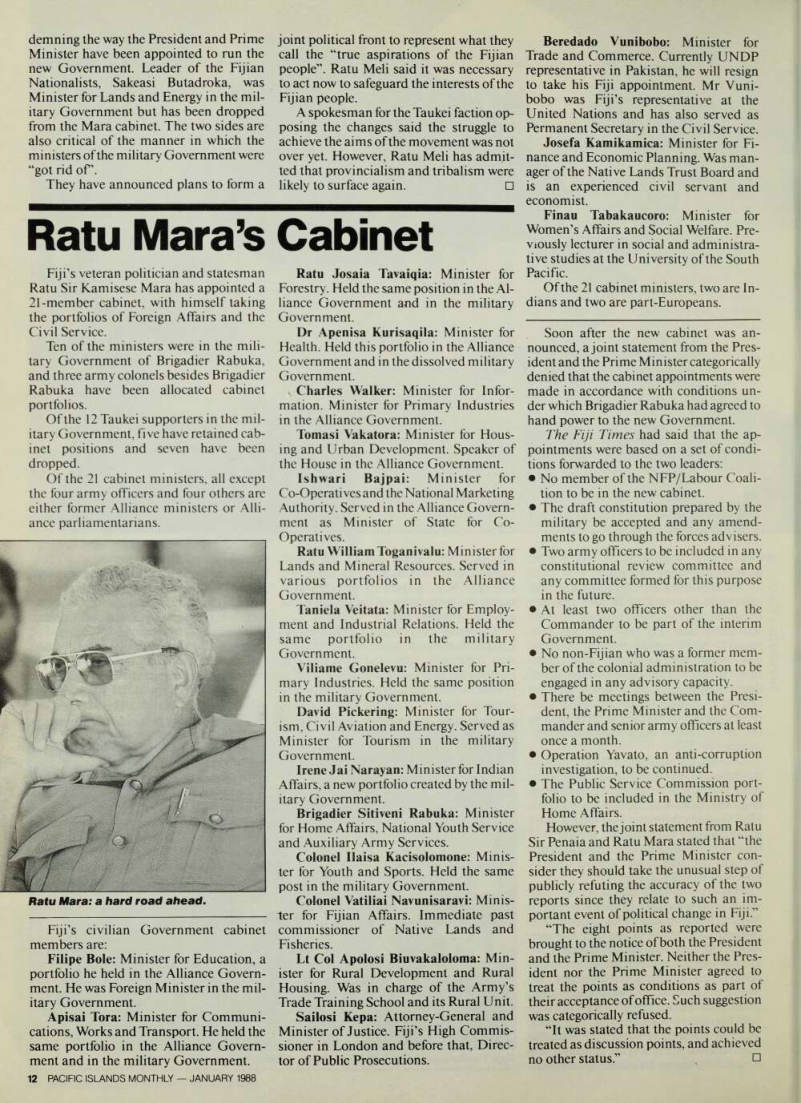
However, another faction led by Rev erend Tomasi Raikivi, Minister for Social Welfare in the military Government, has pledged its support to the new Govern ment. Both Ratu Meli and Mr Raikivi have been dropped from the cabinet. Reverend Raikivi led a delegation of about 100 people to Government House and made a traditional offering pledging their full sup port for the new leadership. The group thanked Ratu Sir Penaia and Ratu Sir Kamisese for accepting the positions and sought forgiveness for insulting and abus
ing Ratu Sir Penaia during the Great Council of Chiefs meeting at the Civic Centre in July. Spokesmen said they were happy the leadership of the country had gone back to the chiefs.
Accepting their support, Ratu Sir Pen aia acknowledged that there were some who did not support the new Govern ment; in his first nationwide broadcast as President, he warned those who “may seek to cause unrest in the future” that “we must
set ourselves firmly against violence, hatred and disorder”. Later, a petition signed by some 1000 Taukei supporters af firming their support for the new Govern ment was delivered to Government House.
However, the faction led by Ratu Meli claimed that the group led by Reverend Raikivi had no mandate to act on behalf of the Taukei movement.
Ratu Meli’s faction has joined forces with the Fijian Nationalist Party in con-^
Top: Public support for the new team. Above: Taukei’s Rev Raikivi.
Jacques Langevin/Sygma
demning the way the President and Prime Minister have been appointed to run the new Government. Leader of the Fijian Nationalists, Sakeasi Butadroka, was Minister for Lands and Energy in the military Government but has been dropped from the Mara cabinet. The two sides are also critical of the manner in which the ministers of the military Government were “got rid of’.
They have announced plans to form a
joint political front to represent what they call the “true aspirations of the Fijian people”. Ratu Meli said it was necessary to act now to safeguard the interests of the Fijian people.
A spokesman for the Taukei faction op posing the changes said the struggle to achieve the aims of the movement was not over yet. However, Ratu Meli has admit ted that provincialism and tribalism were likely to surface again. □
Beredado Vunibobo: Minister for Trade and Commerce. Currently UNDP representative in Pakistan, he will resign to take his Fiji appointment. Mr Vuni bobo was Fiji’s representative at the United Nations and has also served as Permanent Secretary in the Civil Service.
Josefa Kamikamica: Minister for Fi nance and Economic Planning. Was man ager of the Native Lands Trust Board and is an experienced civil servant and economist.
Finau Tabakaucoro: Minister for Women’s Affairs and Social Welfare. Pre viously lecturer in social and administra tive studies at the University of the South Pacific.
Of the 21 cabinet ministers, two are In dians and two are part-Europeans.