No Cause For Confidence
Opinion
An ailing leader and a shaky victory signal a need for the newly elected Vanua’aku Party to put an end to its internecine struggles.
WITH THE ruling Vanua’aku Party returned to power and Father Walter Lini named Prime Minister once again, Vanuatu’s post-election politics might seem unchanged but beneath this still surface, dramatic shifts are under way. The leadership of the VP Government remains in question, despite Father Lini’s successful defence of his post against an unprece dented challenge from his party’s secretary-general, Barak Sope. The Government itself, as it prepares for four more years shaping the nation, must be aware that its support is declining quickly; on present trends it could well lose the next election.
Father Lini and Barak Sope waged an extraordinary
contest for the leadership of party and country in the early days of December, before reaching a con sensus settlement as disarmingly traditional as it is unsatisfactory.
Rivalry gives way to amity.
The opposition Union of Moderate Parties has a clearer picture of its needs; Vincent Bou lekone, the leader in three unsuc cessful election campaigns, was quickly replaced by the articulate Maxime Carlot. The UMP can afford to be pleased with its per formance in the November 30 elections. It won 19 seats in the newly expanded 46-seat parlia ment and received 42 per cent of the popular vote, as against 33 per cent in 1983, while the VP saw its share drop below 50 per cent for the first time.
The allure that has long been attached to the VP as the party of the independence struggle may be wearing down, and the nine per cent swing away from the party is a warning signal that it must change or die. Some of this swing went to the UMP; some was ab sorbed by the group of small new parties that have emerged in the
past year, such as Labour and the New Peoples Party.
While these parties may not yet have a voice in parlia ment, their creation spells the end of the VP’s traditional map of Vanuatu politics which often amounts to a sim ple (and simplistic) Anglophone prescription of us versus them, VP versus UMP, progressive versus conservative.
The pattern of the election result was pervasive; in all
but one of the constituencies, the VP’s vote was on the decline.
Against this background, the retention of Father Lini as Prime Minister, with an expanded role going to Mr Sope, is arguably the worst of all possible outcomes for the VP and for the nation. Father Lini has not recovered his health and may soon take medical leave of absence. His deputy will wield limited authority at a time when the na tion needs concerted action on both diplomatic and economic fronts to regain a growth-path.
Mr Sope, a man with an instinctive and deep appre ciation of and appetite for power, may not be the answer to a fledgling democracy’s prayer either, despite his prom
ises to run the country more “on business lines”. Regional powers have serious doubts about his controversial “Libyan initiative” and his intriguing combination of fiercely non-aligned foreign poli cies with a taste for free enter prise. But even if this elusive figure reinforces his role as party and Government strongman, a power vacuum remains at the top.
Vanuatu’s priorities, as the na tion continues the difficult tran sition from independence to development, should be clear: it needs more education, more for eign aid, more investment and a careful meshing of traditional and modern values. Seen in this light, the VP Government’s running diplomatic war with the French is a quixotic struggle, covertly and ruinously directed at Vanuatu’s own large Francophone minority and the UMP.
This election over, the time has come for the VP (long a party of revolution and struggle) to re shape itself into a force capable of leading all ni-Vanuatu what ever their religion, island, ideol ogy or language forward. This
was the challenge the UMP’s Mr Carlot offered the Government on the first day of the new parliament in Port Vila, when he pledged his party’s efforts as a determined, but constructive, opposition. If the VP does not accept this challenge, devise and implement strong policies mar shalled by a strong leader, its days as Vanuatu’s dominant party could well be numbered.
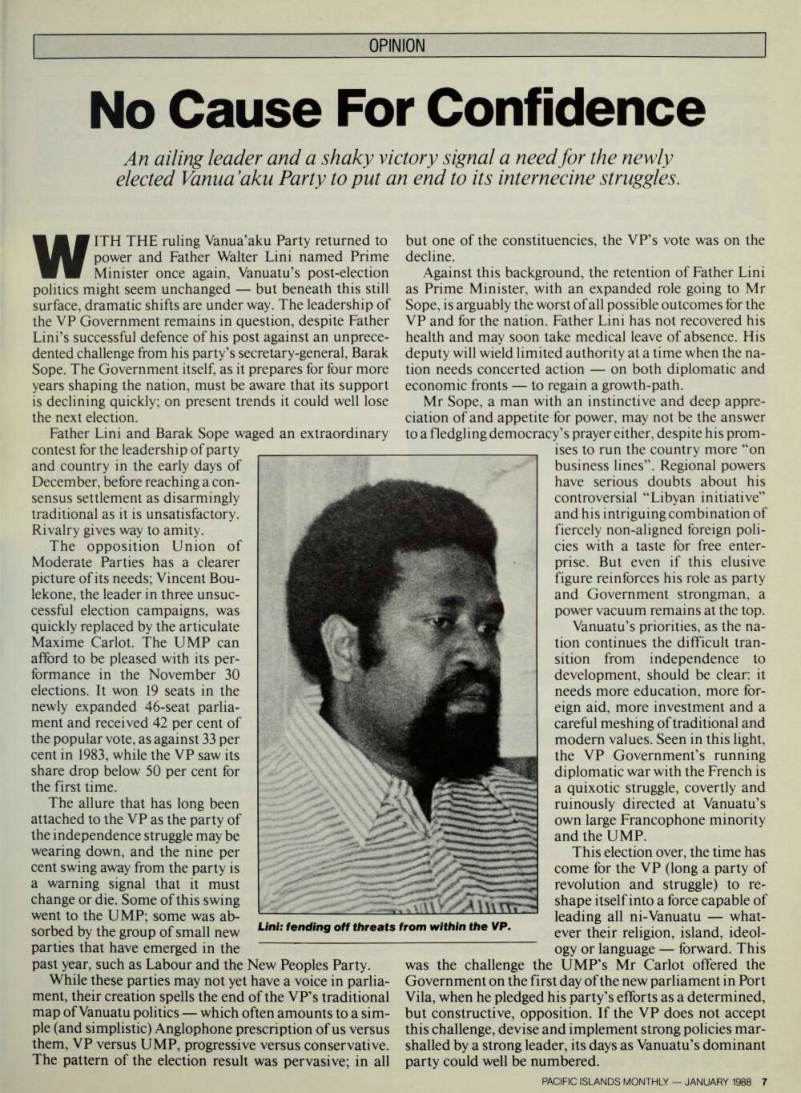
Lini: fending off threats from within the VP.