Memories of Christmas
p. 58 · Read in the full issue
Out Of The Past
Sir Leonard Usher recalls the joys of the festive season
IN THE islands there may be few chim neys for Santa Claus to climb down on Christmas Eve, but the spirit and ob servances of Christmas have been very much alive in Fiji since Christian mis sionaries brought their message to the people of the islands.
The practices customary in Western countries have been adopted and Christ mas in Fiji as much as in Europe has be come a time for the giving and receiving of presents and for feasting and holidays; a time for children’s parties, and for per suading plump gentlemen to don red robes and unconvincing cotton-wool beards to play Father Christmas at the height of the tropical summer.
It has become the occasion for annual staff parties and for business and profes sional firms to entertain their customers and clients.
It is a time looked forward to by shop keepers in expectation of peak sales.
Although less than half of Fiji’s popu lation adheres to the Christian faith, Christmas has, in its non-religious as pects, become a universal festival, and to a remarkable extent there has been each year the lifting of the spirit engendered by community feelings of goodwill.
In recent years a corresponding phe nomenon has occurred at the time of the festival of Diwali late in the year which has, to a growing extent, crossed the barriers of strictly Hindu observance.
Among the Fijian people, the require ments of church attendance on Christmas Day have traditionally had the effect of making New Year a time of greater out ward joy.
I have vivid memories of Christmas holidays spent at Lomaloma, in Lau, with Ratu Sukuna and Adi Maraia in the 19405.
On Christmas Eve, choirs from the Fijian and Tongan communities in the village would come to the house to sing carols and be given food and drink and wished a Merry Christmas.
The last choir was always of men from southern Lau, who sang chants that had come in ancient days from Tonga and had been preserved in Lau, though largely for gotten in Tonga itself.
Ratu Sukuna loved these chants and when I excused myself and went to bed I knew that when I re-appeared next morn ing he would still be sitting on the veran dah, by now in sulu and singlet, still singing vigorously with the choir.
New Year was the time for qiri kapa, or
beating of tins. Parties of men and women would march in turn through the village, beating rhythmically on, in those days, the four gallon cans in which benzine and ker osene were sold. In later years, biscuit tins have come to be used, but the ritual con tinues. It requires that the marchers should change clothes before each parade and there is much competition among the women to produce colourful dresses from the bolts of cloth that have been bought in preparation for the occasion.
As was the case with Diwali in Octo ber, Christmas in 1987 promises to be a sombre affair, or at least more subdued than has been the case in the past.
This year’s successive political coups
and accompanying currency devaluations have had economic effects, and are already leaving more and more families of all communities in all parts of the country with less money to spend. There is likely to be little to spare this year for special celebrations.
But I remain heartened by the personal friendships that have persisted through political turmoil and that transcend racial and religious barriers.
It does not need Christmas, of course, to produce a feeling of goodwill and a de sire for peace among men. We must all hope, however, that in Fiji in 1987 the spirit of Christmas will heighten both that feel ing and that desire. □
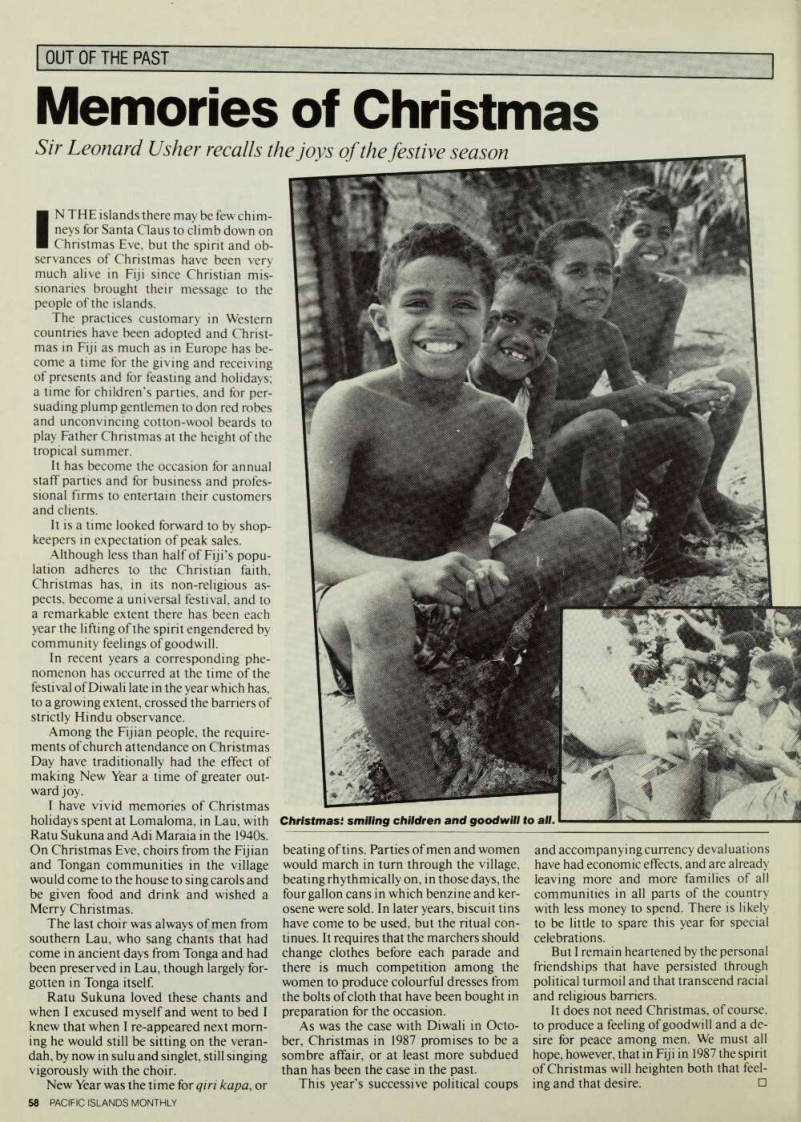
Christmas: smiling children and goodwill to all.