Netball Queen Scores Again
p. 46 · Read in the full issue
Sport
Margharet Matenga's exploits inspire islands’ success.
By Paul Moon
RUGBY UNION has long been ac cepted as the sport in which the Pacific islands achieve the greatest international impact. However, the oval ball code has now been eclipsed in the suc cess stakes by that most genteel of ladies’ recreations netball.
At the recent World Netball Champi onships in Scotland, New Zealand came first, the Cook islands finished sixth, Fiji eighth and Papua New Guinea 13th.
The performance of the Cook Islands team, making its first appearance at a World Championship, was a major feat. A territory of just 19,000 people, it beat es tablished netball playing nations Wales, Scotland, Eire, Malaysia, Barbados and Bermuda and was unlucky to lose to the highly rated Jamaica by a single goal in the play-off for fifth place. The Fijians con solidated their status as a team capable of upsetting anyone and PNG displayed enough enthusiasm and raw skill to sug gest it has great potential.
Two members of the victorious New Zealand side, Rita Fatialofa and Julie So lia, are Western Samoans and one, Mar gharet Matenga, is a Cook Islander.
Margharet Matenga has been an out standing figure in New Zealand and world netball for almost a decade. Yet she first made her sporting mark as a tennis player.
It was to take up a tennis scholarship that Margharet, then 17 years of age and known by her maiden name of Margharet Ka mana, moved from the small Rarotongan village of Tupapa to Auckland in 1973.
The scholarship fell through but she re mained in Wellington, where she joined the Pacific Island Church Netball Club in 1974. In her first season she won a place in the club’s senior second team and the Wel lington under-20 representative side.
Selection for the Wellington senior combination followed and in 1978 she made her international debut. Margharet has been an integral part of Kiwi combi nations ever since.
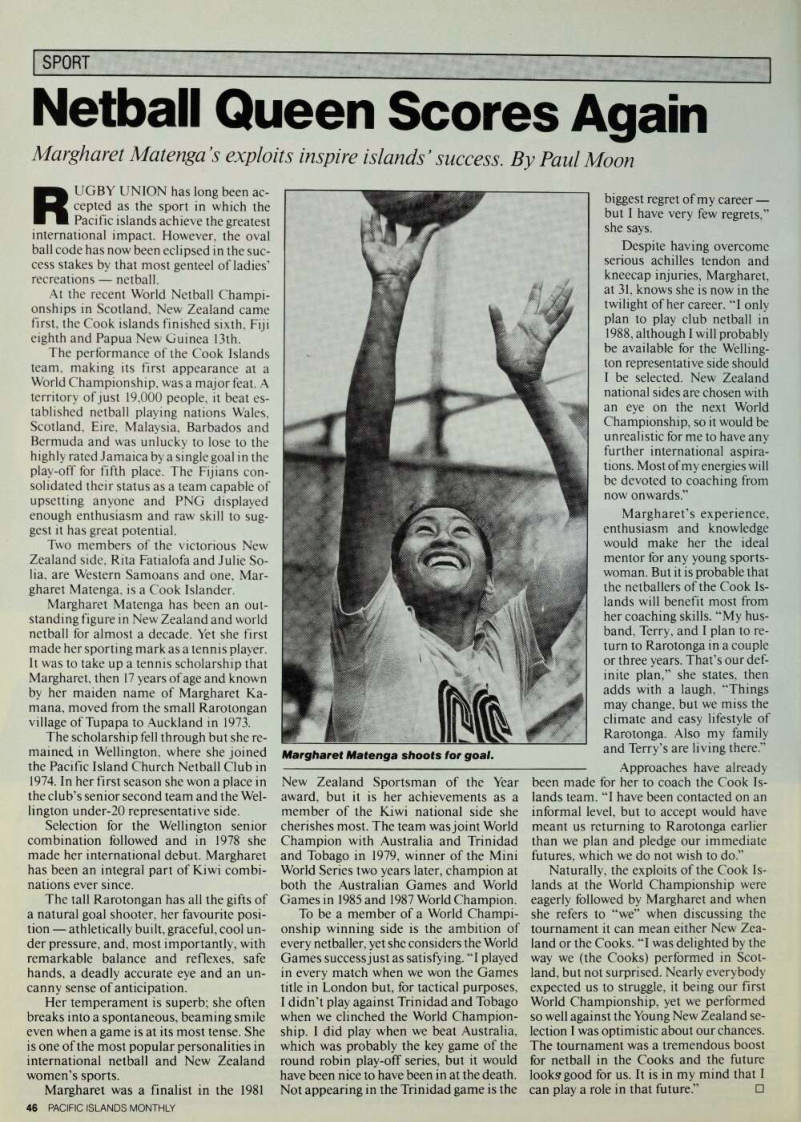
The tall Rarotongan has all the gifts of a natural goal shooter, her favourite posi tion athletically built, graceful, cool un der pressure, and, most importantly, with remarkable balance and reflexes, safe hands, a deadly accurate eye and an un canny sense of anticipation.
Her temperament is superb; she often breaks into a spontaneous, beaming smile even when a game is at its most tense. She is one of the most popular personalities in international netball and New Zealand women’s sports.
Margharet was a finalist in the 1981
New Zealand Sportsman of the Year award, but it is her achievements as a member of the Kiwi national side she cherishes most. The team was joint World Champion with Australia and Trinidad and Tobago in 1979, winner of the Mini World Series two years later, champion at both the Australian Games and World Games in 1985 and 1987 World Champion.
To be a member of a World Champi onship winning side is the ambition of every netballer, yet she considers the World Games success just as satisfying. “I played in every match when we won the Games title in London but, for tactical purposes, I didn’t play against Trinidad and Tobago when we clinched the World Champion ship. I did play when we beat Australia, which was probably the key game of the round robin play-off series, but it would have been nice to have been in at the death.
Not appearing in the Trinidad game is the
biggest regret of my career but I have very few regrets,” she says.
Despite having overcome serious achilles tendon and kneecap injuries, Margharet, at 31, knows she is now in the twilight of her career. “I only plan to play club netball in 1988, although I will probably be available for the Welling ton representative side should I be selected. New Zealand national sides are chosen with an eye on the next World Championship, so it would be unrealistic for me to have any further international aspira tions. Most of my energies will be devoted to coaching from now onwards.”
Margharet’s experience, enthusiasm and knowledge would make her the ideal mentor for any young sports woman. But it is probable that the netballers of the Cook Is lands will benefit most from her coaching skills. “My hus band, Terry, and I plan to re turn to Rarotonga in a couple or three years. That’s our def inite plan,” she states, then adds with a laugh, “Things may change, but we miss the climate and easy lifestyle of Rarotonga. Also my family and Terry’s are living there.”
Approaches have already
been made for her to coach the Cook Is lands team. “I have been contacted on an informal level, but to accept would have meant us returning to Rarotonga earlier than we plan and pledge our immediate futures, which we do not wish to do.”
Naturally, the exploits of the Cook Is lands at the World Championship were eagerly followed by Margharet and when she refers to “we” when discussing the tournament it can mean either New Zea land or the Cooks. “I was delighted by the way we (the Cooks) performed in Scot land, but not surprised. Nearly everybody expected us to struggle, it being our first World Championship, yet we performed so well against the Young New Zealand se lection I was optimistic about our chances.
The tournament was a tremendous boost for netball in the Cooks and the future looks good for us. It is in my mind that I can play a role in that future.” □
Margharet Matenga shoots for goal.