Auckland Institute & Museum
p. 43 · Read in the full issue
The Solomon Islands
Living With Sharks
The great predators hold no terrors for Malaitans
ALTHOUGH Jaws was an interna tional movie success, marking Ste ven Spielberg’s arrival as a filmmaker and netting Universal Studios tens of millions in revenue, it was less pop ular in the Solomon Islands. Guadalcanal loved it; but on Malaita, its reception was distinctly cool.
The explanation is simple. On Guad alcanal, sharks attack people; on Malaita, people worship sharks. The inhabitants of Malaita would have been distressed to see the animal they call “brother” portrayed as a “killing machine” especially since they swim among some of the world’s most dangerous sharks every day, without fear of attack. “The white shark, the black-tip shark, the grey reef shark ... the ham merhead shark, the tiger shark: they are fa miliar to us,” writes one Malaitan. “We never eat them. We adore them.”
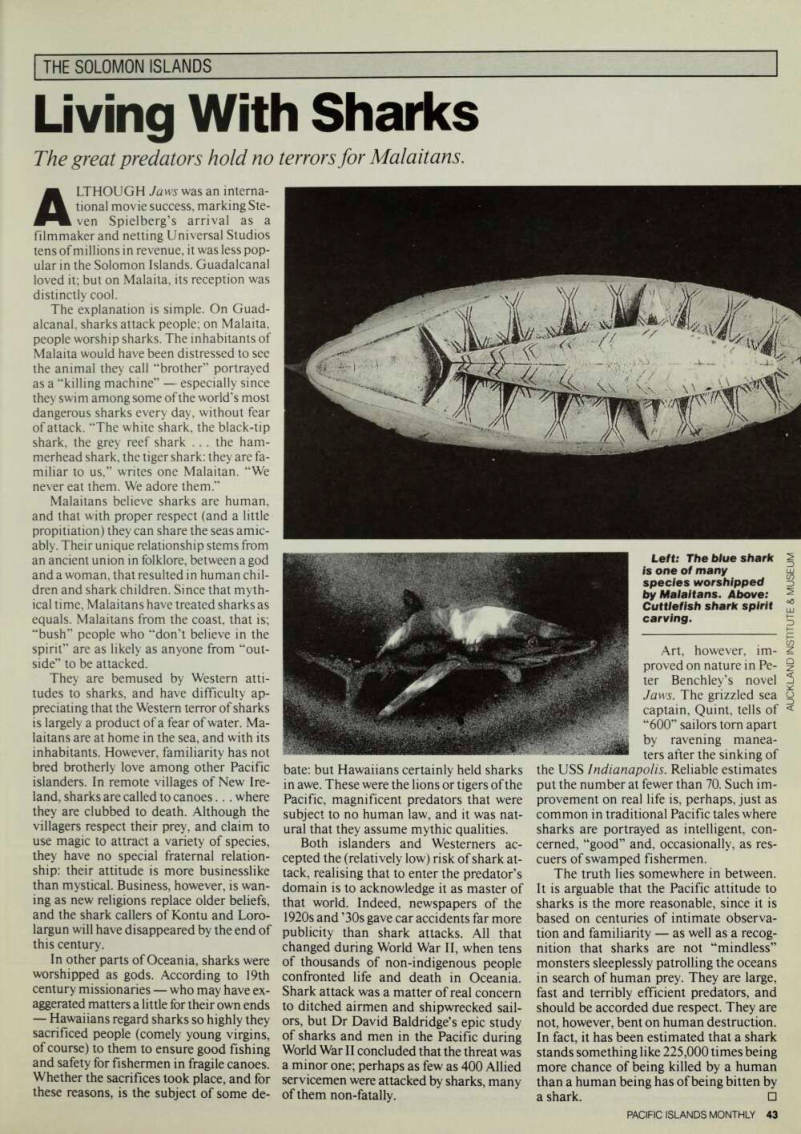
Malaitans believe sharks are human, and that with proper respect (and a little propitiation) they can share the seas amic ably. Their unique relationship stems from an ancient union in folklore, between a god and a woman, that resulted in human chil dren and shark children. Since that myth ical time, Malaitans have treated sharks as equals. Malaitans from the coast, that is; “bush” people who “don’t believe in the spirit” are as likely as anyone from “out side” to be attacked.
They are bemused by Western atti tudes to sharks, and have difficulty ap preciating that the Western terror of sharks is largely a product of a fear of water. Ma laitans are at home in the sea, and with its inhabitants. However, familiarity has not bred brotherly love among other Pacific islanders. In remote villages of New Ire land, sharks are called to canoes... where they are clubbed to death. Although the villagers respect their prey, and claim to use magic to attract a variety of species, they have no special fraternal relation ship: their attitude is more businesslike than mystical. Business, however, is wan ing as new religions replace older beliefs, and the shark callers of Kontu and Loro largun will have disappeared by the end of this century.
In other parts of Oceania, sharks were worshipped as gods. According to 19th century missionaries who may have ex aggerated matters a little for their own ends Hawaiians regard sharks so highly they sacrificed people (comely young virgins, of course) to them to ensure good fishing and safety for fishermen in fragile canoes.
Whether the sacrifices took place, and for these reasons, is the subject of some de-
bate: but Hawaiians certainly held sharks in awe. These were the lions or tigers of the Pacific, magnificent predators that were subject to no human law, and it was nat ural that they assume mythic qualities.
Both islanders and Westerners ac cepted the (relatively low) risk of shark at tack, realising that to enter the predator’s domain is to acknowledge it as master of that world. Indeed, newspapers of the 1920 s and ’3os gave car accidents far more publicity than shark attacks. All that changed during World War 11, when tens of thousands of non-indigenous people confronted life and death in Oceania.
Shark attack was a matter of real concern to ditched airmen and shipwrecked sail ors, but Dr David Baldridge’s epic study of sharks and men in the Pacific during World War II concluded that the threat was a minor one; perhaps as few as 400 Allied servicemen were attacked by sharks, many of them non-fatally.
Art, however, im proved on nature in Pe ter Benchley’s novel Jaws. The grizzled sea captain, Quint, tells of “600” sailors tom apart by ravening manea ters after the sinking of
the USS Indianapolis. Reliable estimates put the number at fewer than 70. Such im provement on real life is, perhaps, just as common in traditional Pacific tales where sharks are portrayed as intelligent, con cerned, “good” and, occasionally, as res cuers of swamped fishermen, The truth lies somewhere in between, It is arguable that the Pacific attitude to sharks is the more reasonable, since it is based on centuries of intimate observa tion and familiarity as well as a recog nition that sharks are not “mindless” monsters sleeplessly patrolling the oceans in search of human prey. They are large, fast and terribly efficient predators, and should be accorded due respect. They are not, however, bent on human destruction, In fact, it has been estimated that a shark stands something like 225,000 times being more chance of being killed by a human than a human being has of being bitten by a shark. □
Auckland Institute & Museum
Left: The blue shark is one of many species worshipped by Malaitans. Above: Cuttlefish shark spirit carving.