The New Pacific Pirates
pp. 38-40 · Read in the full issue
Forum
20th Century Western ways are threatening island traditions and economies.
In Forum this month, Professor M T Daly and Dr John Connell tell why coconuts are fighting a losing battle with Coca-Cola.
IN THE 1980 s, the Pacific shed the last traces of its innocence. Paradise was forever lost. Almost 50 years ago, Aus tralian journalist Wilfred Burchett pro claimed the Pacific “the ocean of the future”: that future has now arrived, and it is one of incorporation into the global arena. The Asia-Pacific region now ac counts for a major share of the world’s trade; its share of world imports rose from 34.9 per cent in 1970 to 41.7 per cent in 1985, and the Japan-US axis bred confident pre dictions that we were entering the Pacific Century. The Pacific Basin has become the booming region in a world whose eco nomic face has been changing rapidly and at its core are the small states of the island Pacific.
In a sense, the rise of the Pacific Rim has been too sudden to be real. As Shoichi Akazawa, Chairman of the Japan Exter nal Trade Organisation, recently re marked: “There are differences in race, religion, culture and language. It would be no exaggeration to say that virtually the only common denominator shared by these many countries is that they border on the Pacific Ocean.” The focus on the Pacific has therefore been inevitable, em phasised by the inexorable rise of Japan as its trade surplus jumped from SUS46.I billion in 1985 to SUSB2.7 billion in 1986.
Alongside this, the US trade deficit climbed from SUSISO to SUSI7O billion over the two years. More pertinently, the US trade deficit with Japan has risen from SUS 18.97 billion in 1982 to $U558.58 bil lion in 1986. The world’s largest market economy and the world’s largest exporter are bound across the Pacific. Alongside are the fast-growing newly industrialising states of Southeast Asia, and politically tense Malaysia, South Korea and the Phil ippines. With such a nexus, every nation of the region has been touched by the re gion’s critical position in the rapidly changing map of trade and geopolitics.
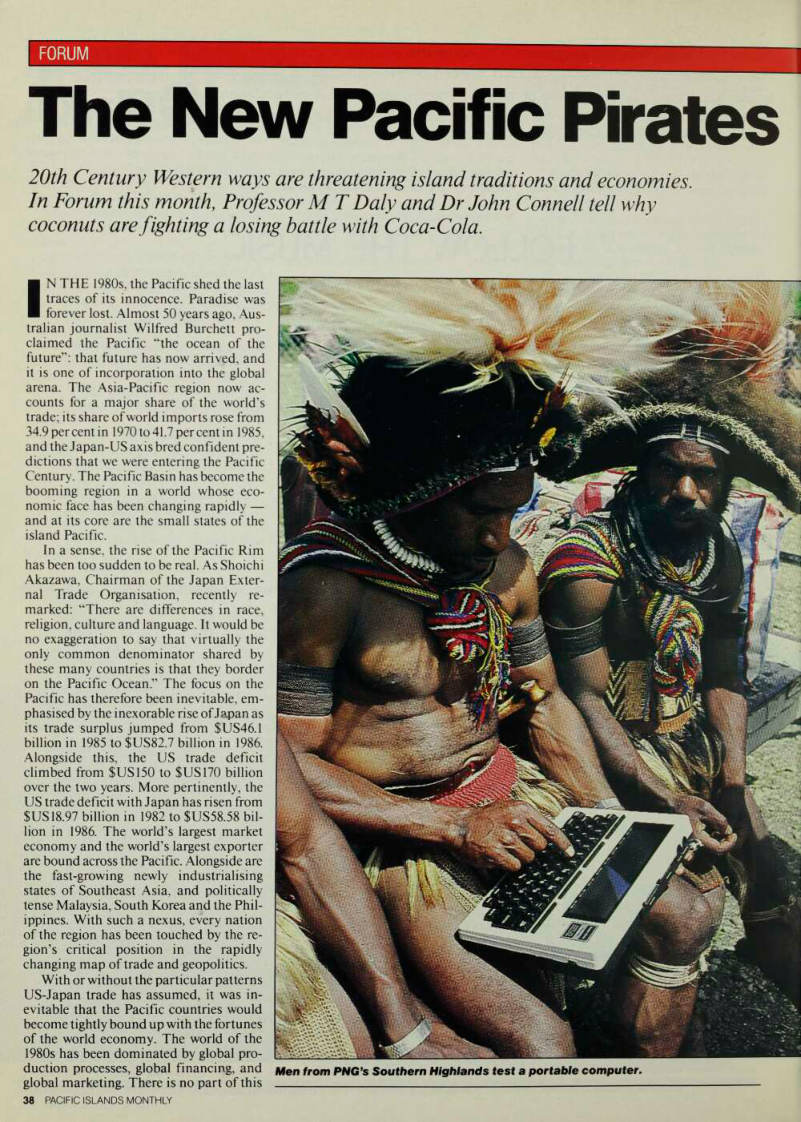
With or without the particular patterns US-Japan trade has assumed, it was in evitable that the Pacific countries would become tightly bound up with the fortunes of the world economy. The world of the 1980 s has been dominated by global pro duction processes, global financing, and global marketing. There is no part of this
Men from PNG’s Southern Highlands test a portable computer.
world remaining untouched by these proc esses: even the tiniest island economies have become enmeshed. This economic globalisation has led to widespread im pacts in the social and political spheres.
When the 64,000-people nation of Kiri bati entered into its SUSI. 7 million agree ment with Sovrybflot in 1985 for the leasing of fisheries in its Economic Exclu sion Zone, it was clear the postwar era of benign neglect of the Pacific Islands was at an end. Walter Lini’s Vanuatu negotia tions with the USSR and Libya brought superpower politics to the fore. All of this was topped off by Soviet Secretary-Gen eral Mikhail Gorbachev’s declaration at Vladivostok on July 28, 1986, that the So viet Union is a Pacific nation and that it was concerned about the buildup of nu clear weapons and naval activities in the Pacific, but would seek to establish a de gree of hegemony there, despite the “cave man-like” response of the US. Commercial ties with Pacific and East Asian nations would increase, and Vladivostok would fi nally be opened to foreigners to become an “open window on the east”.
PERHAPS NOT surprisingly, Admiral James Lyons, Com mander-! n-Chief of the US Pacific Fleet, saw the Soviet moves as the thin end of the wedge. The US boosted its diplo matic presence, and at Tonga in October 1986 finally agreed to control its rapacious fishermen and pay SUSI 2 million to the Forum Fisheries Agency over five years for access to the islands’ fishing resources.
Compacts of Free Association were signed with the US in the Federated States of Mi cronesia and the Marshall Islands, which linked these new states to the US for at least 15 years. Extraordinary pressure on Pa lau, after a series of frustrating referen dums, appears to have finally brought the tiny state irretrievably into the US orbit.
The Compact will last for some 50 years.
A non-American military presence will be banned as the US establishes a cordon militaire from Hawaii westward to Guam, Palau and the Philippines. Meanwhile, the specific role of the US in the military coup in Fiji remains to be unravelled in detail.
Superpower rivalry is being played out in both the North and South Pacific.
Further south, the “medium power” of France remains more powerful than at any previous time in this century. The FLNKS, for the moment, is cowed, and the new leg islation in November’s Pons statute takes back the few gains Kanak nationalists have made. Kanaky has been postponed indef initely. Further east, nuclear testing con tinues in French Polynesia, and recent violence in Papeete has drawn attention to seething discontent in an extremely une qual society. In central Oceania, the for gotten French colony of Wallis and Futuna may one day become a strategic base. The Rarotonga Treaty ignored by France, the United Kingdom and the US was
one attempt to find a collective regional response to the world nuclear threat. How ever, for the moment, regional unity is shallow; the Spearhead Group of Melane sian states challenged France’s response, while France has responded by increasing its aid to Polynesian states such as the Cook Islands, and Fiji. The old colonial ploy of divide and rule has been revived. Only Britain has been willing to recognise the setting of the colonial sun over the Pacific.
If Britain has somewhat decreased its presence, other nations have jostled to play a political role. Delegations from Greece and from the PLO have travelled through
the region seeking support at the United Nations. Israel has given aid to Fiji, and is interested in expanding its regional pres ence. Japan, a major exporter to the re gion, has taken on a new political role, increasing its aid and strongly criticising the French role in the South Pacific. More dramatically, Indonesia’s growing orien tation eastward has been emphasised by the apparent contribution by General Murdani to the campaign funds of the re cently resigned PNG Cabinet Minister Ted Diro, and the visit of a high-level mission to Fiji to discuss trade, aid, airline routes and perhaps military co-operation. Where Indonesia has pioneered the way other Asian countries may follow, and the An glo-Saxon lake is likely to be no more.
THE POLITICAL spotlight that has recently been turned on the Pacific masks the fact that basic changes have been wrought to the islands’ econ omies and societies over two decades.
Rapid population growth (2.5 per cent per year) has been matched by a drift of young people to the cities and the adoption of Western goods and customs. The slow money and hard work of cash cropping have given way to unrealistic expectations of “fast money” from regular wages and salaries, preferably in the secure and cush
ioned government sector. Imported foods have produced both health and'nutrition problems and lowered self-sufficiency in food: coconuts have fought a losing battle with Coca-Cola. At the root of the eco nomic problems of the islands is their de pendence on commodities, in a world in which primary commodity prices have collapsed.
The global economy has linked the is lands both as producers and consumers.
As the latter brought with it the trappings of Western living, the problems at the pro duction end of the system made the is lands less able to afford them. There is an
oversupply of commodities in the world, a decline in global consumption, and a shift toward non-resource-intensive man ufacturing, and so little prospect for sud den improvement in the island economies.
Terms of trade have transformed pro ducers into consumers of aid and remitt ances from overseas migrants. It is no accident that Auckland is the largest Po lynesian city in the world. What the Amer ican anthropologist, George Marcus, calls the “trans-national corporation of kin” has divided Tongan and other Polynesian families over Australia, New Zealand and the US in an attempt to increase incomes and share the benefits with those who re main at home. As the global economy consolidates its hold on the South Pacific, the periphery of global capitalism, so the region’s population seeks new homes closer to the centres of capitalism.
The most fragile part of the world economy is the financial sector, as the Oc tober stock market crash demonstrated.
Small dependent economies have suffered from the problems of a volatile interna tional financial system for most of the 1980 s. In 1984 the net receipts of long-term capital were minus SUS 10.7 billion; in 1985 the deficit reached $U526.3 billion and in 1986 SUS2B billion. In other words, there has been a net outflow of cash from the de
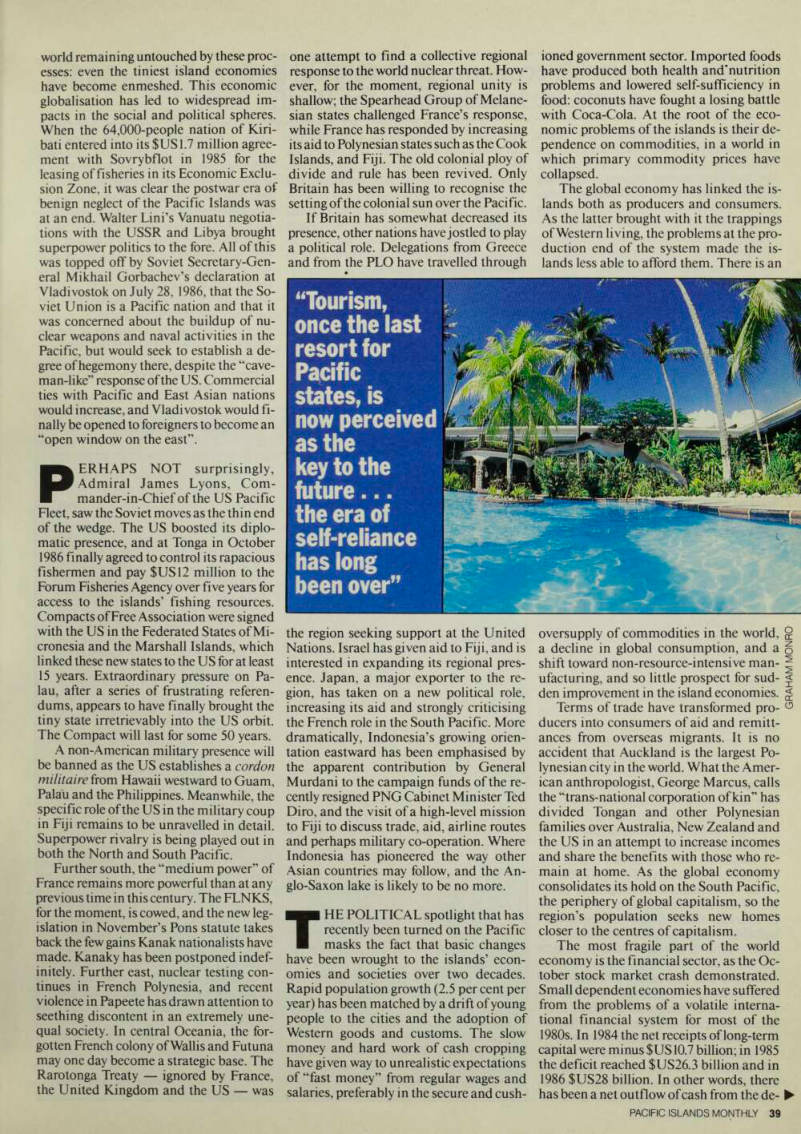
"Tourism, once the last resort for Pacific states, is now perceived as the key to the future... the era of self-reliance has long been over"
Graham Monro
“The unpredictable economic and political decisions of the global giants are transforming the Pacific Basin.”
veloping to the developed world. Since such figures (from the World Bank) do not include capital flight, they underestimate the problem: capital shortage stagnates growth in nations already damaged by de pressed prices for their goods, so a vicious circle of decline is set up. The danger for the small nations of the Pacific islands is that just as they attract world political at tention the world’s economic mecha nisms (particularly the financial system) have tended to turn against them, and in the wake of the stock market crash, inter national investment may well move away from the Pacific. Nonetheless, a future of increasing economic and political de pendence appears inevitable.
By international standards the econ omies of the South Pacific are tiny. Only the new gold rush in mineral-rich Papua New Guinea offers real prospects of sus tained economic growth. Elsewhere, es pecially in the tiny atoll states, the future is bleak; five of the independent states are on the United Nations list of 41 least-de veloped states. Slow economic growth has emphasised the problem of rising unem ployment and the migratory response. The smallest states are characterised by “earn ings” from aid and remittances that are much greater than locally generated in comes. The greatest income potential of several states is their strategic location.
Aid levels are some of the highest in the world: in the new Micronesian states less than 10 per cent of all income comes from locally generated production the re mainder is from a diversity of American aid and welfare schemes. Aid raises the lo cal exchange rate, distorts wages and makes local industries uncompetitive. In the course of this century much of the co lonial Pacific has gone from subsistence to subsidy; in the more affluent New Cale donia and French Polynesia, the islands are now consumer colonies of France isolated from their regional neighbours.
That extremely conservative and Christian Pacific states should establish economic ties with the Soviet Union and east Asian states is an indication of the se verity of economic development prob lems. Most new economic ventures are tied to overseas finance, and foreign invest ment has been gaining importance in every Pacific state. It has been concentrated in the minerals and energy sectors, the ex ploitation and processing of timber and fisheries and in very new service sector ac tivities such as telecommunications, tour ism, banking and finance. Vanuatu has led the way as an international finance centre.
Tourism, once the “last resort” for Pa cific states, is now perceived as the key to the future; in Tonga a new airstrip for wide bodied jets is symbolic of unwarranted
optimism. Manufacturing industry, the key to success in east Asia, is conspicuous by its absence; where it does exist it is primarily industrialisation by imitation and invitation, sustained only by the concessions of SPARTECA. The much-vaunted small industries centre in Tonga is as much a training ground for future migrants to acquire skills as a genuine contribution to national economic growth.
Television, the video industry and mass advertising are transforming cultures as they have never been threatened before; the overwhelmingly foreign content of the new media may, as Robert Underwood records for Guam, make islanders “homesick for places they have never been”. Rising expectations and political uncertainty are
likely to make migration more attractive, The era of self-reliance is long over even if development plans in the South Pacific continue to trumpet its virtues. This rhet one disguises the reality of the increasing incorporation of every phase of economic activity into the global economy. Small may still be beautiful, but it is also vul nerable; islands that once were vulnerable to natural hazards are now vulnerable to the unpredictable economic and political decisions of the global giants that are transforming the Pacific Basin. □ Professor M T Daly is Director of the Re search Institute for Asia and the Pacific at the University of Sydney, and Dr John Connell is Senior Lecturer in Geography at the University of Sydney.