Samoans Win Land Case
p. 19 · Read in the full issue
American Samoa
A long-running and historic dispute is resolved.
By David S North
SAMOANS have won and the Mormons lost a major and, per haps, final round in a lengthy land dispute. A three-judge panel of the US Circuit Court of Appeals in Washington ruled unanimously in October that the High Court of American Samoa had ap propriately awarded a disputed piece of land near Pago Pago to the Puailoa family.
More important than the fate of the land was the impact of the ruling on two major features of life in American Samoa: the judges ruled that the US Court system in American Samoa, despite some unu sual features, met constitutional stand ards, resolving an argument that had been simmering for years if not decades.
Secondly, it ruled (although indirectly) against tampering with Samoan law, so continuing to bar the sale of communally owned land to non-Samoans. Because of this law there is a much higher incidence of land owned by the indigenous popula tion in American Samoa than there is in some other Pacific jurisdictions.
The land dispute is a long and com plicated one. Its origins trace back to 1906 when the Mor mons leased an at tractive piece of land called Malaeimi from Puailoa Vaiuli, a matai. The Mor-
mons developed part of the land, renewed the lease in 1944, and in 1953 bought the land from Saltaima, widow of the matai.
In 1978, the then matai, Tavete M Puai loa, went to court contending that the widow had no right to sell it to anyone and that it should be returned to the family.
The local trial court ruled against him, but in the next year the family started farming part of the land anyway. The Mormons sued on the grounds of trespass.
The family maintained one could not tres pass on land one owns. This time the trial court ruled for the family. The Mormons appealed to the High Court of American Samoa, and lost there as well.
Next the Church appealed to the Sec retary of the Interior in Washington, ask ing him to overrule the High Court. The Secretary refused. The Church’s lawyers then went to the US District Court in the District of Columbia, where they argued that the US Constitution did not permit the kinds of courts found in American Sa moa, and barred the taking of land with out due process.
Again the Mormons lost, so they took the case to the next highest US court, the Circuit Court of Appeals.
At the Circuit Court of Appeals no wit nesses are called, as facts are not in dis pute. The questions relate to the interpretation of the law. Three judges hear such cases, and interrupt proceedings to pepper the rival attorneys with questions.
All three judges are fairly recent Re agan Administration appointees. Presid ing was Laurence H Silberman, who once practised labour law in Hawaii and lec tured at the University of Hawaii.
The second judge was former US Sen ator James L Buckley who got to know something about the Pacific when he was
a member of the Senate Committee on Interior and In sular Affairs. The third was Douglas H Ginsburg, until re cently a professor at Harvard Law School who, soon after this appeal, was President Re agan’s unsuccessful appointee to the Su preme Court.
Arguing before
these three were prominent representa tives of two other conservative institu tions: Reagan’s Department of Justice on one side, and the Church of the Latter Day Saints on the other.
The Justice Department was repre sented by Douglas W Kmiec. The Mor mons, by Rex E Lee.
Kmeic carried the argument for the Secretary of Interior, thus supporting the position of the High Court and of the Puailoa family in Samoa.
The principal points made by Lee were that the Mormons had been denied the opportunity, at the US District Court level, to have a trial on several matters of con cern to them. Lee said that the Church’s long-time occupation of the property had not been given sufficient importance.
The 28-page ruling of the Circuit Court, handed down six months after the argu ment and written by Judge Ginsburg, stated that Congress had not denied any one due process by shaping the Samoan courts as it had, that the “Samoan court proceedings did not constitute gross error or arbitrary action in violation of the Fifth Amendment”, and that the Samoan courts’ handling of the land ownership is sues were not, therefore, subject to reversal.
The Appeals Court, in effect, allowed the Samoan communal land ownership law to stand (together with its provision that no one but persons who had at least 50 per cent Samoan blood can buy such land) without ruling directly on the con situtionality of this provision.
For the Samoans, the long battle may be over at last. □
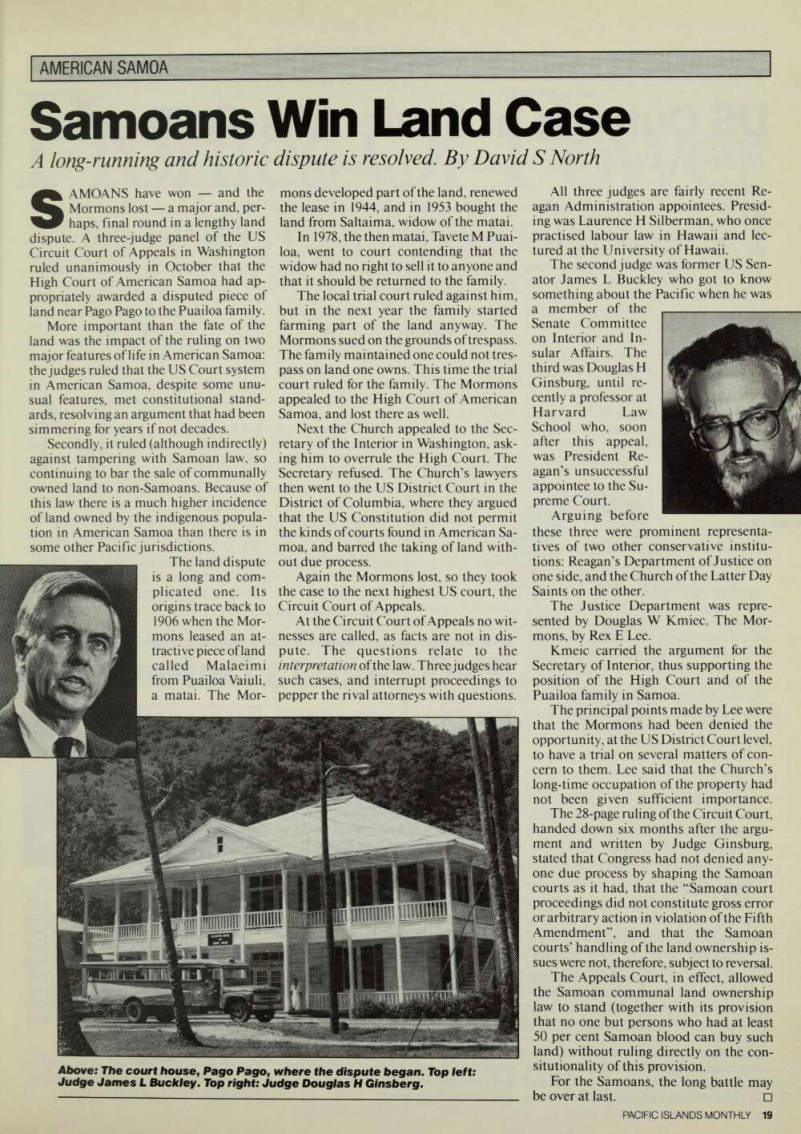
Above: The court house, Pago Pago, where the dispute began. Top left: Judge James L Buckley. Top right: Judge Douglas H Ginsberg.