Learning to Live with Fiji
Opinion
For better or worse, the republic is a fact of Pacific life. Now the world is coming to terms with the new Fiji.
AS THE convulsions caused by Fiji’s coups gradually subside to an acceptance that the Ra buka republic is here to stay there is, at last, some small hope that a form of demo cratic state may yet rise from the chaos of Fiji’s shattered stability.
True, some problems re main achingly far from reso lution tourism is in the doldrums, the economy is in dire straits, number of ex perienced government and business personnel have de parted, sugar may not be har
vested and many Indians are fearful and disaffected. But today there are indications that the republic’s leaders are taking steps to avert the economic and social disaster many thought inevitable after the upheaval.
The ideal of the coups to reassert Fijians’ ascend ancy in their own country remains in the heart of the country’s new leaders. But there are signs that these people have been made to recognise that master plans must be built on a firm foundation of economic growth, military security and social harmony.
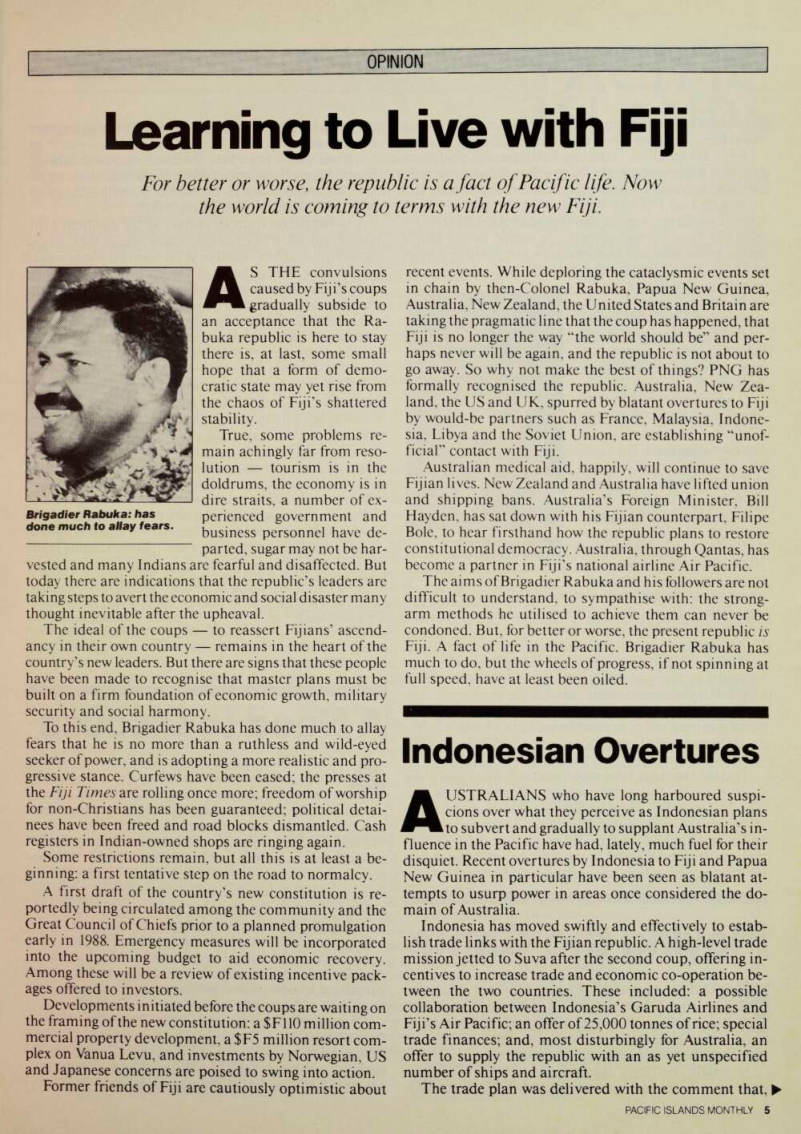
To this end. Brigadier Rabuka has done much to allay fears that he is no more than a ruthless and wild-eyed seeker of power, and is adopting a more realistic and pro gressive stance. Curfews have been eased; the presses at the Fiji Times are rolling once more; freedom of worship for non-Christians has been guaranteed; political detai nees have been freed and road blocks dismantled. Cash registers in Indian-owned shops are ringing again.
Some restrictions remain, but all this is at least a be ginning: a first tentative step on the road to normalcy.
A first draft of the country’s new constitution is re portedly being circulated among the community and the Great Council of Chiefs prior to a planned promulgation early in 1988. Emergency measures will be incorporated into the upcoming budget to aid economic recovery.
Among these will be a review of existing incentive pack ages offered to investors.
Developments initiated before the coups are waiting on the framing of the new constitution: a$F 110 million com mercial property development, a SFS million resort com plex on Vanua Levu, and investments by Norwegian, US and Japanese concerns are poised to swing into action.
Former friends of Fiji are cautiously optimistic about
recent events. While deploring the cataclysmic events set in chain by then-Colonel Rabuka, Papua New Guinea, Australia, New Zealand, the United States and Britain are taking the pragmatic line that the coup has happened, that Fiji is no longer the way “the world should be” and per haps never will be again, and the republic is not about to go away. So why not make the best of things? PNG has formally recognised the republic. Australia, New Zea land, the US and UK, spurred by blatant overtures to Fiji by would-be partners such as France, Malaysia, Indone sia, Libya and the Soviet Union, are establishing “unof ficial” contact with Fiji.
Australian medical aid, happily, will continue to save Fijian lives. New Zealand and Australia have lifted union and shipping bans. Australia’s Foreign Minister, Bill Hayden, has sat down with his Fijian counterpart, Filipe Bole, to hear firsthand how the republic plans to restore constitutional democracy. Australia, through Qantas, has become a partner in Fiji’s national airline Air Pacific.
The aims of Brigadier Rabuka and his followers are not difficult to understand, to sympathise with: the strong arm methods he utilised to achieve them can never be condoned. But, for better or worse, the present republic is Fiji. A fact of life in the Pacific. Brigadier Rabuka has much to do, but the wheels of progress, if not spinning at full speed, have at least been oiled.
Brigadier Rabuka: has done much to allay fears.