Fiji’s Age Of Innocence
p. 58 · Read in the full issue
Out Of The Past
Sir Leonard Usher recalls the free and easy way of life in Fiji 5 7 years ago
IN 1930, FIJI’S main lines of commu nication, both internal and external, lay in the sea.
The Aorangi and Niagara called once a month at Suva on both the north-bound and south-bound voyages between Syd ney and Vancouver via Auckland and Honolulu. Three Matson ships, Sierra, Ventura and Sonoma , arrived at three weekly intervals as they travelled between Sydney and San Francisco. There was also a three-weekly AUSN service between Sydney and Suva, and Suva was a regular port of call for the Union Steam Ship Company’s ship Tofua on her monthly banana trade voyages from Auckland to Fiji, Tonga and Samoa.
The net result was that there was a gap of about 19 days between overseas mails.
The Fiji Times published the passen ger lists of all ships, and there was plenty of gossip material in the names of new ar rivals, and why they had come, and in the names of people who were going away or
returning from leave or from holiday.
Most interior travel was also by water, by bamboo raft or canoe, cutter, launch or small motor vessel. Launches plied regu larly between Suva and Navua (not yet connected by road) and between Suva and Nausori, passing on the way barges car rying sugar from the Nausori mill.
There was hopeful talk of expanding the colony’s tourist trade. At Suva hotels, the charge per day for bed, breakfast, lunch, dinner and morning and afternoon tea was
$F 1.25 ($2 at the Grand Pacific Hotel).
The tariff at boarding houses was 80 cents a day. Permanent residents could live at a hotel for $lB a month (yes, a month) and at a boarding house for less than $lO.
To this you added $1.50 a month for laun dry (collected daily by horse-drawn vehi cle or by a man carrying on his back a large sheet-wrapped bundle).
All costs, of course, are relative. The wage of an unskilled labourer was then be tween 30 cents and 40 cents a day in Suva and from 25 to 30 cents elsewhere. Car penters, mechanics and boatbuilders paid from 70 cents to $1.20 a day but an artisan with special skills could earn up to $2. In the clerical division of the civil service sa laries started at sllO a year, with annual increments of sls.
But then it was possible at eating houses or “lodges” to get a meal for five cents or less. The price of “as much as you can eat” curry and roti was 10 cents. A singlet cost three cents and a sulu 10 cents. Tailors
would make a white drill suit for $2.20 and a suit of Palm Beach or poplin material for between $6 and SB. Walter Horne & Cos, advertised women’s “light washing frocks” from $2.
Produce sellers went from house to house selling tapioca for five cents a bas ket and you could buy a whole bunch of bananas for 20 cents. A 10 cents bundle of fish was a big one. You could get a bottle of whisky for sl. House rents were $lB to S2O a month furnished and $lO to sl4 a
month unfurnished. Mutton was 11 cents a pound, gravy beef three cents and beef steak seven cents.
Male office and shop workers wore ties and white long-sleeved shirts. Few mar ried residents, even without dependants, paid income tax because few of them had incomes of more than SIOOO, which was their tax-free limit.
The income tax rate was five per cent on the first SIO,OOO of taxable income. A surcharge of a further five per cent was levied on each additional SIO,OOO until the maximum tax of 30 per cent was reached at an income of $50,000. Company tax was five per cent.
The credit system extended to chits for drinks in hotel bars. Non-European drinkers in those bars were confined to permit-holders.
Anew motor car cost S3OO, but the to tal number of motor vehicles in the coun try was only a little more than 1000.
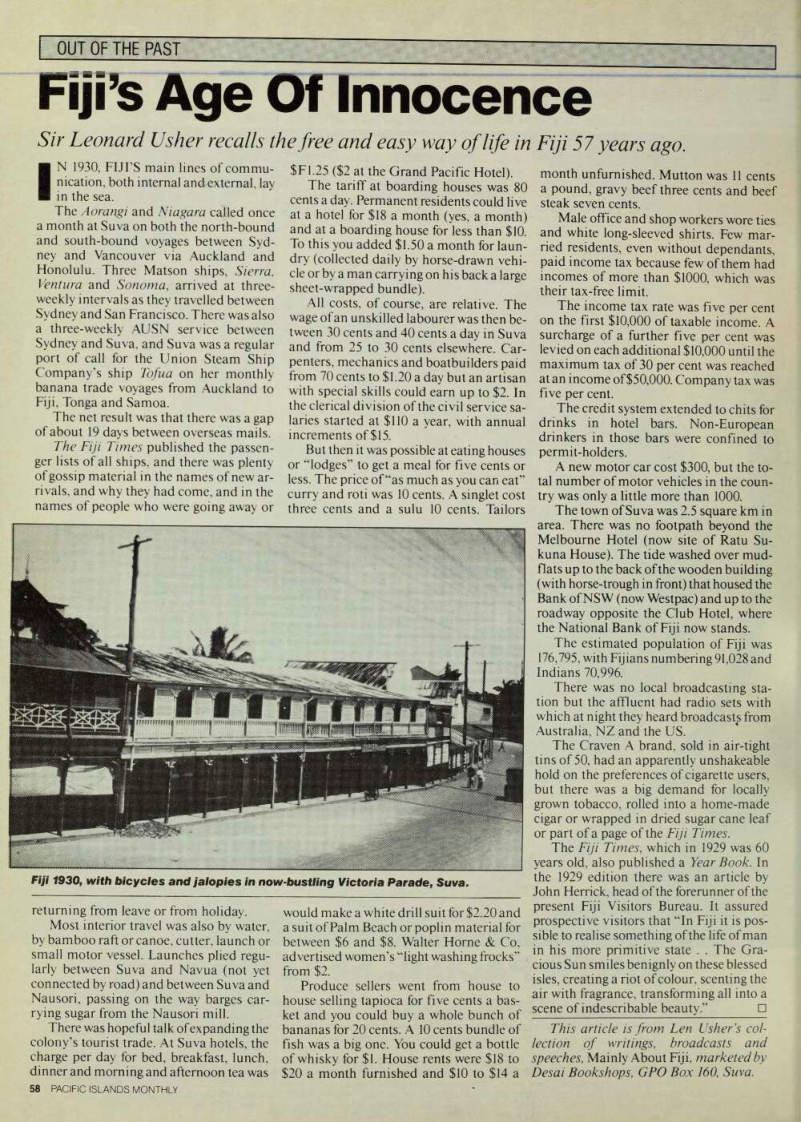
The town of Suva was 2.5 square km in area. There was no footpath beyond the Melbourne Hotel (now site of Ratu Su kuna House). The tide washed over mud flats up to the back of the wooden building (with horse-trough in front) that housed the Bank of NSW (now Westpac) and up to the roadway opposite the Club Hotel, where the National Bank of Fiji now stands.
The estimated population of Fiji was 176,795, with Fijians numbering 91,028 and Indians 70,996.
There was no local broadcasting sta tion but the affluent had radio sets with which at night they heard broadcasts from Australia, NZ and the US.
The Craven A brand, sold in air-tight tins of 50, had an apparently unshakeable hold on the preferences of cigarette users, but there was a big demand for locally grown tobacco, rolled into a home-made cigar or wrapped in dried sugar cane leaf or part of a page of the Fiji Times.
The Fiji Times , which in 1929 was 60 years old, also published a Year Book. In the 1929 edition there was an article by John Herrick, head of the forerunner of the present Fiji Visitors Bureau. It assured prospective visitors that “In Fiji it is pos sible to realise something of the life of man in his more primitive state . . The Gra cious Sun smiles benignly on these blessed isles, creating a riot of colour, scenting the air with fragrance, transforming all into a scene of indescribable beauty.” □
This article is from Len Usher’s col lection of writings, broadcasts and speeches, Mainly About Fiji, marketed by Desai Bookshops, GPO Box 160, Suva.
Fiji 1930, with bicycles and jalopies in now-bustling Victoria Parade, Suva.