Sepik - Adventure in Style
pp. 50-51 · Read in the full issue
Travel
A five-night cruise on the Sepik is still a voyage of discovery , offering insights
into traditional life and culture.
By Carson Creagh.
EGRETS AND herons rise in alarm as the speedboat winds along the jungle-lined barat: then the out board’s clatter dies and the boat swings into the quiet expanse of the Murik Lakes.
Our approach to Mendam village is her alded by laughing children, who seem to regard the weekly boatload of tourists from the MV Melanesian Explorer as ripe sub jects for gentle, if ribald, humour.
Grave smiles greet our contingent of French, German, American and Aus tralian tourists as we stroll through the quiet village, watching men plane a new canoe and women preparing the shellfish that, along with sago, form the villagers’ staple foods. Awaiting us is a slight figure in T-shirt and disreputable shorts; a young villager named Andrew Warepa.
Andrew, whose relaxed manner and friendly handshake put even those suffer ing from culture shock at ease, symbolises the Sepik River in one place, one person and one life. He is a graduate of the Papua New Guinea National Arts School and the designer of the international award-win ning South Pacific Lager label... at home in the often rarefied world of corporate de sign, styling and marketing. Yet he is also a Mendam boy born and bred, and regards this small (and, frankly, less than scenic) village as his real home. This is what really matters: friends, family, the small con cerns and unhesitating support that village life offers.
We might think of Andrew’s dual lives as conflict, but he would find the sugges tion amusing. Like so many of the Sepik’s 350,000-odd inhabitants, Andrew moves with complete assurance between the world the tourists have come from, and the world his forebears have known for hundreds of generations. His great-grand parents might have seen Otto Finsch’s tat tered expedition “discovering” the Sepik in the 1880 s; his grandparents would have known of the German missionaries at Marienberg, several hours’ steaming up stream. His parents’ generation remem bers World War II and the influx of thousands of foreigners, fighting for un known reasons in a land new to both sides.
One hundred and four years of Euro pean contact have, obviously, had an ef fect on the Sepik: the village of Japandai, for example, recalls the killing of Japanese soldiers (thus “Japan die”) during World War 11. But the Melanesian Explorer , a 38metre former ferry owned and operated by Melanesian Tourist Services, can still be
accurately described as “an expeditionary ship, not a cruise ship”.
Its conversion from a ferry and a Japanese ferry at that: headroom is less than generous, and the bunks offer a back to-the-womb experience has meant necessary compromises in cabin sizes and bathrooms. The C Deck cabins would be cosy indeed with two passengers in each, and all but the large deluxe cabin on A Deck share bathrooms. The dining sa loon’s bench seating can make entry and exit difficult at sea... but the lounge saloon and bar exert a magnetic attraction after a sweaty excursion ashore. The Explorer anchors each night while it is on the river, and its excellent library and videotape col lection provide a fascinating way of learn ing about the river and its people.
A five-night Sepik tour is in many ways a real expedition: an opportunity to ex plore a region and culture still in firm and secure contact with its long past. Souve nirs, which represent a handy (and, in many cases, a significant) addition to the area’s generally subsistence economy, tend to be original or reproduction artifacts
not the mass-produced and decidedly tacky objects common in Port Moresby.
Traditional carvings, bilums made of pandanus fibre rather than synthetic twine, jewellery and carved canoe prows are dis played in the welcome shade beneath each village’s Haus Tambaran the men’s cult house described by one ingenuous ex plorer as a “bachelors’ tea house”.
There will, however, always be tourists who insist on categorising new experi ences in familiar terms, and who regard travel as some kind of vast shopping spree.
They seem to set out literally to purchase exotic experiences: they photograph everything and everyone (meanwhile muttering a commentary into their video camera), then purchase an armload of ar-
Top: A Mendam canoe builder takes a break.
Right: Quiet concentration in the market’s clamour.
Above: Crocodiles are still central to Sepik culture.
tifacts behaviour that amuses the vil lagers as much as it infuriates their fellow travellers. They seem unaffected by the tangible power of the Sepik.
Tourism for the sake of adventure and enjoyment is a relatively new develop ment on the Sepik. Sporadic individual journeys have been made for many years, but management first appeared in 1975, with the introduction of Sepik Explorer I and Sepik Explorer II powered hou seboats owned by Peter and Janet Barter, directors of Melanesian Tourist Services and of Madang Resort Hotel. Their com mitment to Papua New Guinea (both Aus tralian-born Barters are now PNG citizens) and their love of the river and its people led them to purchase the Japanese-built Melanesian Explorer and to commence regular river trips in 1980.
Since then they have extended the Ex plorer's services to the Trobriand, Mar shall, Amphlette, D’Entrecasteaux and Siassi Islands, but Janet Barter says they still have a special regard for the Sepik: it is, as the literature says, one of the last great adventures, and thoughts of Joseph Con rad surface unbidden as the Explorer steams past jungle-thick banks, palm thatched villages and village people in narrow dugout canoes decorated with carved crocodile prows.
Crocodiles are central to the Sepik’s re ligious and cultural life: not only did the ancestral woman Gun’namak create the river on her long journey with her snake and eel sons whose father was a croc odile but this primeval, six-metre-long predator continues to hold the river in its
power. Initiation into manhood involves ritual scarification that represents the crocodile’s scaly skin: the skull, skin and teeth of the pukpuk are used in traditional artifacts, in sorcery and in souvenirs, and its meat is a valuable source of protein.
Crocodile meat is also served as a taste of the Sepik to passengers on the Melane sian Explorer a brief contact that could well be expanded by the operators, per haps with an overnight stay in a Haus Tambaran and an opportunity to meet the villagers at a more relaxed pace. Further changes are afoot (or afloat) in 1988, when MV Melanesian Discoverer, a Ass mil lion, 38-metre catamaran that will accom modate 42 passengers in twin or double berth cabins (all with private bathrooms, ISD telephones, colour TV monitors and music systems) comes into service.
The vessel’s three passenger decks in
elude spacious lounges and a full-width dining room, and adventurers will be con veyed from the air-conditioned Discov erer by a 40-person aluminium jet boat complete with toilets and galley. The Dis coverer, whose sister catamaran will be used for tours of the Trobriand Islands, will cruise at 15 knots (the Explorer cruises at 12 knots) with a sprint speed of 20 knots, and is due to enter service in August 1988.
Projected costs of Melanesian Tourist Services trips in 1988 are (in SUS) five night Sepik cruises $850; five-night lower or upper Sepik cruises $720; nine-night full Sepik cruises $1570. Seven-night Trob riand Island cruises will cost $1260 per person, and combined Trobriands-Sepik cruises $2130. For further details, contact Peter and Janet Barter, Melanesian Tour ist Services, PO Box 707, Madang PNG: phone 82 2766, telex 82707. □
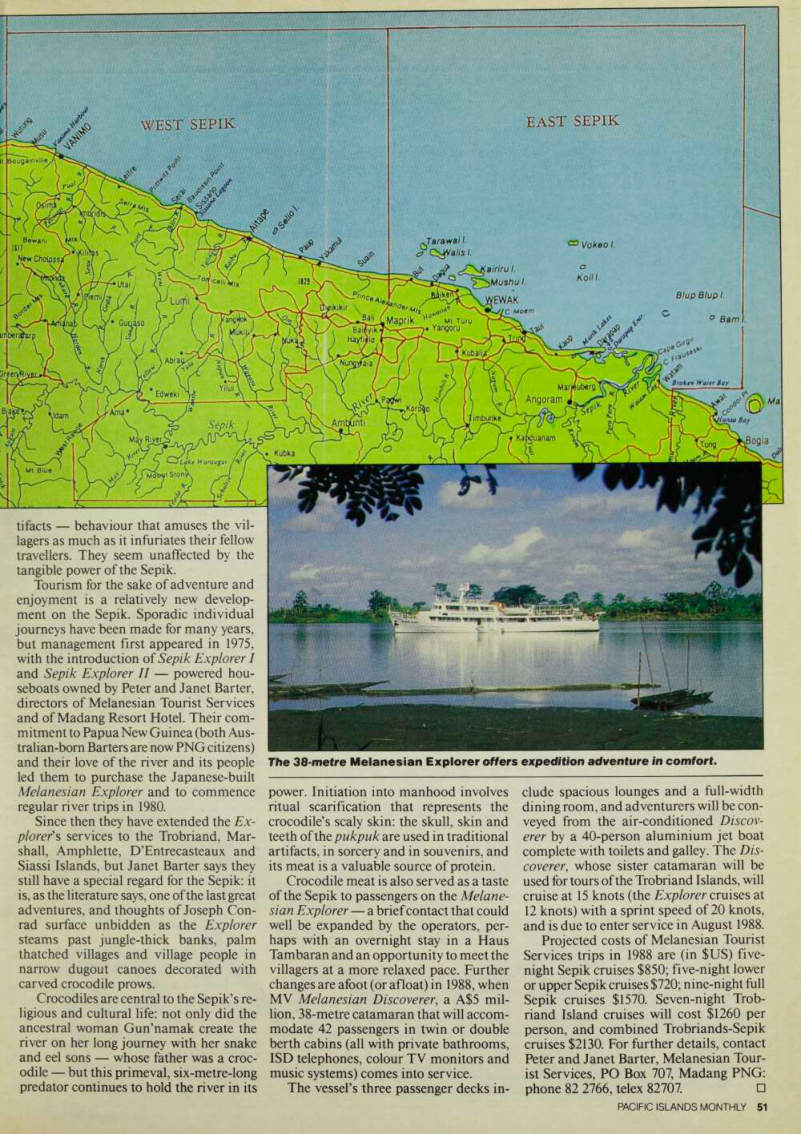
The 38-metre Melanesian Explorer offers expedition adventure in comfort.