The Soviets are Here to Stay
pp. 42-44 · Read in the full issue
Forum
Gorbachev’s Pacific Ambitions: The Soviets are Here to Stay
In our Forum pages this month, PETER YOUNG, Australia’s top defence writer, reveals the strategy behind the Soviet Union Pacific power play and how Mr Gorbachev plans to reap the political, economic and security benefits of its presence in the region.
JUST OVER a year ago in Vladivos tok, in his now famous Pacific Sea farers speech, Soviet Secretary General Mikhael Gorbachev spelled out what was seen by many as an ambit claim on the Pacific by the Soviet Union. “In Asia, in Siberia, in the Far East,” he said, “lies a greater part of our country’s terri tory. It is here that many national tasks put forward by the Party Congress will be re solved. Hence the situation in the Far East as a whole, in Asia and the ocean expanses washing it, where we are permanent in habitants and seafarers of long standing, is to us a national state interest.”
The wording may sound clumsy to western ears but the intent was unmis takeable. The speech was specifically given in the context of what Mr Gorbachev called “the Asian Pacific Viewpoint” and it es tablished a Soviet claim to play a part in Pacific affairs. It also signalled the grow ing importance placed on the Soviet Far East by the new leadership.
The Soviets have long eyed off the Pa cific as a promising area for expansion but had been blocked by the British and Americans and more pressing security problems in the West. But by 1964 they had gained a foot in the door by cleverly ex ploiting the age-old Vietnamese fears of Chinese domination and replaced China as the major source of aid in Hanoi’s struggle against the Americans.
To the Soviets, Vietnam not only blocked the southward expansion of China but afforded operational access into the Pacific free of the choke points of the nar row straits of Tsushima, Tsugaru and Soya in the Korean sea which limited Soviet bases further north at Vladivostok and Sovetskaya Gavan.
The Soviets had also quickly stepped into the vacuum left firstly by the depart ing British, and then the Americans, fol lowing their decision to withdraw from Vietnam in 1968 by deploying forces into the Indian Ocean. They also began to build up their bases in Japan’s Northern Territories.
In June, 1978, the Soviets signed a treaty
of Friendship and Cooperation with Viet nam and tied Hanoi into an economic client state status. It was an act which not only allowed Vietnam’s invasion of Cam bodia but opened the way for Soviet naval visits.
Since then, the Soviets have steadily built up their Soviet Far Eastern “Red Banner” Fleet at Vladivostok to a point where it is now the biggest of their four Fleets.
The Fleet itself is backed up by major air and land forces which form part of the Far East TVD or Military Theatre of
Operations. This Pacific force now enjoys a priority only second to Western Europe and it continues to be reinforced by the most modern vessels and equipment including the Kiev class aircraft carrier which is equipped with 550 km range SS- N-12 anti-ship cruise missiles, and the Ki rov class nuclear-powered guided missile cruiser.
This force is primarily aimed at pro tecting the seaward approaches to the So viet Far East, but has now been given a new reach into the South and South West Pa cific through the use of the staging base at Cam Ranh Bay on the central South Viet nam coast.
Over the past eight years, the aban doned American naval base has been built up to a level where it has now become the focus of Soviet activity within the region and, according to United States sources, is now the site of the largest concentration of Soviet forces deployed to any Soviet na val facility outside the Warsaw Pact.
This concentration now includes sub marines and capital ships with supporting surface combatants and a composite na val air unit made up of “Badger” strike and combat support aircraft and “Bear” and reconnaissance and anti-submarine air craft. There is also a Squadron of MIG 23 “Flogger” interceptors permanently on station to provide air defence.
It is also reliably reported to include a signals intelligence station targeted against China, the Philippines and US naval ac tivities in the region and protected by fixed anti-aircraft batteries manned by Soviet personnel.
According to Admiral Hayes, the US Commander in the Pacific (CINCPAC) at a press conference in Sydney in February this year, at any one time there is a per manent deployment of 20 to 25 Soviet ships at Cam Ranh Bay including four submarines. He also placed the number of Soviet military personnel on permanent assignment at any one time as “round 2500”.
The latest information points to an ex tensive building program, which supports
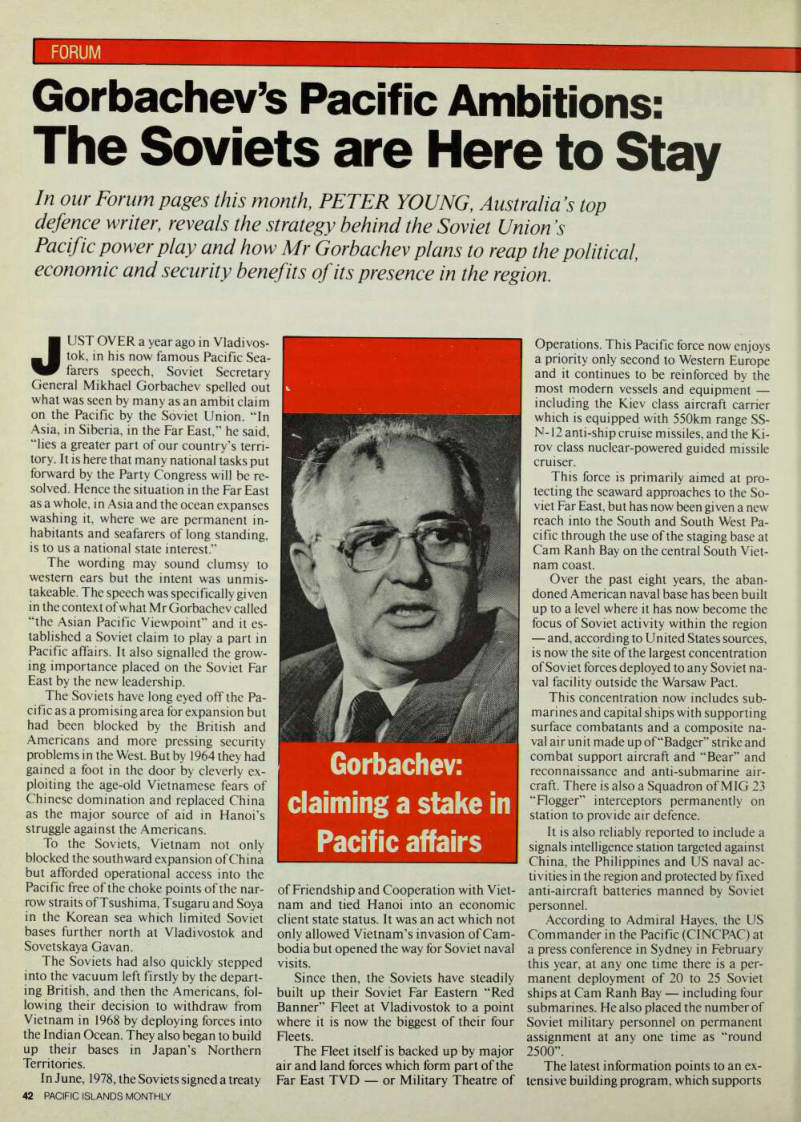
Gorbachev: claiming a stake in Pacific affairs
American claims that the base is a per manent facility. Additional piers have been constructed and a large fuel facility capa ble of storing about five million litres of fuel for ships and aircraft has been built on the site. Satellite photographs also show that further construction has increased the facility’s dock space by around 20 per cent.
There is also evidence that the Soviets are supplementing this facility by a new base at Kompong Som in Cambodia. This is primarily designed to support Vietnam ese military operations in Cambodia but has a secondary role as yet another way station for the projection of Soviet naval power into the Indian and Pacific Oceans.
In addition to these peacetime roles, the Base at Cam Ranh Bay is ideally suited as a springboard from which A
to isolate Allied East/West sea lanes of communications in the event of any major outbreak of hostilities either in Europe or, more importantly, in the Middle East.
Western defence analysts believe that the base has five main aims: ■ To allow Soviet forces to counter US Naval supremacy in the Pacific by the threat of superpower confrontation. ■ To provide support for any pro-Soviet communist insurgency movement in the region at any future date with the Philippines a prime example. ■ To allow Soviet naval forces to counter the Chinese Communist submarine threat. ■ To facilitate rapid reaction of naval forces between the Indian and Pa cific Oceans. ■ For use
in any regional or ASEAN conflict.
Almost every country within the re gion has long been alert to the potential of Cam Ranh Bay and these Soviet aims. As early as 1983, the top secret Australian Strategic Basis paper which was leaked to the press warned that “the continued So viet access to air and maritime facilities in Vietnam must be a cause for alarm.”
The London-based International Insti tute of Strategic Studies (IISS) has rou tinely accepted the deployment of Soviet forces at Cam Ranh Bay in its annual pub lication Military Balance , with the Insti tute’s 1986/1987 edition accepting an informed estimate of 7000 Soviet troops in Vietnam, half of them stationed at Cam Ranh Bay.
The Japanese Govern ment in its official publica tion Defence of Japan ' B6, stated that “Cam Ranh Bay is not only home to Soviet ships and planes but con tains communications, in formation gathering and logistic support facilities.”
But despite this, until very recently the existence of the base has been denied by Vietnamese and Soviet officials.
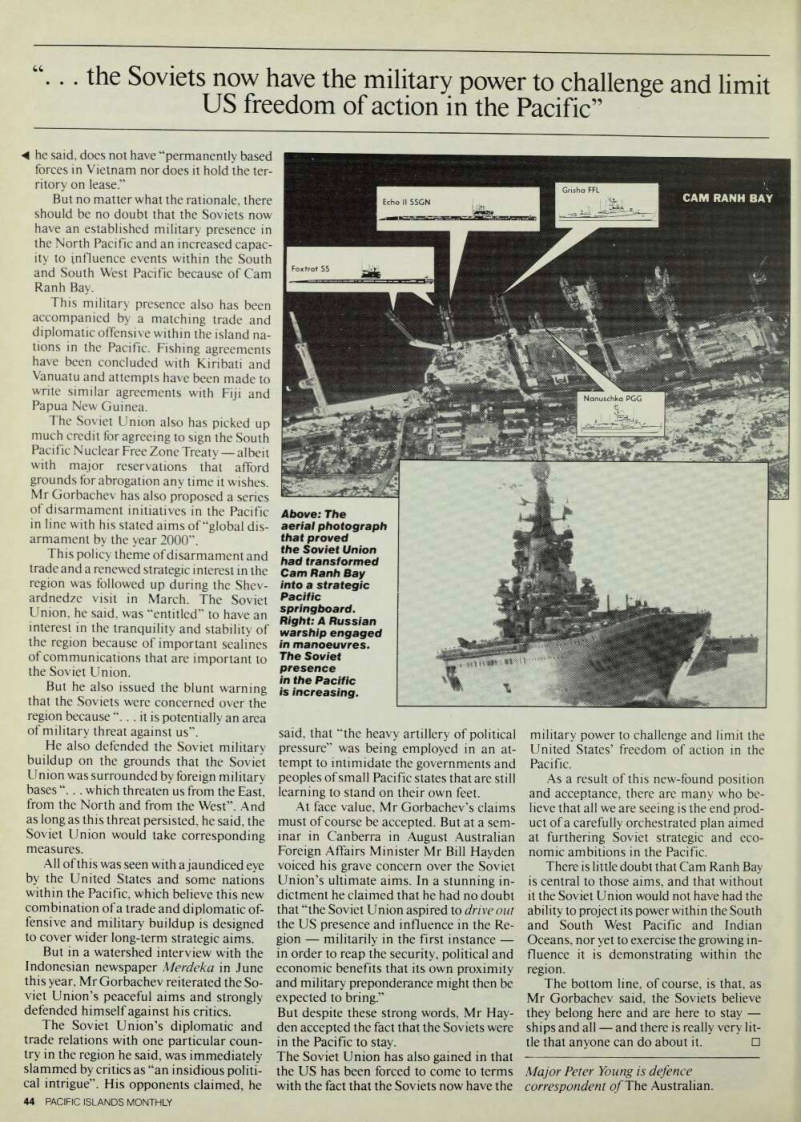
In fact, an article by this author in The Australian published aerial photo graphs that clearly showed the presence in Cam Ranh Bay of two Foxtrot SSBN Submarines, one nuclear powered Echo II class SSGN, two Grishka Frig ates and a Nanuchka Patrol Craft. Other photographs of the adjacent airfield showed Badger and Bear bombers and Flogger fighters lined up wingtip to wingtip.
The first Soviet response was to deny the photo graphs, with Mr Zemskov saying that the photographs “did not show what was as cribed to us”. In March however, whilst on an offi cial visit to Canberra, the Soviet Foreign Minister Mr Eduard Shevardnedze fi nally admitted the presence of the base, describing it as “low level” and little more than “a way station”.
This line was later taken up by Admiral Amelko, re portedly the Deputy Com mander at Vladivostok, who said that it was not a base in the true sense of the word.
Soviet ships, he said . ..
“really only call in order to replenish their food stocks and take rests.” The USSR^
. the Soviets now have the military power to challenge and limit US freedom of action in the Pacific”
◄ he said, does not have “permanently based forces in Vietnam nor does it hold the ter ritory on lease.”
But no matter what the rationale, there should be no doubt that the Soviets now have an established military presence in the North Pacific and an increased capac ity to influence events within the South and South West Pacific because of Cam Ranh Bay.
This military presence also has been accompanied by a matching trade and diplomatic offensive within the island na tions in the Pacific. Fishing agreements have been concluded with Kiribati and Vanuatu and attempts have been made to write similar agreements with Fiji and Papua New Guinea.
The Soviet Union also has picked up much credit for agreeing to sign the South Pacific Nuclear Free Zone Treaty albeit with major reservations that afford grounds for abrogation any time it wishes.
Mr Gorbachev has also proposed a series of disarmament initiatives in the Pacific in line with his stated aims of “global dis armament by the year 2000”.
This policy theme ofdisarmament and trade and a renewed strategic interest in the region was followed up during the Shev ardnedze visit in March. The Soviet Union, he said, was “entitled” to have an interest in the tranquility and stability of the region because of important sealines of communications that are important to the Soviet Union.
But he also issued the blunt warning that the Soviets were concerned over the region because “... it is potentially an area of military threat against us”.
He also defended the Soviet military buildup on the grounds that the Soviet Union was surrounded by foreign military bases “... which threaten us from the East, from the North and from the West”. And as long as this threat persisted, he said, the Soviet Union would take corresponding measures.
All of this was seen with a jaundiced eye by the United States and some nations within the Pacific, which believe this new combination of a trade and diplomatic of fensive and military buildup is designed to cover wider long-term strategic aims.
But in a watershed interview with the Indonesian newspaper Merdeka in June this year, Mr Gorbachev reiterated the So viet Union’s peaceful aims and strongly defended himself against his critics.
The Soviet Union’s diplomatic and trade relations with one particular coun try in the region he said, was immediately slammed by critics as “an insidious politi cal intrigue”. His opponents claimed, he
said, that “the heavy artillery of political pressure” was being employed in an at tempt to intimidate the governments and peoples of small Pacific states that are still learning to stand on their own feet.
At face value, Mr Gorbachev’s claims must of course be accepted. But at a sem inar in Canberra in August Australian Foreign Affairs Minister Mr Bill Hayden voiced his grave concern over the Soviet Union’s ultimate aims. In a stunning in dictment he claimed that he had no doubt that “the Soviet Union aspired to drive out the US presence and influence in the Re gion militarily in the first instance in order to reap the security, political and economic benefits that its own proximity and military preponderance might then be expected to bring.”
But despite these strong words, Mr Hay den accepted the fact that the Soviets were in the Pacific to stay.
The Soviet Union has also gained in that the US has been forced to come to terms with the fact that the Soviets now have the
military power to challenge and limit the United States’ freedom of action in the Pacific.
As a result of this new-found position and acceptance, there are many who be lieve that all we are seeing is the end prod uct of a carefully orchestrated plan aimed at furthering Soviet strategic and eco nomic ambitions in the Pacific.
There is little doubt that Cam Ranh Bay is central to those aims, and that without it the Soviet Union would not have had the ability to project its power within the South and South West Pacific and Indian Oceans, nor yet to exercise the growing in fluence it is demonstrating within the region.
The bottom line, of course, is that, as Mr Gorbachev said, the Soviets believe they belong here and are here to stay ships and all and there is really very lit tle that anyone can do about it. □
Major Peter Young is defence correspondent of The Australian.
Above: The aerial photograph that proved the Soviet Union had transformed Cam Ranh Bay into a strategic Pacific springboard.
Right: A Russian warship engaged in manoeuvres.
The Soviet presence in the Pacific
is increasing.