Papua
p. 38 · Read in the full issue
New Guinea
THE sleeping giant of the South Pacific is beginning to stir. While it is still heavily dependent on aid from its former colonial master, Australia (expected to total $A300.9 million for the 1987/88 financial year or one third of the country’s budget), PNG is tipped to become a significant re gional force by the turn of the century. It has no manufacturing base of any real note, but Papua New Guinea has mineral re serves that are as rich as Croesus. “It has a tremendous future as one of the world’s top gold producers,” the South Pacific Trade Commissioner Mr Bill McCabe has said.
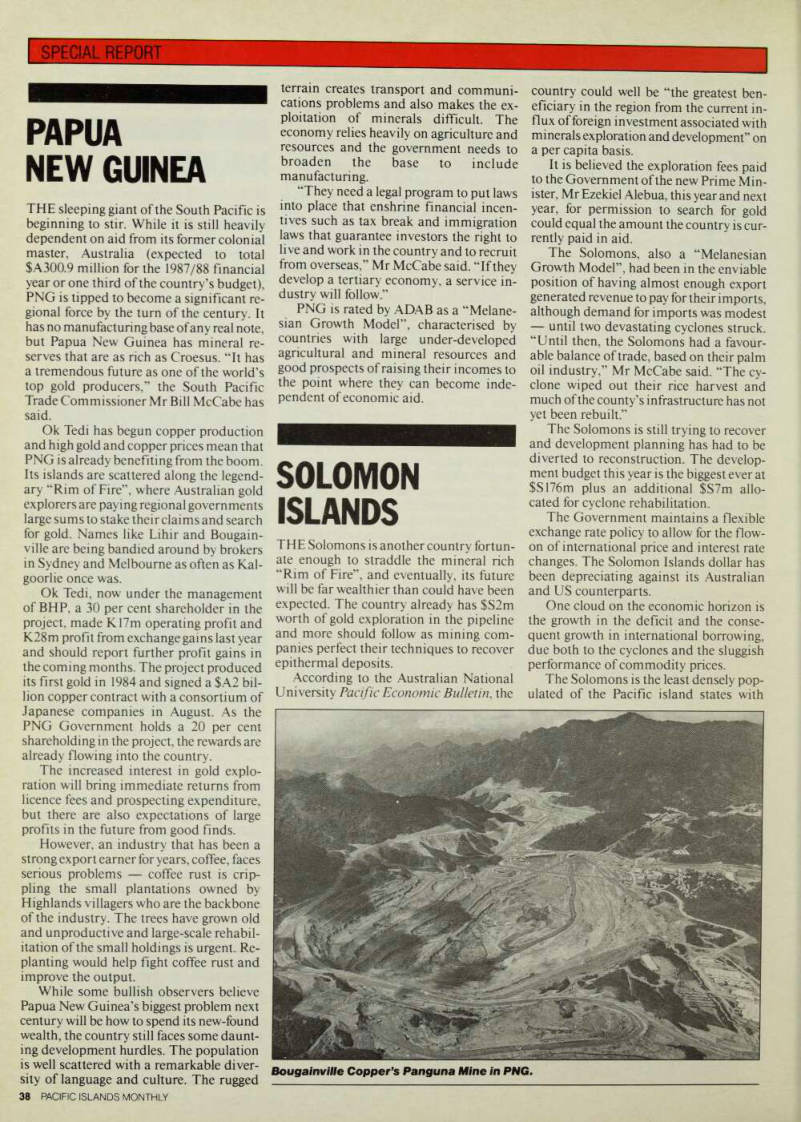
Ok Tedi has begun copper production and high gold and copper prices mean that PNG is already benefiting from the boom.
Its islands are scattered along the legend ary “Rim of Fire”, where Australian gold explorers are paying regional governments large sums to stake their claims and search for gold. Names like Lihir and Bougain ville are being bandied around by brokers in Sydney and Melbourne as often as Kal goorlie once was.
Ok Tedi, now under the management of BHP. a 30 per cent shareholder in the project, made Kl7m operating profit and K2Bm profit from exchange gains last year and should report further profit gains in the coming months. The project produced its first gold in 1984 and signed a SA2 bil lion copper contract with a consortium of Japanese companies in August. As the PNG Government holds a 20 per cent shareholding in the project, the rewards are already flowing into the country.
The increased interest in gold explo ration will bring immediate returns from licence fees and prospecting expenditure, but there are also expectations of large profits in the future from good finds.
However, an industry that has been a strong export earner for years, coffee, faces serious problems coffee rust is crip pling the small plantations owned by Highlands villagers who are the backbone of the industry. The trees have grown old and unproductive and large-scale rehabil itation of the small holdings is urgent. Re planting would help fight coffee rust and improve the output.
While some bullish observers believe Papua New Guinea’s biggest problem next century will be how to spend its new-found wealth, the country still faces some daunt ing development hurdles. The population is well scattered with a remarkable diver sity of language and culture. The rugged
terrain creates transport and communi cations problems and also makes the ex ploitation of minerals difficult. The economy relies heavily on agriculture and resources and the government needs to broaden the base to include manufacturing.
“They need a legal program to put laws into place that enshrine financial incen tives such as tax break and immigration laws that guarantee investors the right to live and work in the country and to recruit from overseas,” Mr McCabe said. “If they develop a tertiary economy, a service in dustry will follow.”
PNG is rated by ADAB as a “Melane sian Growth Model”, characterised by countries with large under-developed agricultural and mineral resources and good prospects of raising their incomes to the point where they can become inde pendent of economic aid.