Economies
pp. 33-36 · Read in the full issue
Special Report
Economies of the Pacific
In the first of our monthly Special Reports, MELISSA ROBERTS spotlights the economies of the island nations. She examines the factors that will make some countries economic super powers and tells why others are doomed to aid dependency for ever.
WHEN Colonel Sitiveni Rabuka’s men stormed Fiji’s Parliament the nation lost more than its much-valued democracy. With record foreign reserves, falling inflation, a buoy ant agricultural sector and a booming tourist industry Fiji was undeniably the economic powerhouse of the South Pacific.
On the morning of May 14, the Gov ernor of the Reserve Bank, Savenaca Si watibau, put his head in his hands and wept. But, in the weeks that followed Colonel Rabuka’s stunning military action, the economy miraculously started to recover. The sugar was harvested and tourists, taking advantage of super-cheap package deals, flooded back to the is lands. There was even a trickle of foreign investment into the tourist sector.
“I’m rather optimistic, now, that our political leaders are beginning to talk,” Si watibau said, in early September.
Unfortunately, the politicians’ discus sions didn’t please Colonel Rabuka and he was to strike again before the month was out and, finally, declared the country a re public. It may be decades before the coun try regains its lost prosperity, a fact that doesn’t seem to concern the Colonel as he pursues his goal of Melanesian domi nance of Fiji’s political system. If neces sary, he says the Fijian people will go “back to the villages” and lead a subsistence ex istence in a cashless society.
As impractical as the suggestion may be in economically complex Fiji, Colonel Ra buka can at least afford the luxury of con templating the “agrarian” option. Most of Fiji’s Pacific neighbours cannot. As one member of the Kiribati Government said at the time of the nation’s independence in 1979, “What we have here is a lot of sun, sea, sand and coconuts nobody wants.”
In the post-colonial era the Pacific south of the equator has become a sea of economic and social contrast and contra diction. Last year Tuvalu and Kiribati
joined nations like Bangladesh and Chad on the United Nations’ list of Least De veloped Countries. The two were working on their joint application for classification as “economic basket cases” in need of spe cial financial assistance just as Papua New Guinea was realising the enormous eco nomic potential of its vast mineral re serves lying beneath some of the world’s most rugged and forbidding jungle.
If its resources are managed properly, most observers agree that Papua New Guinea will, one day, become a regional power in its own right because of its vast wealth while the mini and micro states of the region are destined to remain heavily dependent on foreign assistance.
Midway along the economic spectrum lie a number of nations, such as Western Samoa and Tonga, which are attempting
to meet the post-colonial aspirations of their people through limited industrial, agricultural and tourist development but remain constrained by a lack of natural re sources, foreign investment, expertise and, to some extent, systems of traditional land ownership and use.
Two years ago, the Jackson report on Australia’s foreign aid attempted to sum marise the economic contradictions that dominate life in the Pacific region: “The area absorbs the highest rate of aid per capita in the world but compared to other regions, the need for aid is only mar ginal. Everywhere that poverty exists in statistical terms the quality of life is high.”
More recently, the Australian Devel opment Assistance Bureau (ADAB), which administers the country’s hefty foreign aid bill, described the Pacific bluntly as “a re markably aid dependent region”. In a sub mission to an Australian Parliamentary inquiry into the South Pacific, ADAB said that “despite large inflows of aid, eco nomic prospects are generally discourag ing: there are major constraints to growth.”
Australia, ADAB said, has made the mistake, in the past, of believing that all countries in the region would eventually attain self-sufficiency and, as a result, aid given in an attempt to achieve that goal has been misspent.
Although Australia will give an esti mated SASO million in aid to the region in 1987/88 in addition to its separate budgetary assistance to Papua New Guinea of more than SA3OO million ADAB says aid alone will not achieve de velopment for Pacific Islanders.
“In spite of large injections of aid>
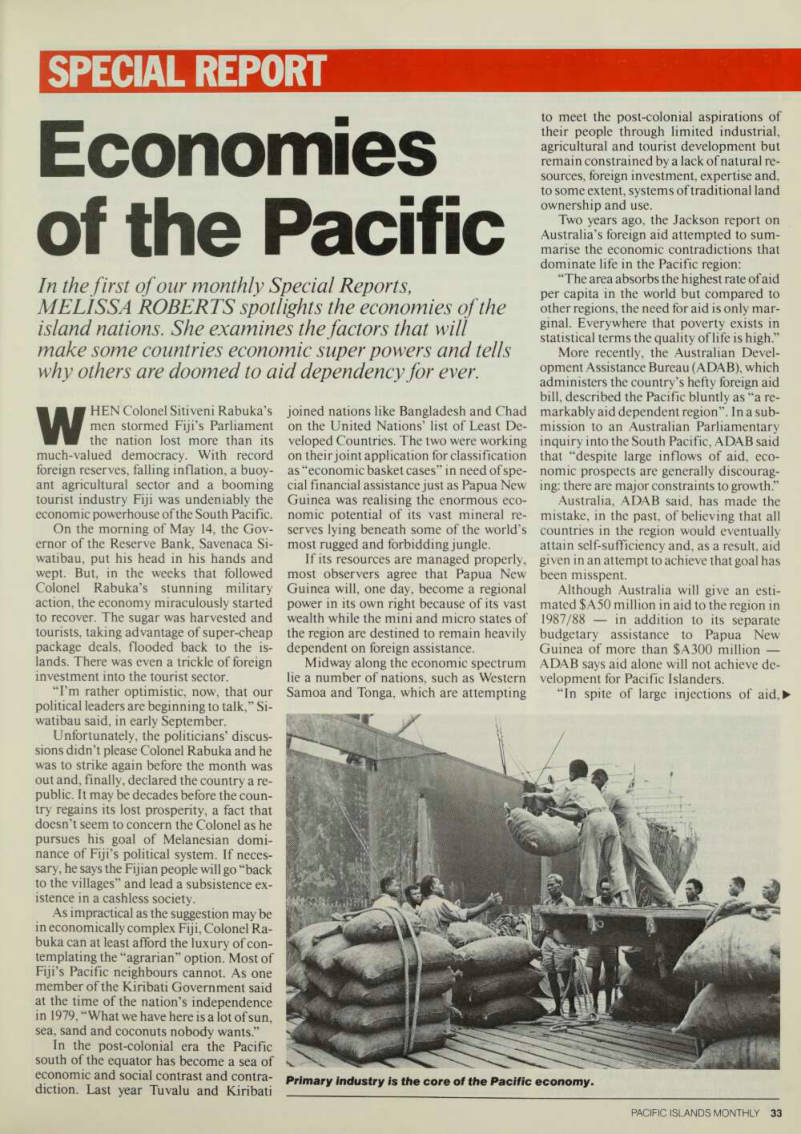
Primary industry is the core of the Pacific economy.
< standards of living are tending to fall.
Trends to the year 2000 are worrying.” The Bureau says the small size of many of the countries added to their large populations causes a significant part of the problem. It believes their limited revenue bases, their remoteness from markets and high trans port costs, as well as their open economies with little government control, all con spire to retard development.
To that list of disadvantages many ex perts add the high cost of maintaining bureaucracies of a type that only a former colonial master can afford. More than a third of Papua New Guinea’s annual budget, for example, is swallowed up in re current administrative costs.
If ADAB’s assessments of post-colon ial economic trends in the region are cor rect, the task of removing what the agency calls the “major constraints to growth” now rests heavily with a new generation of university-educated politicians like lere mia Tabai, who, at 29, became the first President of Kiribati eight years ago.
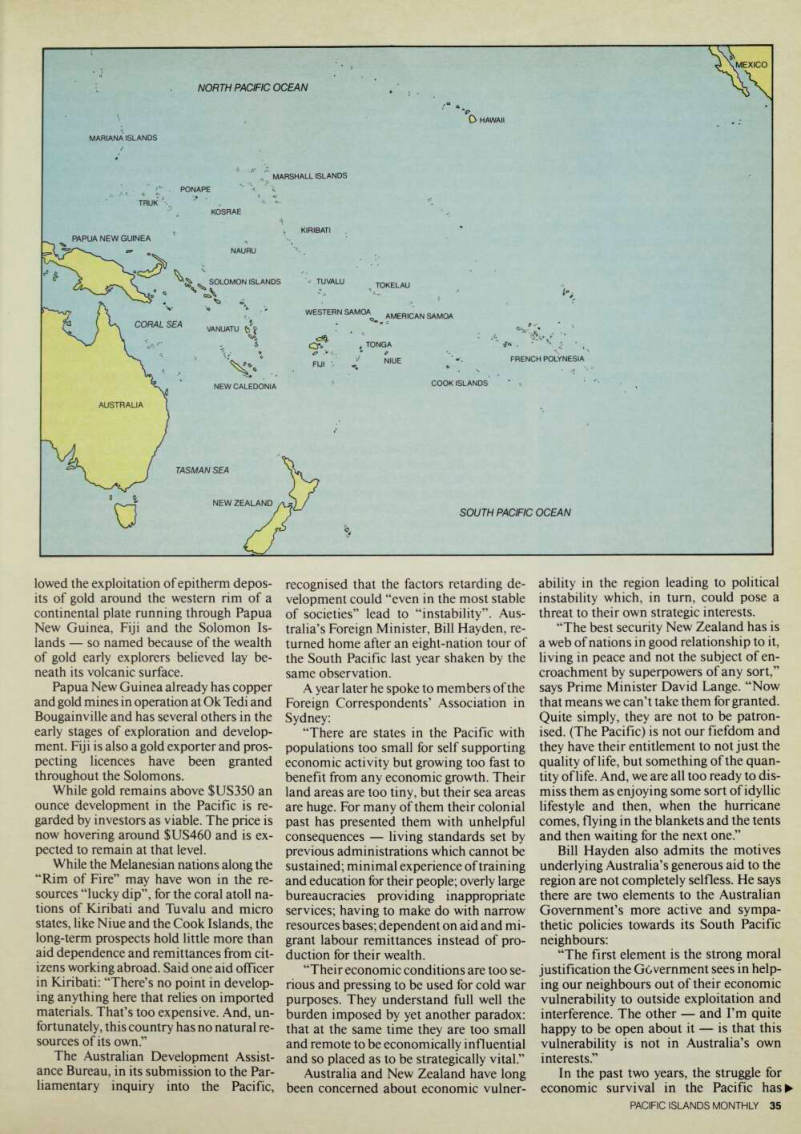
Formerly the British Gilbert islands, Kiribati is a nation of 690 square kilo metres of land area dotted across 3.5 mil lion square kilometres of the central Pacific. With a population of only 60,000 it already suffers chronically from over population. While the search continues for valuable manganese nodules on the sea floor, the country’s only proven resources remain copra and fish. But when asked what he wants for his people President Ta bai’s response is simple: “I want to be able to say no to foreign aid,” he says, “self re spect is very important to us.”
That sort of determination led, this year, to the signing of a multilateral fish ing-access agreement between the 16 members of the South Pacific Forum Fisheries Agency (FFA) and the US. The agreement, which took two years of bitter negotiation to finalise, will be worth SUS6O million to the island nations in lic ence fees and US industry assistance.
However, the money can only flow once the treaty has been ratified by the US Con gress and although the Reagan Adminis tration recognises the strategic importance of the agreement it remains bound up in legislative red tape.
In the meantime, members of the American Tunaboat Association, says FFA director Philip Muller, continue to “poach” tuna in the 320 kilometre Exclu sive Economic Zones that surround the is lands. Last year Australia offered to supply naval patrol boats to the island states un der various defence co-operation agree ments, but there were few takers. Most could not afford the annual running costs of $A200,000.
While the wheels of government in Washington may grind slowly, the money from the tuna treaty will, eventually, flow
to the Pacific. The price of tuna sashimi for the tables of Japan, is currently rising and with the islands free to also conclude agreements on a bilateral or multilateral basis with other fishing nations, the out look for the industry seems bright.
Unfortunately, there is less optimism surrounding the future of copra. Prices on world markets have only risen slightly on last year, to about a fifth of their 1984 lev els. At a recent meeting in Suva called by the South Pacific Bureau for Economic Co operation (SPEC), copra producers formed a cartel in the hope of saving the industry but, with strong competition from other, more easily processed, sources of edible oils, analysts doubt that it will ever re cover. Particularly with Spain and Portu gal, both oil seed producers, now pressing the European Economic Community (EEC) to restrict imports from the Pacific.
With nowhere else to turn some na tions have been looking increasingly to wards tourism as a future source of income but the industry is severely under-devel
oped and patchy in all but a few Pacific countries.
Pre-coup Fiji had 360,000 arrivals last year while Western Samoa, which has a similar climate and sun, sea and sand which is just as attractive but with vir tually no facilities, managed to attract only 20,000 most of them nationals return ing to see family and friends.
Recognising the long-term potential of the industry, nevertheless, SPEC has es tablished a Suva-based Tourism Council of the South Pacific which now operates on a SUSS million grant from the EEC. On behalf of its 20 members (the independent states as well as American Samoa and French Polynesia) the council aims to co ordinate tourist development on a region wide basis.
More capital-intensive, but less subject to changes in fashion or the unnerving im pact of a military coup, is mining. New discoveries have led to an investment rush along the Pacific’s so-called “Rim of Fire”.
The latest mining techniques have al-
lowed the exploitation of epitherm depos its of gold around the western rim of a continental plate running through Papua New Guinea, Fiji and the Solomon Is lands so named because of the wealth of gold early explorers believed lay be neath its volcanic surface.
Papua New Guinea already has copper and gold mines in operation at Ok Tedi and Bougainville and has several others in the early stages of exploration and develop ment. Fiji is also a gold exporter and pros pecting licences have been granted throughout the Solomons.
While gold remains above SUS3SO an ounce development in the Pacific is re garded by investors as viable. The price is now hovering around SUS46O and is ex pected to remain at that level.
While the Melanesian nations along the “Rim of Fire” may have won in the re sources “lucky dip”, for the coral atoll na tions of Kiribati and Tuvalu and micro states, like Niue and the Cook Islands, the long-term prospects hold little more than aid dependence and remittances from cit izens working abroad. Said one aid officer in Kiribati: “There’s no point in develop ing anything here that relies on imported materials. That’s too expensive. And, un fortunately, this country has no natural re sources of its own.”
The Australian Development Assist ance Bureau, in its submission to the Par liamentary inquiry into the Pacific,
recognised that the factors retarding de velopment could “even in the most stable of societies” lead to “instability”. Aus tralia’s Foreign Minister, Bill Hayden, re turned home after an eight-nation tour of the South Pacific last year shaken by the same observation.
A year later he spoke to members of the Foreign Correspondents’ Association in Sydney: “There are states in the Pacific with populations too small for self supporting economic activity but growing too fast to benefit from any economic growth. Their land areas are too tiny, but their sea areas are huge. For many of them their colonial past has presented them with unhelpful consequences living standards set by previous administrations which cannot be sustained; minimal experience of training and education for their people; overly large bureaucracies providing inappropriate services; having to make do with narrow resources bases; dependent on aid and mi grant labour remittances instead of pro duction for their wealth.
“Their economic conditions are too se rious and pressing to be used for cold war purposes. They understand full well the burden imposed by yet another paradox: that at the same time they are too small and remote to be economically influential and so placed as to be strategically vital.”
Australia and New Zealand have long been concerned about economic vulner
ability in the region leading to political instability which, in turn, could pose a threat to their own strategic interests.
“The best security New Zealand has is a web of nations in good relationship to it, living in peace and not the subject of en croachment by superpowers of any sort,” says Prime Minister David Lange. “Now that means we can’t take them for granted.
Quite simply, they are not to be patron ised. (The Pacific) is not our fiefdom and they have their entitlement to not just the quality of life, but something of the quan tity of life. And, we are all too ready to dis miss them as enjoying some sort of idyllic lifestyle and then, when the hurricane comes, flying in the blankets and the tents and then waiting for the next one.”
Bill Hayden also admits the motives underlying Australia’s generous aid to the region are not completely selfless. He says there are two elements to the Australian Government’s more active and sympa thetic policies towards its South Pacific neighbours: “The first element is the strong moral justification the Government sees in help ing our neighbours out of their economic vulnerability to outside exploitation and interference. The other and I’m quite happy to be open about it is that this vulnerability is not in Australia’s own interests.”
In the past two years, the struggle for economic survival in the Pacific has I
◄ brought the “Cold War” between East and West into the heart of the region. An an nouncement from tiny Kiribati, in late 1985, that it was signing a fishing-access agreement with the Soviet Union sent State Department officials in Washington scur rying for their atlas.
President Tabai claimed that he was doing no more than looking after the fi nancial interests of his poverty-stricken people. While American fishermen poached his nation’s only viable resource the Russians, Tabai said, “were prepared to pay and pay on time”.
Washington, nevertheless, accused the President of Kiribati of undermining the defence of the West by turning what was once a “tranquil ANZUS lake” into an other Cold War battlefield. In late 1986 the agreement between Kiribati and the So viet Union collapsed when Moscow claimed it was not getting value for money out of the nation’s Central Pacific waters and wanted to halve its fleet of 16 ships and the licence fee of $A2.4 million it was pay ing to the Government in Taraway.
At one point an angry leremia Tabai declared: “The Americans think we are so poor we will bite at anything, but they are wrong,” and, almost as if to prove his ar gument, he rejected the new Soviet deal.
Vanuatu has since signed an agreement with the Soviet Union and Bill Hayden has laid the blame for Moscow’s successes squarely on the shoulders of the American Tunaboat Association and the Adminis tration in Washington.
“There can be little doubt,” Hayden says, “that the Soviet interest in doing fishing deals with South Pacific nations is connected to clumsy attempts by private American interests to exploit fishing areas (in the region).”
Japan, too, has signalled that it no longer intends taking the Pacific for granted. Although the region receives less than one per cent of its total aid budget, Tokyo’s assistance to the islands has been growing faster than contributions from any other donor. In 1985 the Japanese spent SA23 million in the islands and nearly SA6 million in Papua New Guinea. During a swing through the Pacific in January, For eign Minister Kuranari announced the es tablishment of a SUS 2 million special development fund for the region and in vited South Pacific Forum officials to make regular visits to Japan.
While Tokyo is keen to move in (to keep the Soviets out) it recognises that it has a lot to learn about the unique problems as sociated with donating aid to the mini and micro states of the Pacific. Japanese offi cials have regularly sought advice from Australian experts. “Their bureaucracy, for a start, is not geared towards projects that don’t run to millions of dollars,” said a Canberra-based aid officer.
While Australia has undertaken larger projects, such as the Maritime Training School in Tuvalu and a desiccated coco nut factory in Tonga, 95 of Canberra’s 169 current projects are valued at less than $A250,000. The 47 projects scheduled for Tonga in 1986/87, for example, totalled no more than SAS million. In the past year, the South Pacific Regional Trade and Eco nomic Co-operation Agreement (SPAR TECA), which gives island producers duty free access to Australian and New Zealand markets, has also emphasised the need for aid investment in export oriented industries.
“There is no point in allowing them into our markets,” observed an Australian of ficial, “unless they have something to sell.”