Military Morale Plummets
p. 25 · Read in the full issue
The ANZUS split takes its toll.
SINCE THE acrimonious ANZUS Alliance split between New Zealand and the US, caused by the former’s anti-nuclear policy barring US navy ships from its ports, the group hardest hit has been New Zealand’s armed forces.
Deprived of assured exercises and training with the US which provided access to the latest technology and military methods, morale plummeted and many of the experienced officers and men left the forces.
While the military is, on the surface, apolitical, its feelings about the Alliance split were made clear recently when former senior army, navy and air force officers spoke out against Government policy and in favour of retaining the US military links. Their outspokenness had them branded geriatric generals by the acerbic New Zealand Prime Minister David Lan S e - However that rearguard action by the senior officers may have done some good, as there is now in some quarters in Washington an apparent realisation that a totally incapacitated New Zealand military may not be in the best long-term strategic interests of the US.
Some indication of that came out during a hearing in Stephen Solarz s House Foreign Affairs East Asia and Pacific subcommittee last month on the Administration-backed bill of senior Republican Congressman William Broomfield, which m effect will officially strip New Zealand ° tS ir a - status anc * rnake it just a mend , a situation which has in practice existed for the past three years.
During the hearing Republican Jim each questioned whether the legislation was the right way to go as its intent, to ehmmate New Zealand from the list of US
allies that get preferential military assist ance, would impact hardest on the New Zealand armed forces, it would make it more difficult for them to train in the US, he said. “Is there not a way to punish the politicians but not the defence establishment?” asked Mr Leach, noting that the object of the bill was ex actly what the Left in New Zealand wanted, that is, the breaking of defence ties be tween the United States and New Zealand, “What we have here is ‘tit-for-tat’,” Mr Leach said, picking up on the fact that the bill is the official United States response to New Zealand’s anti-nuclear law passed in June. “But why proceed with rubbing their nose in it when we are rubbing the wrong noses?”
Democrat Chester Atkins also raised the point, suggesting there was a need to soften attitudes toward the New Zealand military which was after all, most allied to the US position, But Mr Broomfield pointed out that the “bottom line” of training had to be that it was for alliance purposes and for now the alliance relationship between the United States and New Zealand was “inoperative”.
For all that it was a sign of a new sett sitivity on the part of some Americans at least as to the long-term effects of their hard-line attitude to New Zealand for breaking away, as the US sees it, from the ranks of the Western alliance, The official line was most strongly put by Deputy Assistant Defence Secretary Karl Jackson who said the US had to en sure “New Zealand officials understand that we will neither forget nor ignore the damage done by New Zealand to Western security interests and the network of alli ances crucial to preserving freedom.” □
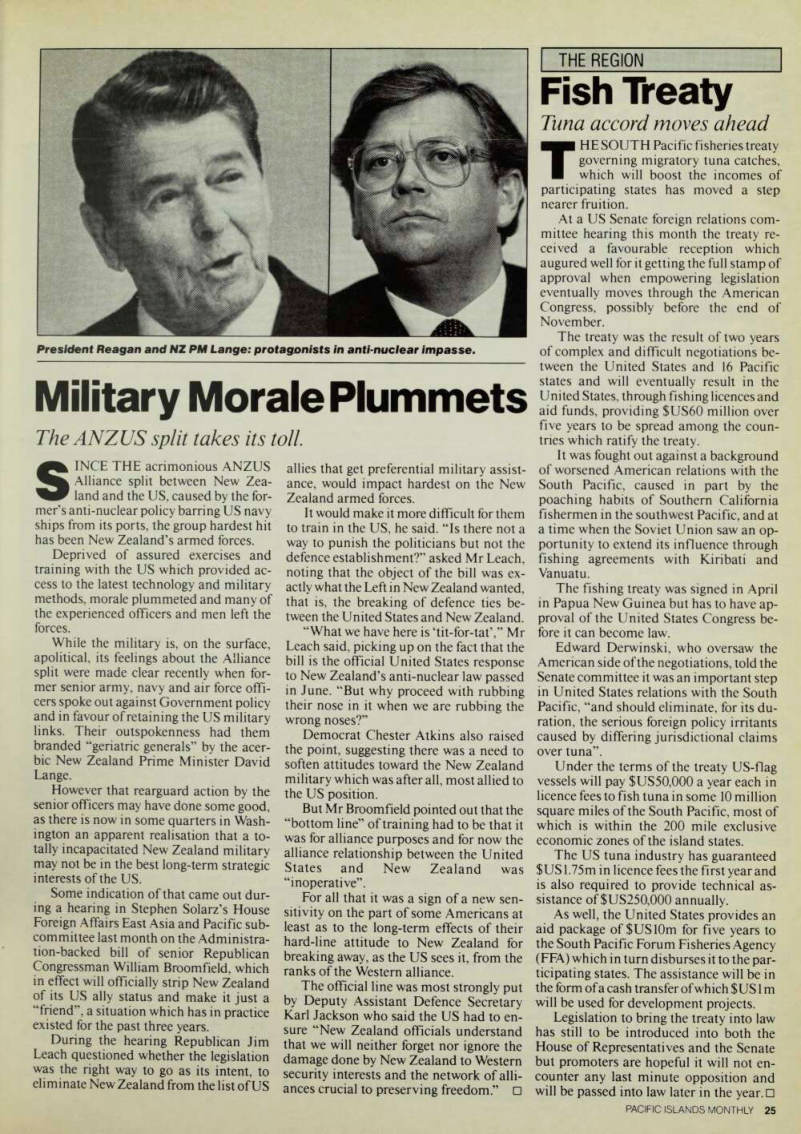
President Reagan and NZ PM Lange: protagonists in anti-nuclear impasse.