A Recipe for Ruin
Opinion
In his bid to turn back the clock, Colonel Rabuka is setting the new Fijian Republic on a collision course with disaster.
One of the inevitable consequences of Colonel Si tiveni Rabuka’s drive to lead Fiji back into what he and his Taukei Movement supporters choose to believe was a “Golden Age” was to lose some old and powerful friends. The Monarchy, Great Britain, Aus tralia, New Zealand, the United States, India and others all moved with haste to dissociate themselves from the actions of the military coup leaders.
But Fiji under Rabuka will not want for allies. Already Indonesia, Singapore, South Korea, Taiwan, even France, are negotiating trade and other reciprocal programs with the new republic.
Whether the new Fijian republic is now equipped to deal with the hardened deal makers of its new-found friends remains to be seen. Certainly the naive timbre of
many of its confused and conflicting statements on trade and defence would indicate that Fiji would be fair game for hard-nosed “partners”. However, it will come as a sur prise to absolutely nobody that there exist some other would-be “friends” of Fiji who are sitting back, waiting and watching.
Libya and the Soviet Union are past masters at the shadowy art of exploiting a destabilised country. They will have found much to encourage their ambitions in Colonel Rabuka and his followers and advisers’ erratic lurch to power. The Gaddafis and Gorbachevs of the world need fallow ground to sow their seeds. The new republic’s stance that an economy in tatters is an affordable price for a re turn to an ethnically pure agrarian society, adhering to the system of chiefs and unpolluted by Western influ ences, is fertile territory indeed.
The Taukei vision of Fijians reverting to an 18th cen tury economy in tribal villages betrays a limited grasp of reality. Taukei’s dream of a “racially pure” Fiji purged of Indian influence and industry, without Western trade and defence pacts, and with a press, judiciary and trade unions muzzled by military muscle is a recipe for ruin. So weak ened, so chaotic, so friendless, would such a Fiji be that it would be ripe for the plucking by a predatory power.
While researching his account of events in Fiji that be gins on page 10 of this issue, our reporter Nicholas Roth well himself one of many press people incarcerated after the September 26 coup did what Taukei seemingly has never done. He visited the Fiji Museum to catch up on a little history. There, available for everybody to read, is in formation that puts the lie forever to Taukei theories of racial purity.
The Movement’s single origin theory is demolished by archeological evidence that establishes that like many, many others’, Fiji’s culture and people evolved through a long and confused blending of many races. Similarly, his tory shows that the pre-British Fiji so lovingly and long ingly evoked by Colonel Rabuka and the Taukei Movement was a “nation” characterised by civil war, espionage, blackmail, bloodshed and subversion, and one that was easily taken over by a larger power.
The Colonel and his Taukei advisers would do well to heed the history of their homeland as it really was, not as they would like it to have been. They would do well to file their simplistic, revisionist version of events where it be longs under “Fiction” and to temper their danger ous ideological zeal with a practical, hard-line approach to solving the problems of Fiji. These problems include those they have themselves created, as well as those that wrought the undeniably well-founded discontent of native Fijians in the first place and which are endemic to any multi-racial society. If the country’s new leaders do not, they will propel Fiji the land they profess to love so much not into a Golden Age, but into a Dark Age.
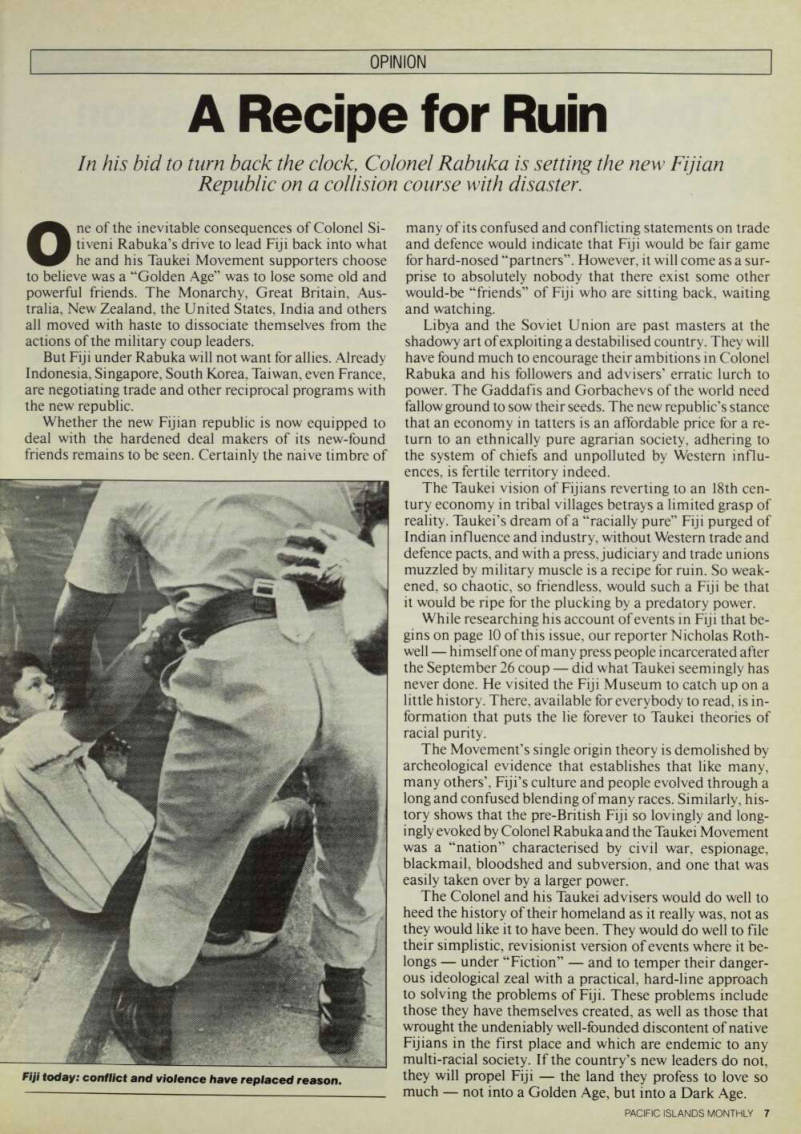
Fiji today: conflict and violence have replaced reason.