After Namu: The Big Clean-up
p. 19 · Read in the full issue
The Solomon Islands
Rotary volunteers lend a hand to rebuild schools.
By Billy Williams.
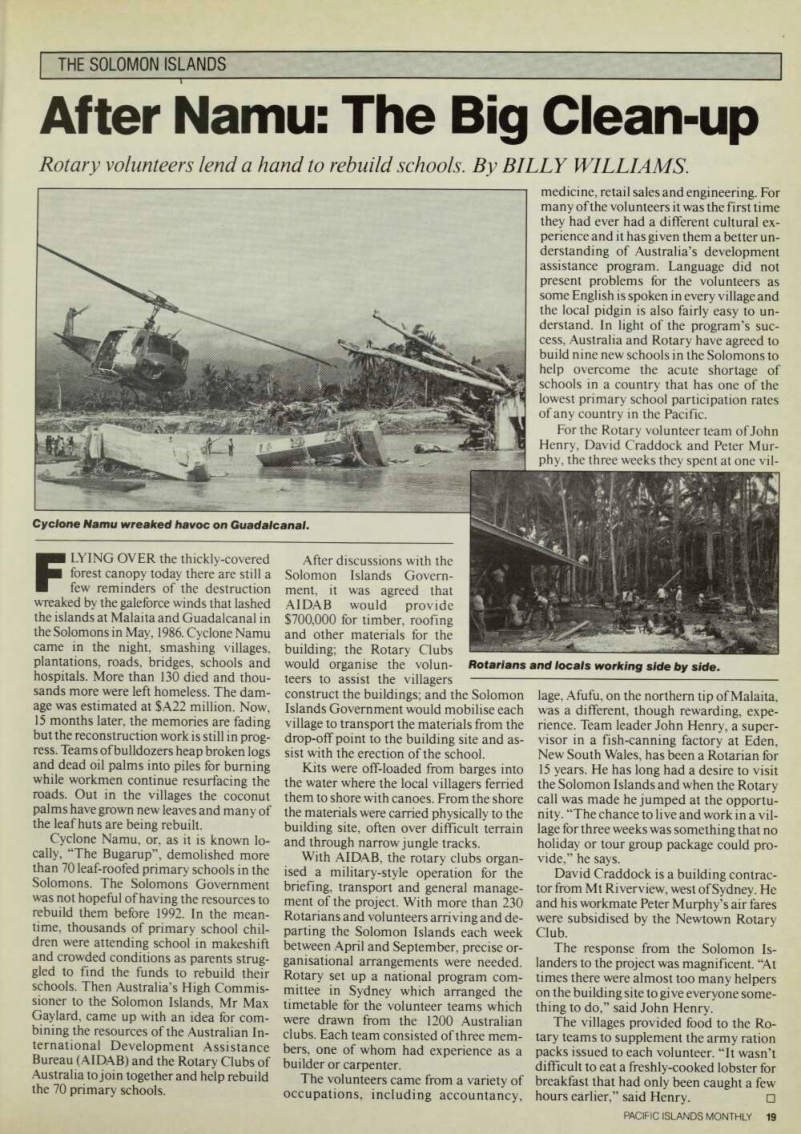
FLYING OVER the thickly-covered forest canopy today there are still a few reminders of the destruction wreaked by the galeforce winds that lashed the islands at Malaita and Guadalcanal in the Solomons in May, 1986. Cyclone Namu came in the night, smashing villages, plantations, roads, bridges, schools and hospitals. More than 130 died and thou sands more were left homeless. The dam age was estimated at SA22 million. Now, 15 months later, the memories are fading but the reconstruction work is still in prog ress. Teams of bulldozers heap broken logs and dead oil palms into piles for burning while workmen continue resurfacing the roads. Out in the villages the coconut palms have grown new leaves and many of the leaf huts are being rebuilt.
Cyclone Namu, or, as it is known lo cally, “The Bugarup”, demolished more than 70 leaf-roofed primary schools in the Solomons. The Solomons Government was not hopeful of having the resources to rebuild them before 1992. In the mean time, thousands of primary school chil dren were attending school in makeshift and crowded conditions as parents strug gled to find the funds to rebuild their schools. Then Australia’s High Commis sioner to the Solomon Islands, Mr Max Gaylard, came up with an idea for com bining the resources of the Australian In ternational Development Assistance Bureau (AIDAB) and the Rotary Clubs of Australia to join together and help rebuild the 70 primary schools.
After discussions with the Solomon Islands Govern ment, it was agreed that AIDAB would provide $700,000 for timber, roofing and other materials for the building; the Rotary Clubs would organise the volun teers to assist the villagers
construct the buildings; and the Solomon Islands Government would mobilise each village to transport the materials from the drop-off point to the building site and as sist with the erection of the school.
Kits were off-loaded from barges into the water where the local villagers ferried them to shore with canoes. From the shore the materials were carried physically to the building site, often over difficult terrain and through narrow jungle tracks.
With AIDAB, the rotary clubs organ ised a military-style operation for the briefing, transport and general manage ment of the project. With more than 230 Rotarians and volunteers arriving and de parting the Solomon Islands each week between April and September, precise or ganisational arrangements were needed.
Rotary set up a national program com mittee in Sydney which arranged the timetable for the volunteer teams which were drawn from the 1200 Australian clubs. Each team consisted of three mem bers, one of whom had experience as a builder or carpenter.
The volunteers came from a variety of occupations, including accountancy,
medicine, retail sales and engineering. For many of the volunteers it was the first time they had ever had a different cultural ex perience and it has given them a better un derstanding of Australia’s development assistance program. Language did not present problems for the volunteers as some English is spoken in every village and the local pidgin is also fairly easy to un derstand. In light of the program’s suc cess, Australia and Rotary have agreed to build nine new schools in the Solomons to help overcome the acute shortage of schools in a country that has one of the lowest primary school participation rates of any country in the Pacific.
For the Rotary volunteer team of John Henry, David Craddock and Peter Mur phy, the three weeks they spent at one vil-
lage, Afufu, on the northern tip of Malaita, was a different, though rewarding, expe rience. Team leader John Henry, a super visor in a fish-canning factory at Eden, New South Wales, has been a Rotarian for 15 years. He has long had a desire to visit the Solomon Islands and when the Rotary call was made he jumped at the opportu nity. “The chance to live and work in a vil lage for three weeks was something that no holiday or tour group package could pro vide,” he says.
David Craddock is a building contrac tor from Mt Riverview, west of Sydney. He and his workmate Peter Murphy’s air fares were subsidised by the Newtown Rotary Club.
The response from the Solomon Is landers to the project was magnificent. “At times there were almost too many helpers on the building site to give everyone some thing to do,” said John Henry.
The villages provided food to the Ro tary teams to supplement the army ration packs issued to each volunteer. “It wasn’t difficult to eat a freshly-cooked lobster for breakfast that had only been caught a few hours earlier,” said Henry. □
Cyclone Namu wreaked havoc on Guadalcanal.
Rotarians and locals working side by side.