Wingti Plays Defence Trump
pp. 17-18 · Read in the full issue
Papua New Guinea
PETER YOUNG on PNG’s masterly plan for self-protection.
THE WINGTI Government ap pears to have pulled off the diplo matic coup of having its cake and eating it too with new links with In donesia, a defence agreement with Aus tralia and now reports that it intends to distance itself from the West and join the non-aligned movement.
PNG is of course only exercising its sovereign rights in the same manner as other regional nations such as Malaysia with whom Australia also has defence links but it is noteworthy that the decision has come within weeks of the Hawke Government’s approval of the request from Port Moresby for a more formal def ence arrangement between the two countries.
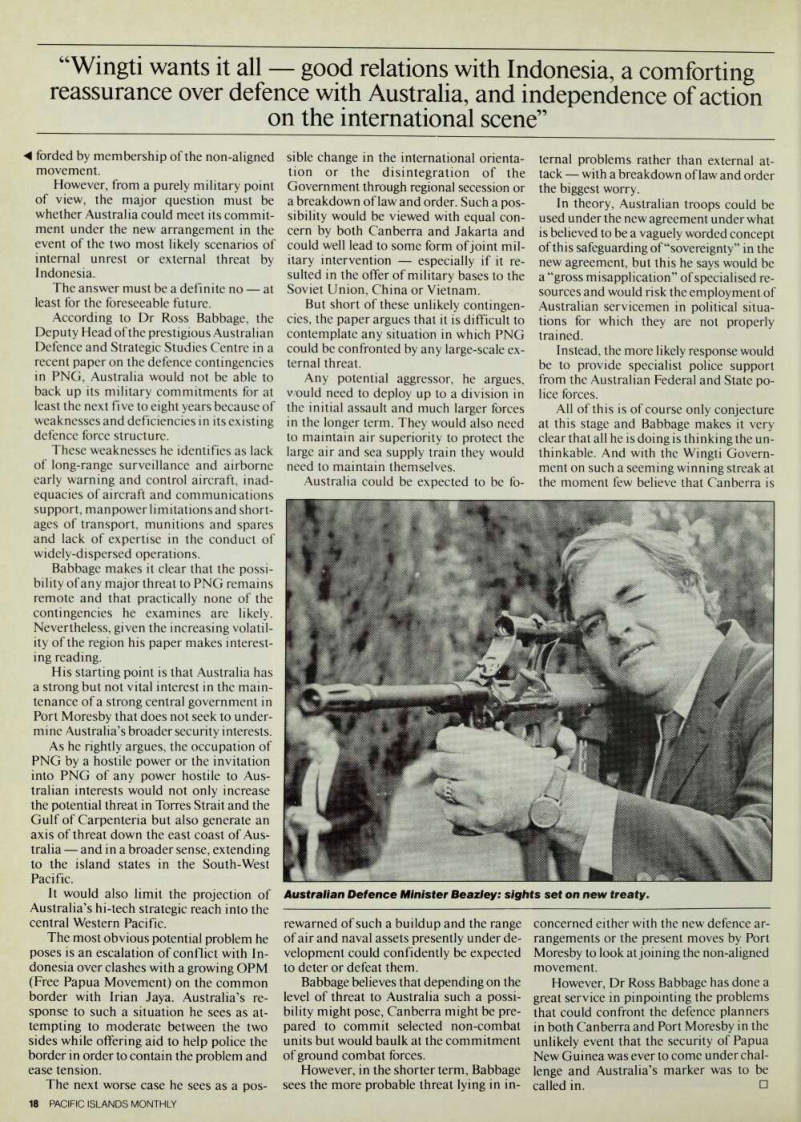
The decision in favour of closer def ence links was seen as a major win for Aus tralian Defence Minister Kim Beazley over the more cautious approach taken by For eign Minister Bill Hayden who felt that more was to be gained by keeping Aus
tralia’s options open and avoiding any specific commitment.
Four courses of action were proposed to Cabinet. They ranged from Option A, proposed by Mr Hayden, which argued for no change to the existing arrangements, all the way to Option D, put forward by Mr Beazley which called for a more formal agreement in line with the importance placed on PNG by the Defence White Pa per and the Government’s initiatives in the South West Pacific tabled in Parliament last February.
Option D was accepted and Mr Bea zley won but only after a healed argu ment in Cabinet where Mr Hayden is reported as having argued that it might be a decision Australia may one day regret.
No details have yet been released of the text of the agreement or the results of the discussions between the Wingti Govern ment and an Australian delegation held in Port Moresby early in September, but it is believed that the new arrangements closely follow the line of the 1971 Five-power Def ence Agreement with Malaysia.
This states that in the event of any form of armed attack, the five contracting par ties “would immediately consult together for the purposes of deciding what meas ures should be taken jointly or separately in relation to such attack or threat”.
A similar form of wording with PNG would formalise the de facto defence co operation arrangements that stemmed from the 1977 agreement between the Fraser and Somare Governments and open the way to a further range of co-operative measures, whilst stopping short of any outright guarantees.
Defence argued that this solution would underline Australia’s appreciation of the strategic importance of PNG and the spe cial relationship that exists between the two countries.
It is also believed that Defence was also very much alert to the fact that such an agreement would go a long way to heading off any possible search for other partners by Port Moresby whilst allowing Australia a continued involvement in regional def ence matters.
The more cautious approach by For eign Affairs however is believed to have been based on an appreciation that de spite the promise shown by the present Administration, PNG is inherently politi cally unstable and that the shared border with Indonesia is a potential time bomb.
Foreign Affairs also believes that even such an innocuous document as is being proposed could well lead Papua New
Guinea to act with far more confidence in her relations with Indonesia than she might otherwise.
There was also puzzlement in some quarters in Canberra as to why it was nec essary to formalise what up until now has been a very effective working arrange ment both at the defence and political levels. This is especially so considering the recent signing of the treaty of mutual re spect, friendship and co-operation be tween PNG and Indonesia and the excellent relations built up with Jakarta by Mr Wingti.
The answer of course is that Mr Wingti wants it all. Good relations with Indone sia, a comforting reassurance over defence from Australia and now the independence of action on the international scene af
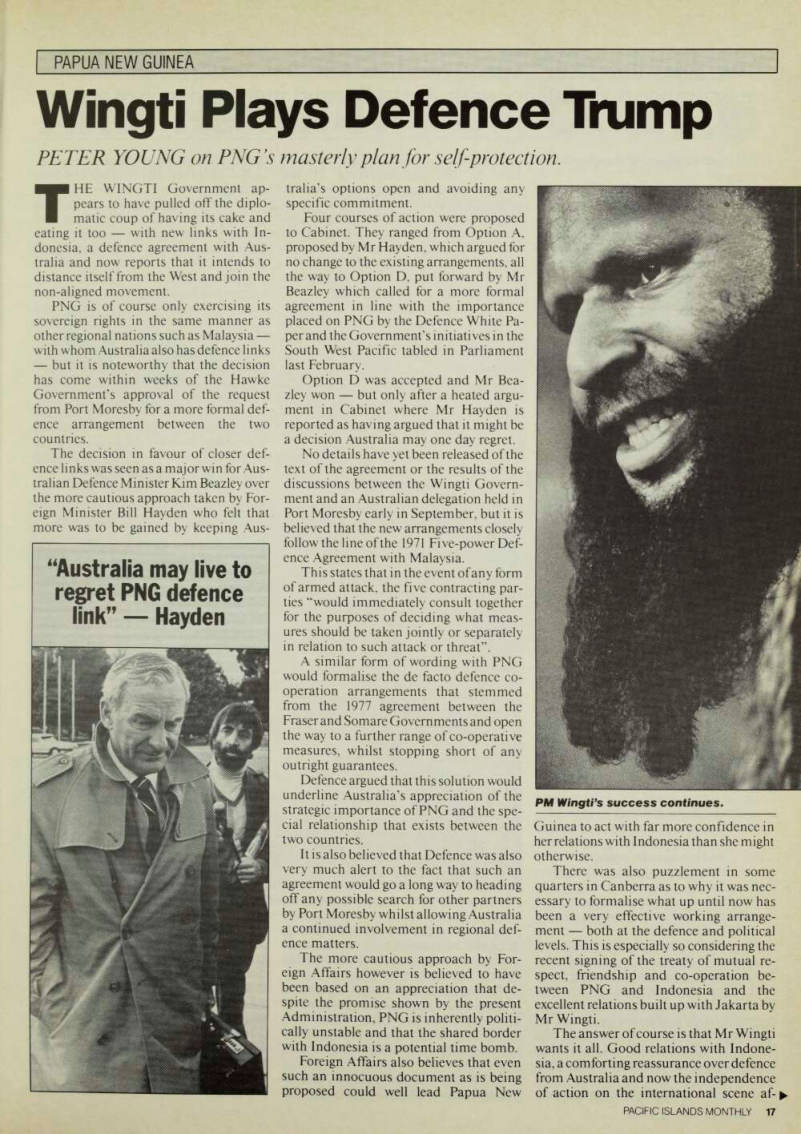
PM Wingti’s success continues.
“Wingti wants it all good relations with Indonesia, a comforting reassurance over defence with Australia, and independence of action on the international scene”
◄ forded by membership of the non-aligned movement.
However, from a purely military point of view, the major question must be whether Australia could meet its commit ment under the new arrangement in the event of the two most likely scenarios of internal unrest or external threat by Indonesia.
The answer must be a definite no at least for the foreseeable future.
According to Dr Ross Babbage, the Deputy Head of the prestigious Australian Defence and Strategic Studies Centre in a recent paper on the defence contingencies in PNG, Australia would not be able to back up its military commitments for at least the next five to eight years because of weaknesses and deficiencies in its existing defence force structure.
These weaknesses he identifies as lack of long-range surveillance and airborne early warning and control aircraft, inad equacies of aircraft and communications support, manpower limitations and short ages of transport, munitions and spares and lack of expertise in the conduct of widely-dispersed operations.
Babbage makes it clear that the possi bility of any major threat to PNG remains remote and that practically none of the contingencies he examines are likely.
Nevertheless, given the increasing volatil ity of the region his paper makes interest ing reading.
His starting point is that Australia has a strong but not vital interest in the main tenance of a strong central government in Port Moresby that does not seek to under mine Australia’s broader security interests.
As he rightly argues, the occupation of PNG by a hostile power or the invitation into PNG of any power hostile to Aus tralian interests would not only increase the potential threat in Torres Strait and the Gulf of Carpenteria but also generate an axis of threat down the east coast of Aus tralia and in a broader sense, extending to the island states in the South-West Pacific.
It would also limit the projection of Australia’s hi-tech strategic reach into the central Western Pacific.
The most obvious potential problem he poses is an escalation of conflict with In donesia over clashes with a growing OPM (Free Papua Movement) on the common border with Irian Jaya. Australia’s re sponse to such a situation he sees as at tempting to moderate between the two sides while offering aid to help police the border in order to contain the problem and ease tension.
The next worse case he sees as a pos
sible change in the international orientation or the disintegration of the Government through regional secession or a breakdown of law and order. Such a possibility would be viewed with equal concern by both Canberra and Jakarta and could well lead to some form of joint military intervention especially if it resuited in the offer of military bases to the Soviet Union, China or Vietnam.
But short of these unlikely contingencies, the paper argues that it is difficult to contemplate any situation in which PNG could be confronted by any large-scale external threat.
Any potential aggressor, he argues, v ould need to deploy up to a division in the initial assault and much larger forces in the longer term. They would also need to maintain air superiority to protect the large air and sea supply train they would need to maintain themselves.
Australia could be expected to be fo-
ternal problems rather than external at tack with a breakdown of law and order the biggest worry, In theory, Australian troops could be used under the new agreement under what is believed to be a vaguely worded concept of this safeguarding of “sovereignty” in the new agreement, but this he says would be a “gross misapplication” of specialised re sources and would risk the employment of Australian servicemen in political situa tions for which they are not properly trained.
Instead, the more likely response would be to provide specialist police support from the Australian Federal and State po lice forces.
All of this is of course only conjecture at this stage and Babbage makes it very clear that all he is doing is thinking the un thinkable. And with the Wingti Govern ment on such a seeming winning streak at the moment few believe that Canberra is
rewarned of such a buildup and the range of air and naval assets presently under de velopment could confidently be expected to deter or defeat them.
Babbage believes that depending on the level of threat to Australia such a possi bility might pose, Canberra might be pre pared to commit selected non-combat units but would baulk at the commitment of ground combat forces.
However, in the shorter term, Babbage sees the more probable threat lying in in
concerned either with the new defence ar rangements or the present moves by Port Moresby to look at joining the non-aligned movement.
However, Dr Ross Babbage has done a great service in pinpointing the problems that could confront the defence planners in both Canberra and Port Moresby in the unlikely event that the security of Papua New Guinea was ever to come under chal lenge and Australia’s marker was to be called in. □
Australian Defence Minister Beazley: sights set on new treaty.