Book Reviews
pp. 48-49 · Read in the full issue
An overview of economic change
Fiji Economic History: 1874-1939:
Studies of Capitalist Colonial Development By Bruce Knapman; National Centre for Development Studies, Research School of Pacific Studies, The Australian National University, Canberra, ISBN 0-86784-977-0.
Reviewed by ROBERT ALDRICH THE recent events in Fiji make a study of the archipelago’s eco nomic history especially interest ing; even more so when commentators interpret the coup d’etat in terms of eco nomic and political disparities between the Fijians and Indians or (as in the case of South magazine) as “class war”.
Knapman provides the serious reader with a well-crafted overview and a refu tation of trendy but simplistic theses about Third World economic change. His ap proach is that of a professional economist, who also assumes that readers will already be familiar with the general outline of Fi jian history.
Some general readers will find the study rather technical and a bit dry, but even for those with no specialised knowledge, the book merits the effort for the author’s in formation and his interpretation.
Knapman treats Fiji’s economic his tory thematically, devoting chapters to ex port (the Colonial Sugar Refining Company), the evolution of the tradi tional, non-capitalist economy, “the de mise of the white sugar planter”, shipping (the Union Steam Ship Company of New Zealand and the Australasian United Steam Navigation Company), commerce (Burns Philp, Morris, Hedstrom Ltd and Brown & Joske) and monetary policy; his documentation includes secondary sources, government records and com pany archives.
The narrative is the installation of a capitalist economy in Fiji; the develop ment of exports of bananas, gold and, es pecially, sugar, the domination of foreign transport and mercantile companies, the monetarisation of exchange and the lin kage of Fiji to the global economy. The import of indentured Indian labourers, the growth of a white settler population and then the pushing aside of the colonists by the international corporations are among the social repercussions. The social costs were great in a system of “placing an un derpaid Indian at the receiving end of an Australian overseer’s whip or swagger stick”; statistics on the suicide rate 15 times higher for indentured Indians in Fiji than in the province of India from which most came are one proof. But the eco nomic and social history of Fiji is more complex than the stereotype of exploita
tion, and the value of Knapman’s study is the revelation of this complexity.
Contrary to certain received models, the foreign companies did not gain huge profits from their Fijian ventures. Neither were the Fijian operations central to the shippers' and traders’ overall strategy; “Although the shipping companies man aged to extract monopoly profits from the carriage of Fiji’s imports, six decades of Fiji’s dependence on the companies ended with them needing Fiji less than they ever had done.”
Similarly, Burns Philp’s early years in Fiji were not encouraging. CSR had to abandon its original intention of buying cane from private planters and its opera tion of estates in favour of leasing land to canegrowers to maintain its profits. The white planters, themselves, enjoyed only a veneer of prosperity and became indebted to the corporations which loaned them the money they desperately needed. Tempo rary alliances between settlers and government and outright collusion be tween various competing companies in dicated weakness rather than strength.
The list of failed enterprises is long. The economic crises of the 1920 s and 1930 s un veiled the fragility of the capitalist system set in place and, as well, the failure of the foreign ideal of creating a yeoman society of Indian and Fijian farmers.
Knapman sets out to do more than just nuance the portrait of capitalism in the Pacific islands or to show the shakiness of that capitalist system. He wants to. dis prove the Marxist (or neo-Marxist) model that capitalist imperialism caused under development in Fiji. He wants to avoid “the tunnel vision of the paradigmatically my opic, who squeeze the evidence into a pre ferred model”.
He charges that the contention that capitalism caused underdevelopment is tautological. Furthermore, and more sig nificantly, the model overlooks the op tions available to the various actors, the non-economic constraints to develop ment and the undeniable developments credited to capitalism (such as the eco nomic infrastructure).
The weak point of Knapman’s expo sition is what model he intends to substi tute for the neo-Marxist one, as he is also skeptical about modernisation, neo-clas sical or purely empirical frameworks.
Bandying about catchwords such as “exploitation” and “oppression”, “capi talism” and “imperialism” does not amount to a real analysis. Knapman’s fine study, one hopes, will be one of many pre senting a more sophisticated view of Oceanic societies. Theorising is not help ful only to specialists.
Knapman, for example, speaks of the preservation of native properly and life in Fiji, arguing that “increasing integration into the world capitalist economy does not necessarily cause disintegration of local structures”.
The continued vitality of this Fijian Oceanic society, coupled with the remark able transformation of the Indians’ situa tion. is ultimately a more useful explanation of the island’s contemporary problems than simplistic statements about ethnic disputes, class confrontations or political quarrels.
A practical guide
MAKE YOUR OWN BILUM By Sylvia Baker; Boolarong Publications, 12 Brooke St, Bowen Hills, Old 4006. ISBN 0-959-0226-00. $A9.95.
Reviewed by JOHN HUNTER WAITING to catch a plane from Lae to the Highlands I noticed a Highlands lady arrive with a bilum hanging down her back from her fo rehead. The huge bilum was packed with taro. She carried it with ease to the small plane for loading. However, it took two well-built males all their strength to lift the load into the plane. Such is the strength of PNG women and the versatility of the bilum. The bilum is the traditional carry bag of Papua New Guinea and is similar, in many ways, to the dilly bag of the Aus tralian Aborigines. The bag is used to carry babies, food, wood, betel nut and 1000 other goods.
Sylvia Baker had a lifelong interest in the bilum and built up a vast knowledge about its making and patterning. Fre quently asked to demonstrate bilum-mak ing, and often asked for an instruction book, she set about compiling a book on all she knew. Unfortunately she died soon after completing the work. What she has left behind is a well-researched memorial to her expertise.
Sections of this classic reference work include: structure of the bilum, materials and equipment, thigh spinning, melting, making the handle and mouth, and patterning.
I found the book very practical after a recent trip to PNG when I discovered a hole in my bilum. The book enabled me to successfully do my own repairs.
Mrs Baker illustrates her work with nu merous photographs of colourful bilums and diagrams, designed, as she says, to en able any keen craftsman to tackle the making of the simplest basic bilum types.
Every bilum is unique, allowing free dom for self expression at every phase of the working. No two bilums will ever be
exactly alike because they are so totally hand-made and personal.
Mrs Baker has left a book for the en thusiast and novice. An excellent refer ence of an item which is part of Papua New Guinea.
A diary of disaster
THE FIRE HAS JUMPED: Accounts of the Eruption and Evacuation of Niuafo’ou, Tonga. Edited by Garth Rogers. Institute of Pacific Studies, USP, Suva, Fiji.
Reviewed by NORMAN DOUGLAS EVER since they arrived in their is lands centuries ago, the people of the Pacific have had to endure nat ural disasters of a frequency and, some times, on a scale which seems little short of incredible to those of us who live in more stable enviroments.
The frequency with which Paradise shows its malevolent face in hurricanes, tsunami , periods of drought, earthquakes and volcanic eruptions give cause for wonder that many small islands in the Pa cific remain populated at all. That they do, and that their inhabitants remain in their traditional homelands and persist in their traditional lifestyles, fully conscious of the fact that the next disaster may be just around the corner, is a remarkable illus tration of human resilience and fortitude.
Few of the many great natural calami ties have been fully documented, which is hardly surprising: if you are suddenly obliged to tie yourself to the strongest tree on the atoll to ride out a 150 kph gale, or forced to flee your house because it is in the path of the approaching molten lava, then you don’t need a notebook or type writer to inhibit your movements, and once the disaster is over you are probably more likely to forget the whole thing than to re cord or recall your experiences.
Perhaps surprisingly then, when Ni uafo’ou, the northernmost outlier of the
Tonga Islands, blew its top in September 1946, a number of eyewitnesses had the presence of mind to record the event in diaries while others had the clarity of re call sufficient to re-live their experiences years later.
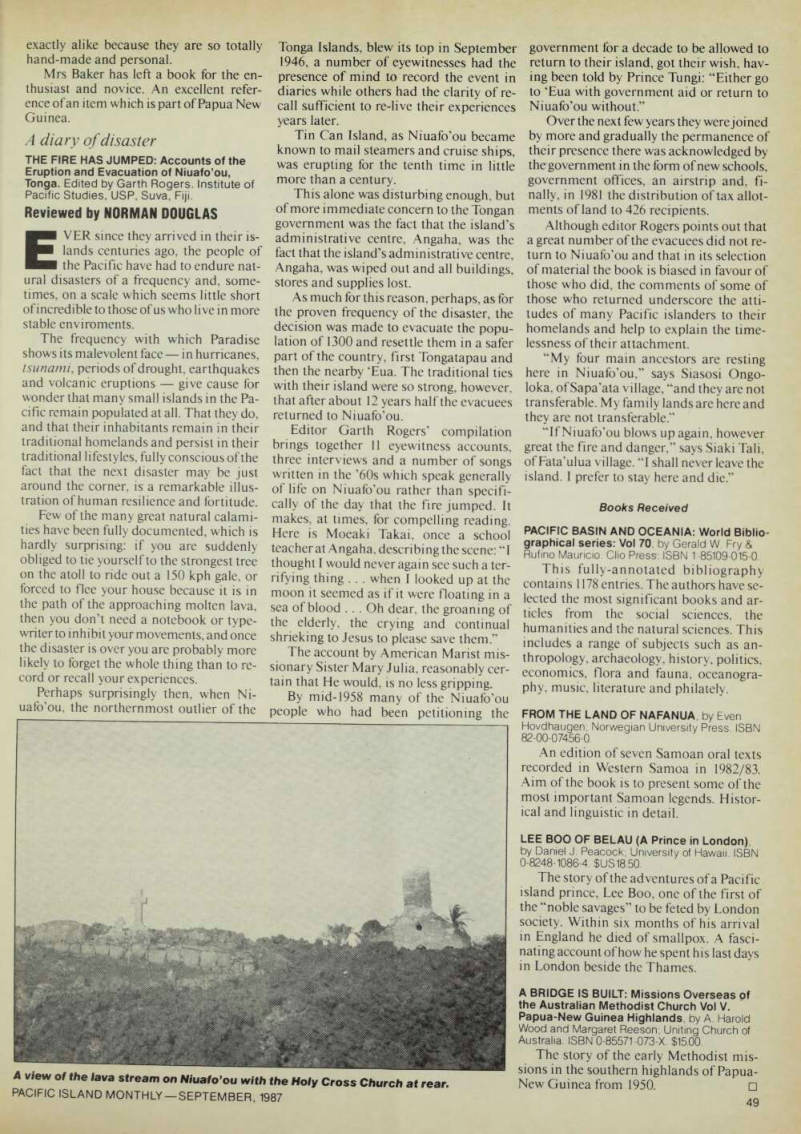
Tin Can Island, as Niuafo’ou became known to mail steamers and cruise ships, was erupting for the tenth time in little more than a century.
This alone was disturbing enough, but of more immediate concern to the Tongan government was the fact that the island’s administrative centre, Angaha, was the fact that the island’s administrative centre, Angaha, was wiped out and all buildings, stores and supplies lost.
As much for this reason, perhaps, as for the proven frequency of the disaster, the decision was made to evacuate the popu lation of 1300 and resettle them in a safer part of the country, first Tongatapau and then the nearby ‘Eua. The traditional ties with their island were so strong, however, that after about 12 years half the evacuees returned to Niuafo’ou.
Editor Garth Rogers’ compilation brings together 11 eyewitness accounts, three interviews and a number of songs written in the ’6os which speak generally of life on Niuafo’ou rather than specifi cally of the day that the fire jumped. It makes, at times, for compelling reading.
Here is Moeaki Takai, once a school teacher at Angaha, describing the scene: “1 thought I would never again see such a ter rifying thing . . . when I looked up at the moon it seemed as if it were floating in a sea of blood . . . Oh dear, the groaning of the elderly, the crying and continual shrieking to Jesus to please save them.”
The account by American Marist mis sionary Sister Mary Julia, reasonably cer tain that He would, is no less gripping.
By mid-1958 many of the Niuafo’ou people who had been petitioning the
government for a decade to be allowed to return to their island, got their wish, hav ing been told by Prince Tungi: “Either go to ‘Eua with government aid or return to Niuafo’ou without.”
Over the next few years they were joined by more and gradually the permanence of their presence there was acknowledged by the government in the form of new schools, government offices, an airstrip and, fi nally, in 1981 the distribution of tax allot ments of land to 426 recipients.
Although editor Rogers points out that a great number of the evacuees did not re turn to Niuafo’ou and that in its selection of material the book is biased in favour of those who did, the comments of some of those who returned underscore the atti tudes of many Pacific islanders to their homelands and help to explain the time lessness of their attachment.
“My four main ancestors are resting here in Niuafo’ou,” says Siasosi Ongo loka, of Sapa’ala village, “and they are not transferable. My family lands are here and they are not transferable.”
“If Niuafo’ou blows up again, however great the fire and danger,” says Siaki Tali, of Fata’ulua village. “I shall never leave the island. I prefer to stay here and die.”
Books Received
Pacific Basin And Oceania: World Biblio
graphical series: Vol 70 by Gerald W Fry & Rufino Mauricio. Clio Press: ISBN 1-85109-015-0.
This fully-annotated bibliography contains 1178 entries. The authors have se lected the most significant books and ar ticles from the social sciences, the humanities and the natural sciences. This includes a range of subjects such as an thropology, archaeology, history, politics, economics, flora and fauna, oceanogra phy, music, literature and philately.
FROM THE LAND OF NAFANUA. by Even Hovdhaugen; Norwegian University Press ISBN 82-00-07456-0 An edition of seven Samoan oral texts recorded in Western Samoa in 1982/83.
Aim of the book is to present some of the most important Samoan legends. Histor ical and linguistic in detail.
LEE 800 OF BELAU (A Prince in London) by Daniel J. Peacock; University of Hawaii. ISBN
0-8248-1086-4. Sus 18.50.
The story of the adventures of a Pacific island prince, Lee 800, one of the first of the “noble savages” to be feted by London society. Within six months of his arrival in England he died of smallpox. A fasci nating account of how he spent his last days in London beside the Thames.
A BRIDGE IS BUILT: Missions Overseas of the Australian Methodist Church Vol V.
Papua-New Guinea Highlands, by A Harold Wood and Margaret Reeson; Uniting Church of Australia. ISBN 0-85571-073-X. $15,00.
The story of the early Methodist mis sions in the southern highlands of Papua- New Guinea from 1950. □
A view of the lava stream on Niuafo’ou with the Holy Cross Church at rear.