Exit Sir Tom...
p. 38 · Read in the full issue
Cook Islands
Karen Mangnell reports on the end of a controversial era.
NEW Zealand and the Cook Islands believe their relations will take a warmer turn with the dumping of the former Cooks prime minister, Sir Thomas Davis. In a rare moment of unity, the Cooks Parliament voted unanimously to oust Sir Tom, who had led the country for eight years. His successor. Dr Pupuke Robati, a 62-year-old former cabinet chairman, was elected along normal par tisan lines.
Dr Robati’s arrival was greeted with sighs of relief from New Zealand officials.
New Zealand Prime Minister Mr David Lange, promptly invited his new counter part to visit soon.
Dr Robati is keen to accept the offer.
He was also to travel to Paris in late Au gust to sign a $l5 million soft loan from France negotiated by Sir Tom to help re build Cyclone Sally’s devastation earlier this year.
Sir Tom’s unpredictable prime minis terial utterances particularly over the Anzus rift had caused regular sharp in takes of breath in Wellington diplomatic and political circles. New Zealand is re sponsible for the Cooks defence, foreign relations and about SNZ3 million in an nual aid. Sir Tom’s undiplomatic viola tion of that relationship by criticising New Zealand’s anti-nuclear policies had riled Mr Lange on several occasions.
The July rebellion by Sir Tom’s coali tion MPs was organised by the then for eign minister, Mr Norman George, who is widely believed in the Cooks and New Zealand to be the man behind Dr Robati’s throne.
Mr George said a whole series of prob lems had led to Sir Thomas’ removal. “The man has become impossible to work with.
He’s very bad tempered, and swears a lot.
No minister is confident to work for him because every time he is angry about something he threatens to sack a minister.
It’s like having a gun pointed at you every day,” Mr George said.
Mr George said he now expected a “vastly improved” relationship with New Zealand. “Our cabinet, the rest of our co alition government and our people of the Cook Islands have always been very close to New Zealand and Sir Thomas’ behav iour was an embarrassment to all of us.”
Mr George said any political comeback by Sir Thomas would be bound to fail be cause the former leader lacked a big public following.
Sir Thomas is keeping quiet about fu ture plans, saying he wants a rest before staging any comeback. He declared him self not at all upset by his removal because he believed he had always done the job well.
But he predicted that New Zealand would get along better with the Cooks be cause Dr Robati would be prepared to accede to “Mr Lange’s neocolonial attitudes”.
Sir Tom came to power in 1978 after an historic Cook Islands court case over turned the election of the longtime prime minister. Sir Albert Henry. Sir Albert’s fly in voter scheme paying Cook Islanders to come from New Zealand to vote was de scribed by the court as “unlawful conduct of monumental proportions”. From the time he took power, Sir Thomas a for mer research doctor moved to stake out a more independent Cooks foreign and trade policy.
Sir Thomas lost power and his own seat briefly in 1983 to Mr Geoffrey Henry’s Cook Islands Party. After regaining the leadership, he was plagued by domestic political problems. In 1984, one of his MPs, Mr Vince Ingram, and a colleague de fected and forced Sir Thomas into a coa lition with Mr Henry. Mr Henry walked out a year later but five of his own MPs stayed in a shaky coalition with Sir Thomas. Since then, for Sir Thomas, it was only a matter of time. □
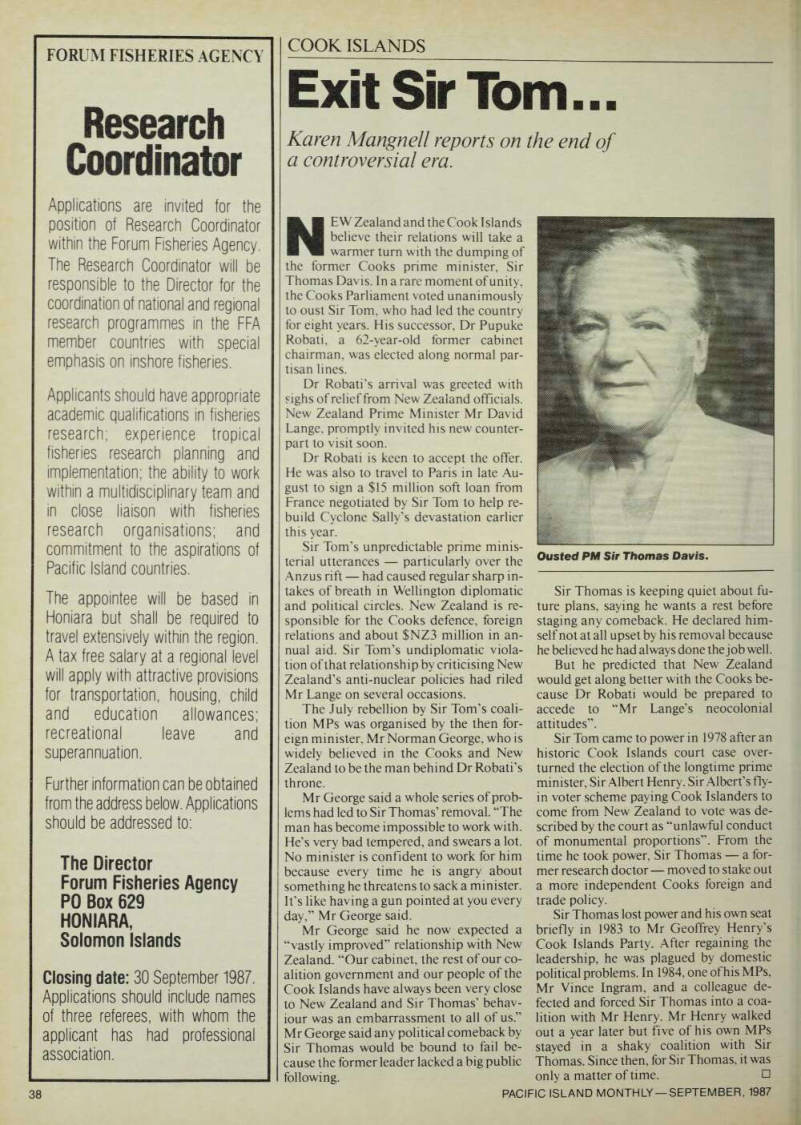
Ousted PM Sir Thomas Davis.