Tension Mounts
pp. 18-20 · Read in the full issue
as Referendum Looms
New Caledonia
Pro- and anti-independence passions are at flashpoint, reports Helen Fraser.
“If we look at the 16 months (of our government), the results of our efforts would be undisputedly positive: the authority of the State restored, calm and security assured throughout the territory, a lot of building construc tion underway again, tourism on the way up, numerous projects for estab lishing businesses, reinforced social assistance, and employment figures clearly on the way up”
Bernard Pons, August 3, Noumea.
THE confidence of Overseas Terri tories Minister Bernard Pons in the French Government’s New Cale donia policies as the September 13 refer endum on independence looms is reflected in the capital Noumea. Once-rare con struction sites abound, and beautification schemes are underway around the city. In deed, the roadsides leading to Noumea from the airport are being landscaped with boulders and palm trees at a cost of $ A 13,000. Pons’ confidence is also due to the aid that France is pouring into the Ca ledonian economy; over and above the heavily subsidised territorial budget the Minister announced in Noumea that the special aid funds of 302.5 million French francs(sA7o.3 million) will be topped up by 137.5 million francs (SA32 million).
The assurance of the minister and the largely non-Kanak anti-independence population of Noumea is also fed by a daily media which rarely acknowledges the ex istence of an independence movement.
Both the daily newspaper (owned by the fiercely pro-government Hersant Group) and the State-run TV and radio network, RFO, are unapologetic about the selectiv ity of their news and not only the in dependence parties but also right wing critics of government policy are generally ignored.
Reporters who write for papers dis liked by the government find themselves denied places on aircraft during the min ister’s visits, while the local paper na-ljmed the minister editor-in-chief for a day.
Many New Caledonians could, and
surely do, believe that the independence issue is no longer a problem. The one con stant indicator of the past 10 years the numerous and often vicious political graf fiti has also disappeared, and Noumea now finds itself with many newly painted walls.
Only by listening to Radio Djiido, the station run by the FLNKS, or by watching the vans of bored CRS riot police cruising around the beach suburbs, would one be aware that for the FLNKS and the mod erate independence parties, LKS and OPAO, the independence issue is alive and well.
There are signs, however, of cracks in the confidence of Minister Pons and the French Government. On returning to Paris the minister announced that a further 1300 riot troops (six companies of CRS and seven squadrons of‘gardes mobiles’) were to be sent to the territory before the ref erendum. This brings to well over 8000 the number of the security force in the territory.
And in this latest visit to the territory Minister Pons concentrated on visiting Kanak tribal villages to exhort Kanaks to take part in the September 13 referendum on independence. “Because you are chil dren of France, because you are unquali fied citizens of the country of human rights, you can benefit from an excep tional privilege, a privilege that is sadly rare in today’s world that of expressing your opinion and deciding your destiny with a ballot paper. Remember well that this precious thing which is guaranteed for you by the grand democratic state that is France, is a fragile thing.
“Look around you and ask your friends and brothers of the Pacific and you will understand how tempting and easy it is for some to stop this act one which is so simple but which symbolises the dignity of man, the act of putting a ballot paper in the ballot box.”
While in Noumea Mr Pons banned the FLNKS planned “peaceful march for in dependence”, along with the pro-France “tricolour march” announced by the
Rpcr.
Indeed, most observers assumed the RPCR march was announced by leader Jacques Lafleur in order to give the Min ister a pretext to ban the FLNKS march.
Yeiwene Yeiwene, FLNKS President of the Loyalty Islands Regional Council, said the banning was “programmed by Lafleur and Pons ... since we have been barred from media access, Pons and others want to affirm that we don’t exist anymore, and so they oppose the march.”
Yeiwene said that before the ban a let ter had gone to French Prime Minister Chirac in which the FLNKS had ex plained the purpose of the march and ad vised that their proposal for an act of self determination and the constitution of an independent state would be distributed along the way to settlers and then deliv- ►
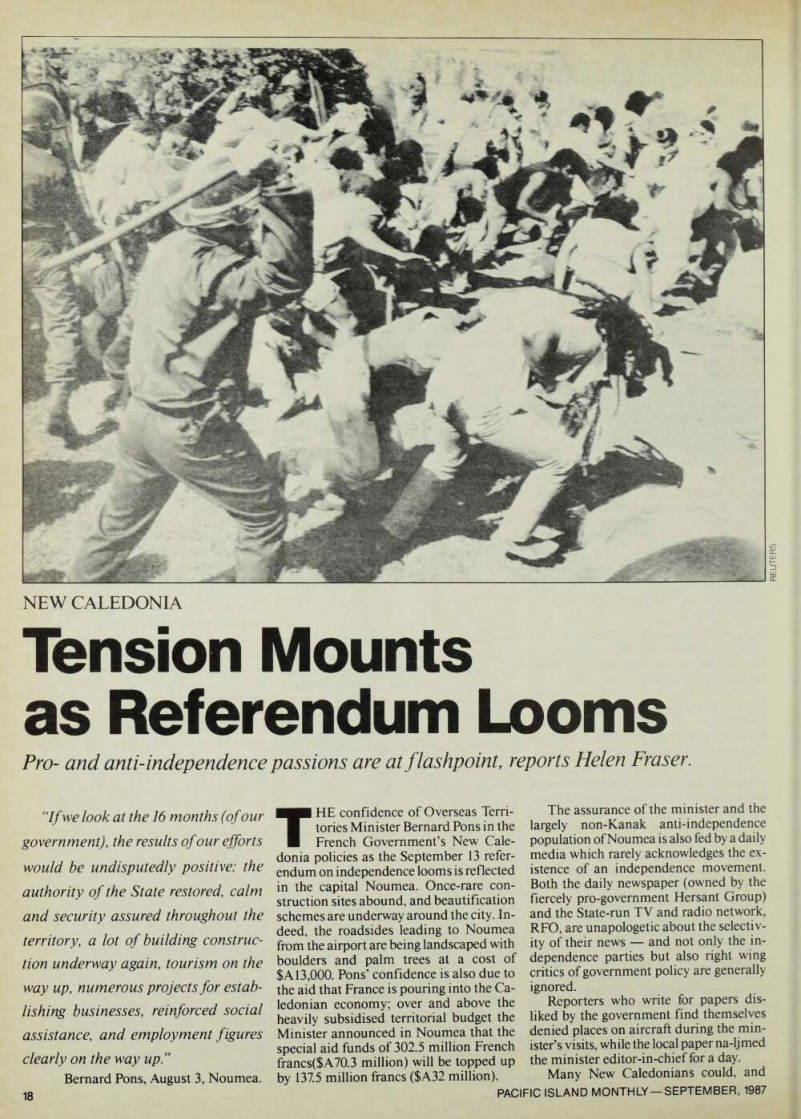
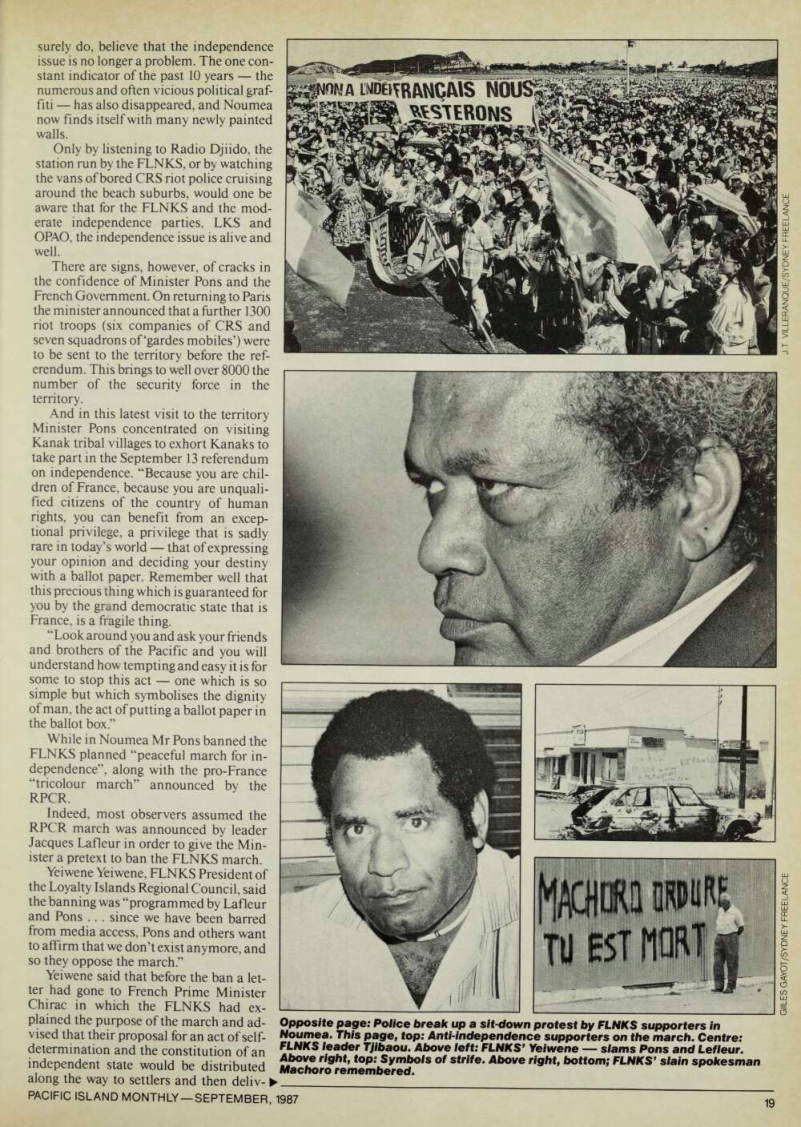
Opposite page: Police break up a sit-down protest by FLNKS supporters in Noumea. This page, top: Anti-independence supporters on the march. Centre: FLNKS leader Tjibaou. Above left: FLNKS' Yeiwene slams Pons and Lefleur.
Above right, top: Symbols of strife. Above right, bottom; FLNKS' slain spokesman Machoro remembered.
◄ ered in Noumea to the French High Com missioner. The letter gave assurances that security measures would be taken by the FLNKS to avoid incidents or provocation.
Yeiwene also cited the pledge signed by each militant who was to take part in the march, which demands strict obedience to FLNKS orders: no alcohol, drugs or other stimulants, and acceptance that provocation would not be answered.
Pierre Maresca, RPCR general-secre tary and member of the Southern Re gional Council, said the FLNKS wanted the march “because they can’t accept that things (the referendum) go ahead like that, without problems, because they know the results of this referendum will be difficult for them.” Maresca said he was certain that without pressure from the FLNKS, Me
lanesian participation in the poll would be massive.
He said the referendum will prove the futility of the Kanak independence cause.
“The FLNKS has the certitude now that it has no serious support in France, even amongst the Socialists. The Socialists I’ve met in France recently have all said that Kanak independence is an illusion. Apart from the Communist Party they have no political support. There is no possibility within the French Constitution that the Kanaks will obtain independence.”
Maresca said the RPCR and the min ister hoped that after the referendum the FLNKS would take part in the discussion on the new statute of autonomy: “The FLNKS has a following a minority, but a significant one. It’s sure that the system
we will put in place will be regionally based and the FLNKS will be able to get expe rience of management in the regions it will control.”
The immediate focus of all anti-inde pendence groups and parties is, however, on securing as high a participation rate as possible in the September 13 referendum.
Initially confident the poll would attract a participation rate of 60 per cent, the RPCR has looked at the figures again and been wary of such a prediction.
Speaking to reporters during his visit, Bernard Pons claimed that normal ab stentions in the territory were in the order of 30 to 40 per cent. He warned the inde pendence movement that the abstention figure “would have no political signifi cance at all”. □