Wingti The Victorious
pp. 12-14 · Read in the full issue
Png Elections
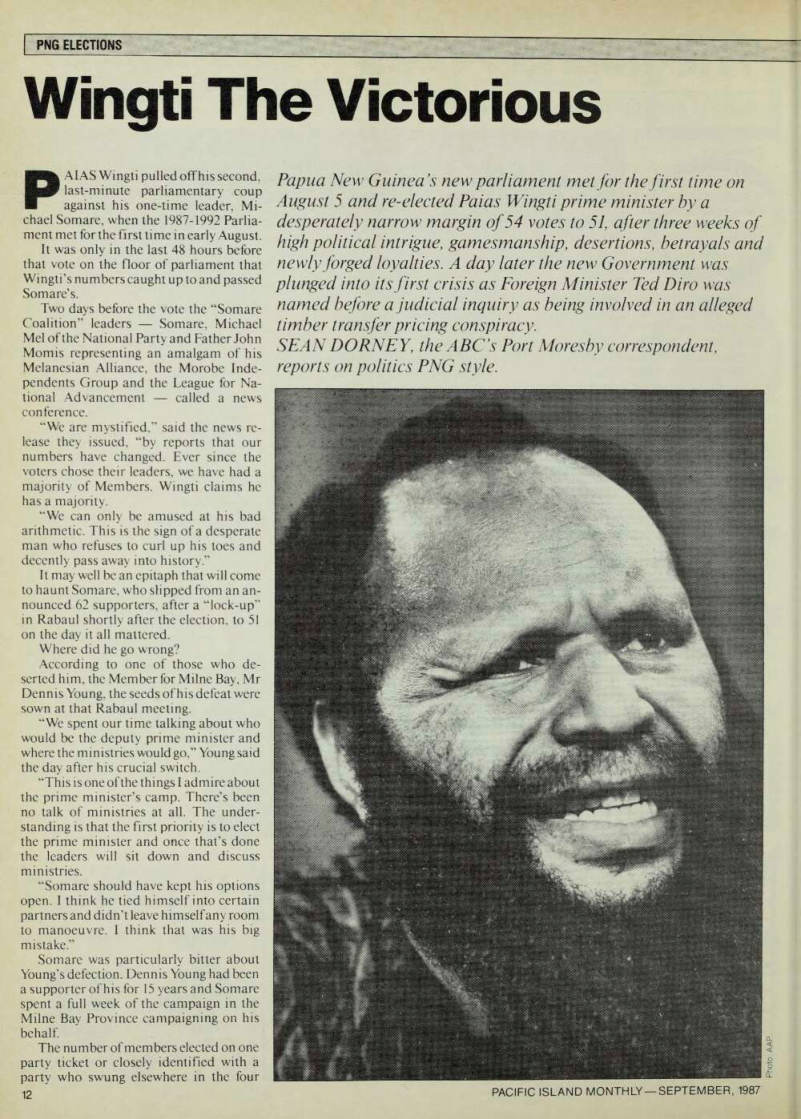
PAI AS Wingti pulled off his second, last-minute parliamentary coup against his one-time leader, Mi chael Somare, when the 1987-1992 Parlia ment met for the first time in early August.
It was only in the last 48 hours before that vote on the floor of parliament that Wingti’s numbers caught up to and passed Somare’s.
Two days before the vote the “Somare Coalition” leaders Somare, Michael Mel of the National Party and Father John Momis representing an amalgam of his Melanesian Alliance, the Morobe Inde pendents Group and the League for Na tional Advancement called a news conference.
“We are mystified,” said the news re lease they issued, “by reports that our numbers have changed. Ever since the voters chose their leaders, we have had a majority of Members. Wingti claims he has a majority.
“We can only be amused at his bad arithmetic. This is the sign of a desperate man who refuses to curl up his toes and decently pass away into history.”
It may well be an epitaph that will come to haunt Somare, who slipped from an an nounced 62 supporters, after a “lock-up” in Rabaul shortly after the election, to 51 on the day it all mattered.
Where did he go wrong?
According to one of those who de serted him, the Member for Milne Bay, Mr Dennis Young, the seeds of his defeat were sown at that Rabaul meeting.
“We spent our time talking about who would be the deputy prime minister and where the ministries would go,” Young said the day after his crucial switch.
“This is one of the things I admire about the prime minister’s camp. There’s been no talk of ministries at all. The under standing is that the first priority is to elect the prime minister and once that’s done the leaders will sit down and discuss ministries.
“Somare should have kept his options open. I think he tied himself into certain partners and didn’t leave himself any room to manoeuvre. I think that was his big mistake.”
Somare was particularly bitter about Young’s defection. Dennis Young had been a supporter of his for 15 years and Somare spent a full week of the campaign in the Milne Bay Province campaigning on his behalf.
The number of members elected on one party ticket or closely identified with a party who swung elsewhere in the four
Papua New Guinea's new parliament met for the first time on August 5 and re-elected Paias Wingti prime minister by a desperately narrow margin of 54 votes to 51, after three weeks of high political intrigue, gamesmanship, desertions, betrayals and newly forged loyalties. A day later the new Government was plunged into its first crisis as Foreign Minister Ted Diro was named before a judicial inquiry as being involved in an alleged timber transfer pricing conspiracy.
SEAN DORNEY, the ABC's Port Moresby correspondent, reports on politics PNG style.
weeks between being declared winners and having to make their first vote in the Par liament astounded even veteran observ ers of PNG politics.
The most amazing case of flip-flop ping was that by the Member for East New Britain, Mr Ereman Tobaining a for mer East New Britain Provincial Premier.
Mr Tobaining stood on the Pangu Pati ticket with Mr Somare’s photo next to his.
In the last week in July he flew to Port Moresby from Rabaul in the prime min ister’s aircraft and was deep in discussions with the almost defunct United Party, which was limply attached to Wingti’s coalition.
Some Pangu officials wrote him off as lost but then out came the first of several intriguingly conflicting press releases.
“Mr Tobaining today hit out at the manner he had been hijacked from Ra baul,” it said. “I was virtually kidnapped and later detained in Port Moresby. I played along with my kidnappers because I wanted to know what they were plan ning. I want to say categorically that I am a member of Pangu Pati and that I have unqualified support for Michael So mare,” said Mr Tobaining on July 29.
On August 4, Mr Tobaining was wait ing at Mr Wingti’s home for him to return from an interview on the National Broad casting Commission and within a few hours he and Mr Wingti fronted the cam eras and journalists to announce his al legiance to Wingti.
In a jointly signed press statement, the switch was described as “a move that has shattered the Somare camp.”
“Somare has already made his contri bution to the development of our nation, and I feel that our country now needs new and vigorous leaders like Mr Wingti to lead it through the next five years,” Tobaining said.
The next day the confusion over just where Tobaining belonged led to a physi cal confrontation in the Parliament build ing itself as the Member for Rabaul and Minister for Minerals and Energy, Mr John Kaputin, found Tobaining having tea in Somare’s office and attempted to pull him outside.
Equally intriguing was the behaviour of the Member of Mendi, Mr William Ank, who retained his seat for Sir Julius Chan’s Peoples Progress Party part of the Wingti coalition.
When the bells stopped ringing on the first day of Parliament, he was sitting with Somare’s supporters and apparently voted for the Opposition candidate for Speaker.
In the hour between the vote for speaker and the vote for prime minister, he switched back and was sitting on the Government benches when the speaker returned from being sworn in at govern ment House to call for prime ministerial nominations.
The brave move by the Electoral Com missioner, Mr Luke Lucas, to revamp the ballot papers so that endorsed members of
political parlies had the photos of their party leaders next to their photos turned out, in the end, to emphasise the fragility of the party system, not strengthen it, as was the expressed purpose.
A whole clutch of members had swopped and switched allegiance by the first sitting day.
The new member for Usino/Bundi, Mr ►
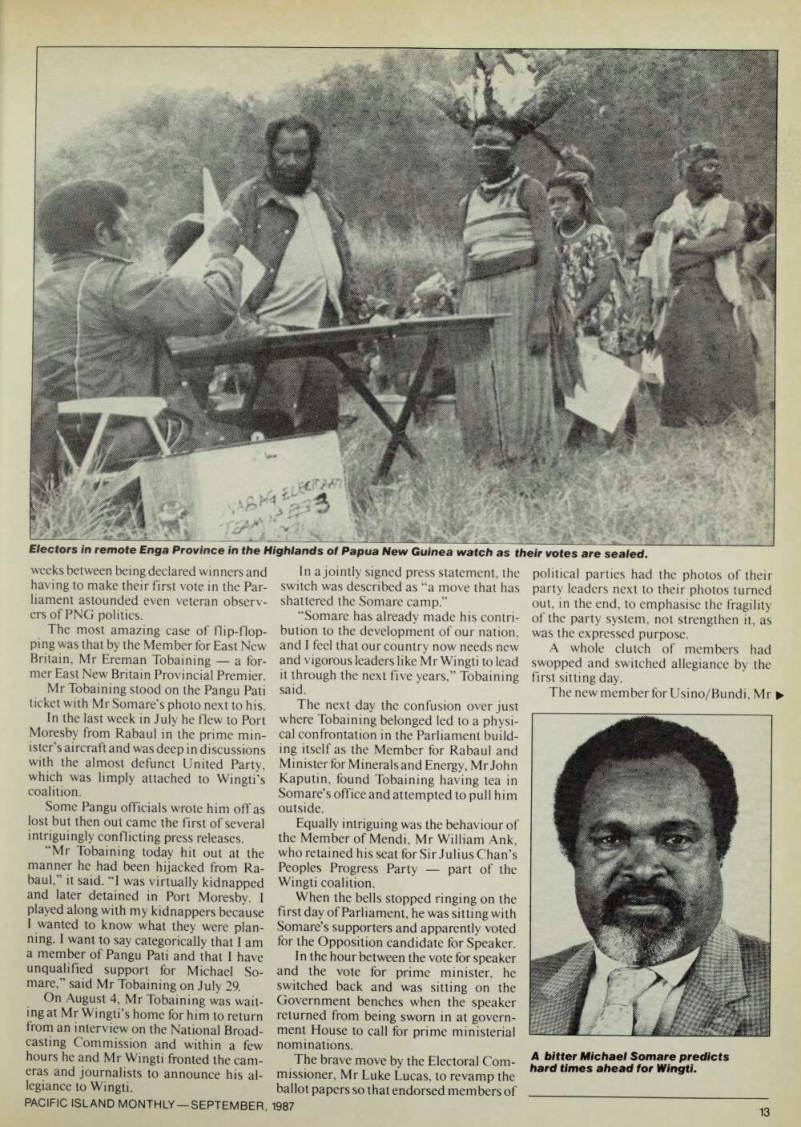
Electors in remote Enga Province in the Highlands of Papua New Guinea watch as their votes are sealed.
A bitter Michael Somare predicts hard times ahead for Wingti.
◄ Theodore Tuya a former journalist with both the NBC of PNG and Radio Aus tralia claimed he was offered Kina 10,000 in cash to switch from the Peoples Progress Party to vote with the Opposi tion. But he stuck with Sir Julius Chan’s
Ppp.
When the final vote was taken, and Paias Wingti edged Somare out 54 to 51, it was a bitter and angry Michael Somare who returned to his seat after shaking Wingti’s hand.
His gesture to shake hands drew loud applause not only from the floor of parlia ment but also the packed public and offi cial galleries. However the chamber hushed in shock as Somare launched into a blis tering attack on the newly re-elected Government.
“The nation deserves better than a co alition so shaky it can barely win a vole on the floor of parliament. . .
“Your coalition is a ramshackle gaggle of unruly independents who are about to discover the hard way that you can’t de liver the ministries they expect from you .. .” Somare boomed.
“There are sleepless nights ahead for anyone trying to control such a shaky bunch of individualists, trying to pass leg islation in the parliament.
“We are a solid team, pledged to fight the corruption which bought votes, trucked men from polling booth to booth to vote
In a recent issue of The Sydney Morning Herald columnist Maximil lian Walsh commented: It is widely suggested in Port Mo resby that the Commission of Inquiry (into aspects of the forest industry), moved immediately after the election of Mr Wingti to pre-empt any deal that may have been struck w ith Mr Diro to emasculate it. While there is no evi dence that Mr Wingti proposed to do this, PNG has incorporated some dis tinctly local rules into what we know as the Westminster system of govern ment we thought we bequeathed them.
The Australian political legacy is looking increasingly inappropriate in a country where regional, tribal and linguistic differences render impossi ble the creation of a two-party system, the Westminster ideal.
To that political problem is about to be added the management problem of rich gold and oil discoveries that will deliver a large and rapid stream of rev enue to a spoils-driven parliamentary system. It is easy to be pessimistic about the future of the country but, in an important fashion, the Ted Diro case may well redraw an Important line in this frontier world.
over and over; and which induced sup posed independents and endorsed party men to betray their voters.
“We will fearlessly expose the several criminal cases against men on your side, which taint the members you are forced to rely on,” Somare went on. “Not only are senior men implicated in a variety of fi nancial scandals soon due to be heard in court, but they in turn may implicate the highest elected officials in the nation.”
The Constitution allows Wingti six months grace now before a vote of no Con fidence can be moved against him in Par liament. But Somare gave notice that such motions could be on the agenda soon after.
“I promise ... the nation that we will fulfill our democratic duty to expose, op pose and depose,” he said.
A day after the vote those taunts of So mare’s about scandals were borne out. A judicial inquiry into PNG’s forest indus try heard allegations that the Foreign Min ister, Mr Ted Diro, was implicated in a major corruption scandal.
The judicial inquiry was established by Paias Wingti earlier this year following a series of articles in the Times of Papua New Guinea about troubles within the industry.
Counsel assisting the inquiry, Mr John Reeve, said evidence would be called which he said would link Mr Diro and the former Malaysian Foreign Minister, Tan Sri Ghazali Shafei, with a timber com pany he would seek to prove was involved in substantial transfer pricing activities.
The company Angus (PNG) which is now under official management was granted a Timber Resource Permit to the Gadaisu forest area in the Central Prov ince when Mr Diro was Forests Minister.
Mr Reeve said he’d produce evidence aimed at proving that the plan which
never came to reality was to transfer profits amounting to SUS 9.4 million from log shipments to a dormant company in the Channel Islands with a Hong Kong bank account.
The counsel assisting the inquiry said evidence would be presented how Minis ter Diro had short circuited departmental advice and, with a very compliant Secre tary for Forests, improperly granted the company its timber resource permit.
As PIM went to press, Mr Diro was saying he would not step down. He said he would engage lawyers to prepare his defence.
“I owe it to the newly formed Papuan Block and the Papuan people to represent their interests actively in the National Par liament and in the ministry,” Diro said.
“It is totally unjust and highly im proper that a trial is conducted by the me dia, before the proper legal investigating authority has completed its work.
“I very much regret the timing and the manner in which publicity on these alle gations has been made.
“Obviously there are political dimen sions to the matter, which I will reveal in due course.”
Mr Diro’s chances of becoming Dep uty Prime Minister vanished in mid-Au gust when Sir Julius Chan was named Deputy Prime Minister. Mr Diro was named Minister without Portfolio. The big unknown now is whether Mr Diro’s Pap uan block the most powerful Papuan block to have been formed in the parlia ment since independence would re main solid behind Prime Minister Wingti. D
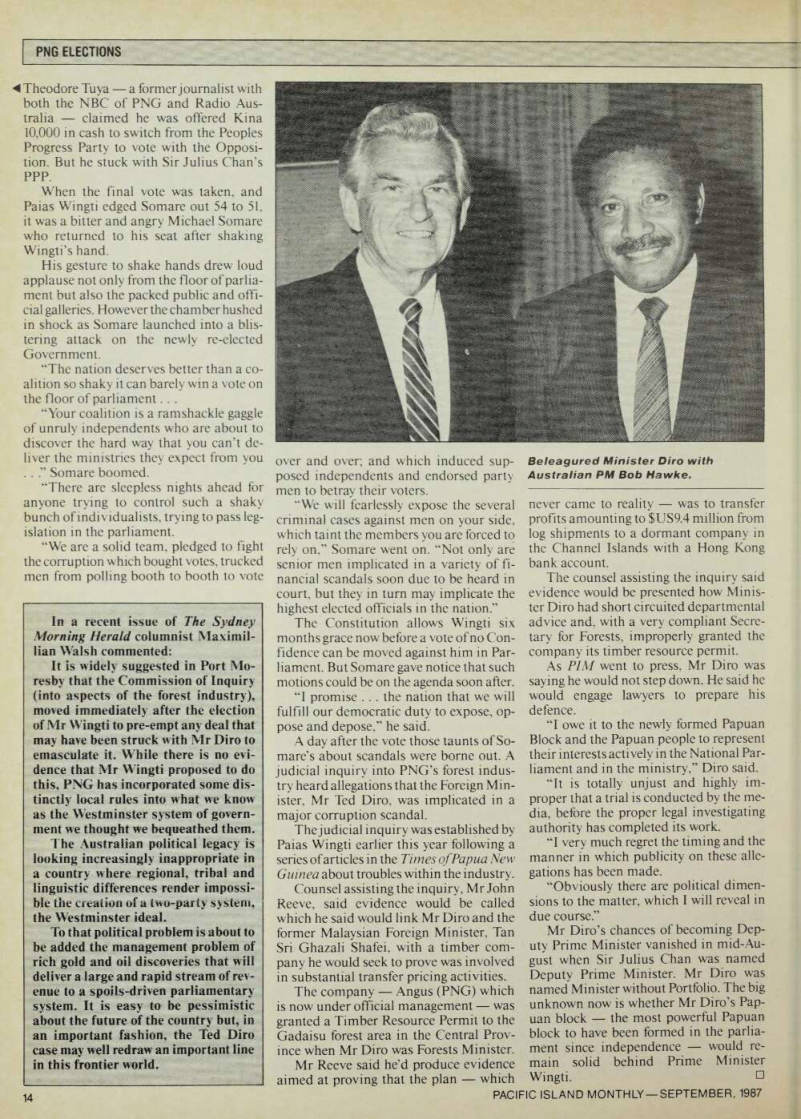
Beleagured Minister Diro with Australian PM Bob Hawke.