Jim Taylor
pp. 26-47 · Read in the full issue
The Encyclopaedia of Papua New Guinea has a page with the single heading, “Taylor”.
Everyone connected with Papua New Guinea knows who that refers to - James Lindsay Taylor, the legendary explorer of the Highlands.
He was a man of seeming contraditions: an adventurer and a civiliser, a romantic visionary who took to his heart the highly pragmatic Highland ers, a quiet and peaceful man who led some of the most testing patrols in New Guinea, a man of both the grand gesture and the most forward looking policy proposal. He could be a stern father and a tough leader, but he upheld all the gent lemanly courtesies, and he spoke always for tolerance.
He valued civilisation highly, and thought that no people could be civilised until they had learnt to read, but he consi dered the Highlanders a wise and energetic people. He spent most of his life among them, and he helped introduce them to the world with perhaps less stress, so far, than any other colonised people.
Jim Taylor was born at Bronte, NSW, on 25 January 1901. That, he was later fond of saying, was at least a hundred years too late. His age was the age of adventurers - of Black beard, stout Cortez, Wolfe, Cook and Livingstone.
Yet adventure was not enough. His greatest heroes were men whose deeds also help advance European civilisa tion. He grew up during the Great War, when both adven ture and civilisation were much talked about, but when he left Sydney Technical High School and enlisted, aged barely 16, in the 34 Battalion of the First AIF in March 1917, it was, he recalled, to help civilisation.
Back from the war, Taylor shared the restlessness of many returned men. He began a search for a purpose - a quest for the Holy Grail of life, he might have said: a year at Sydney University, an odd job or two, three years from 1923 in the NSW Police, and in 1926 a shift to the New Guinea Constabulary. He arrived when
an appreciation of his life and work by close friend Bill Gammage
think, one of the happiest and most exciting times in our lives.
We felt that we were taking part in some very great discoveries and looked forward to life with bounding hearts.” He had found his Holy Grail. Within a few days he wrote to his district officer, “It would seem that we are on the verge of a new era of development in these parts...it is probable that this interior tableland...extends from the Morobe border to the Sepik and contains a population of something like 200,000 people - none of whom are under control... 1 wish to suggest that ...this interior...be made the subject of a concentrated effort to bring the whole area under control...”
This was a majestic vision.
Taylor knew that the Adminis tration had not the immediate resources to achieve it, but he began the task anyway.
On March 28, 1933 he left Bena with Mick and Danny Leahy and surveyor Ken Spinks. A few days later he looked down into the mighty Wahgi vally, feeling like stout Cortez, and then descended into the lands where more people lived than any white person had ever dreamt was possible in the Highlands. They had found one of the world’s most beautiful places, a land and people splashed with bright colours.
the recent Edie Creek gold discoveries had created an ur gent demand for the extension of European administration there, and soon was seconded from the police to work as a patrol officer in Morobe.
The work appealed: it was adventurous, self-directed, and civilising. He made a deal with the New Guinea Administra tion. In return for cleaning up police corruption in Rabaul, he would be permanently made a kiap. He was Inspector of Police, Rabaul, in 1928-31, and in 1931 was posted back to Morobe as an assistant district officer. In October 1932 he was sent to open the Upper Ramu patrol post, now Kainantu, the first government station in the Highlands.
Around him were densely populated grasslands occupied, by a vigorous, self-reliant and agriculturally sophisticated people, and beyond the moun tains to the west and south stretched lands never seen by white men. The challenge and the opportunity seized Taylor’s imagination.
That December Taylor met Mick Leahy’s prospecting party in the Goroka Vally west of Bena Bena. They told him they had been as far west as Mount Elimbari and had seen a large populated valley stretching away to the northwest.
“We were all very excited,”
Taylor recalled, “This was, I
Within three weeks they were at Mount Hagan and exploring the country around. Within two months they had walked over more of the Highlands and contacted more people than any European or Highlander had ever done. They stayed seven months.
On returning, the civiliser in Taylor took the place of the adventurer. “It now remains for us,” he wrote, “To bring the inhabitants the Britannica.
The Bena-Hagen patrol was probably the most satisfying time of Taylor’s life, but he knew there was more to do in the Highlands. He worked happily there from 1934 to 1936, and when in 1937 he was transferred to Manus he was disconsolate. He thought Manus pleasant, but a backwa ter. The real work and the great adventures lay in the High lands, and it was with relief that he learnt in October 1937 of his appointment to lead an ex ploratory patrol from Mount Hagen west to the Dutch border.
This was the Hagen-Sepik patrol, comprising Taylor, pat rol officer John Black, medical assistant Pat Walsh, twenty police and 230 carriers. It left Mount Hagen in March 1938 and in the next 15 months traversed much new country.
It was the longest and best equipped patrol in the history of New Guinea, and the last of the great Australian exploratory ex peditions which had begun with Blaxland, Lawson and Went worth 126 years before. In deed, in some senses it marked the end of five centuries of major European exploration into the lands of other peoples.
Taylor had not been born too late.
It took Taylor almost a year to write his Hagen-Sepik patrol report, but he produced an invaluable account of some 500-pages in which he again spoke of bringing Pax Britanni ca to the lands he had recently contacted. But he was sent to the Sepik, and was at Aitape when the Pacific War began.
Early in 1942 another Sepik ADO, George Ellis, began be-
Continued on page 47
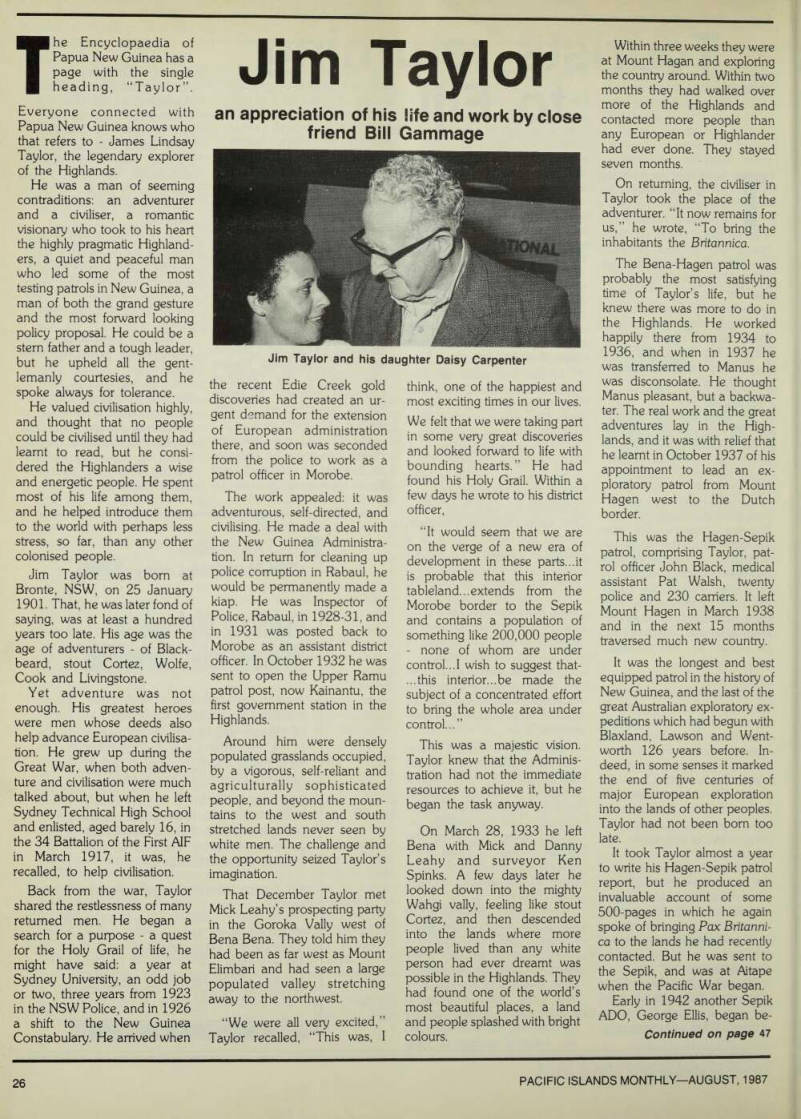
Jim Taylor and his daughter Daisy Carpenter
having strangely and Taylor was sent to relieve him. At Ambunti, Taylor’s party was ambushed by Ellis and his police. Taylor was wounded and the party retreated downriver. Two days later they returned with reinforcements, finding that Ellis had shot him self.
For the rest of the war, Taylor was a major in the Australian New Guinea Administrative Unit, behind the Japanese lines in the Sepik, in the Highlands, or on policy work in Port Moresby or Australia.
With the war won, he was appointed director of native labour in the provisional Civil Administration of the newly unified Papua New Guinea.
This was a senior post at a critical and much neglected time in Papua New Guinea affairs and Taylor played his part in resisting European ex ploitation of Papua New Gui neans.
But he yearned for the High lands and in November 1946 stepped down to become dis trict officer in charge of the Central Highlands. The district ran from Kainantu in the east to Lake Kutubu in the south and Telefomin in the west - virtually the whole of the Highlands which Taylor had urged should be brought under control in 1932. He could refer to it as a kingdom, could think of High landers as a kind of medieval aristocracy, and no doubt saw his new job as the consumma tion of his life’s work.
But in 1947 he was sus pended and reprimanded, un fairly he thought, for inade quately supervising a patrol officer, and increasingly he grew impatient with desk work.
In 1949 he quit the Adminis tration and soon after married Yerima Manamp of Kerowil, a strong and gracious lady whom he thought the epitome of everything beautiful about the Highlands and who was the rock of his life for the next 40 years.
Taylor developed various
business interests, in cattle and in trade stores and gold dreg ding at Porgera, but his chief and longest interest was a cof fee plantation just west of Goro ka. There his family lived for over 30 years, and there on June 28 last Taylor died. He was 86. He left Yerima, two daughters, Daisy and Meg, a son, Jason, and thousands of friends and admirers.
Jim Taylor was a brave, tough, quiet and resourceful man. He was an outstanding explorer, a pioneer in using the aeroplane and the wireless in exploratory work, a Fellow of the Royal Geographical So ciety, an innovative administra tor, a courtly host, an instinctive romantic, and a friend of the Highlanders.
Perhaps uniquely among Europeans of the 19305, he greeted Highlanders by name, as friends, instead of by nick name or by no name at all His last adventure was to look toward to the day when Highlanders would share equal ly his civilisation. In December 1985, when his memory and his powerful intelligence were fading fast, he confused sub urban Adelaide with Goroka and stood amazed at the or dered rows of houses, the streets and parks, the busy traffic. “It’s wonderful” he ex claimed, “In only fifty years It’s wonderful how far they have come Splendid” Then he paused. “Mind you, I always knew they would.”
Goodbye Jim. You were a true friend, and a great man
Jim Taylor(right) with Murray
Edwards at Mt Hagen, 1938- Photo John Black