Drastic steps taken on Fiji
pp. 22-24 · Read in the full issue
economy
Fiji is heading for econo mic ruin and disaster as the country’s foreign re serves decline and its main export crop faces un certainty. The interim govern ment which took over after the military coup on May 14 has already devalued the Fiji dollar by 17.75 per cent as the first measure to prop up the declin ing foreign reserves, and the civil servants are to take a pay cut of up to 25 per cent to bring about a saving of Fsso million in expenditure.
On May 14, the day of the military takeover by Colonel Sitiveni Rabuka and his men, Fiji’s foreign reserves stood at Fsl7o million. On June 29 they were down to $ll3 million and it was then that the Governor of the Reserve Bank, Mr Savena ca Siwatibau, ended the six
week long speculation of when and by how much the Fiji dollar was to be devalued. Everyone expected a devaluation in the Fiji dollar after the military coup but most financial experts, in cluding the banks, were looking at 10 to 15 per cent devalua tion.
In announcing the devalua tion, Mr Siwatibau, who is also the adviser on economic affairs
to the Governor-General Ratu Sir Penaia Ganilau’s interim government, said “It was un avoidable under the circumst ances”.
Circumstances in Fiji, both politically and economically, are now very different from those during the pre-coup period. Instead of a strong democratically-elected govern ment in office, the country is
run by the governor-general with the help of a team of advisers. There is no solution in sight to end the political stale mate, bringing back the confi dence the country had enjoyed prior to the coup.
The first meeting of the spe cial committee set up to redraft the country’s Constitution was boycotted by deposed Prime Minister, Doctor Bavadra, and three of his former Cabinet Ministers. The chairman of the committee, Sir John Favley, has said that the presence of Doctor Bavadra and the three ministers is essential for the group to achieve a meaningful consensus. Coup leader, Colonel Rabuka, has also im posed strict security at airports to prevent the importation of weapons. He said there were fairly good grounds to believe attempts may be made to im port weapons and the increased security was justified. All this political uncertainty has direct bearing on the Fijian economy.
Fiji’s tourist industry the second most important sector in terms of foreign exchange ear nings stands to lose millions of dollars through cancelled bookings because of negative publicity about Fiji abroad. The projection for 1987 was 287,000 visitors with a potential foreign exchange earning in excess of Fs2oo million. How ever with the massive dollar devaluation, extensive market ing efforts and low fares special ly for Australian and New Zea land visitors, the industry hopes to recover much of the lost ground over the next six months.
But the real concern is over the number one foreign ex change earner, sugar. Sugar is the backbone of Fiji’s economy.
Sugar accounts for about 15 per cent of gross domestic
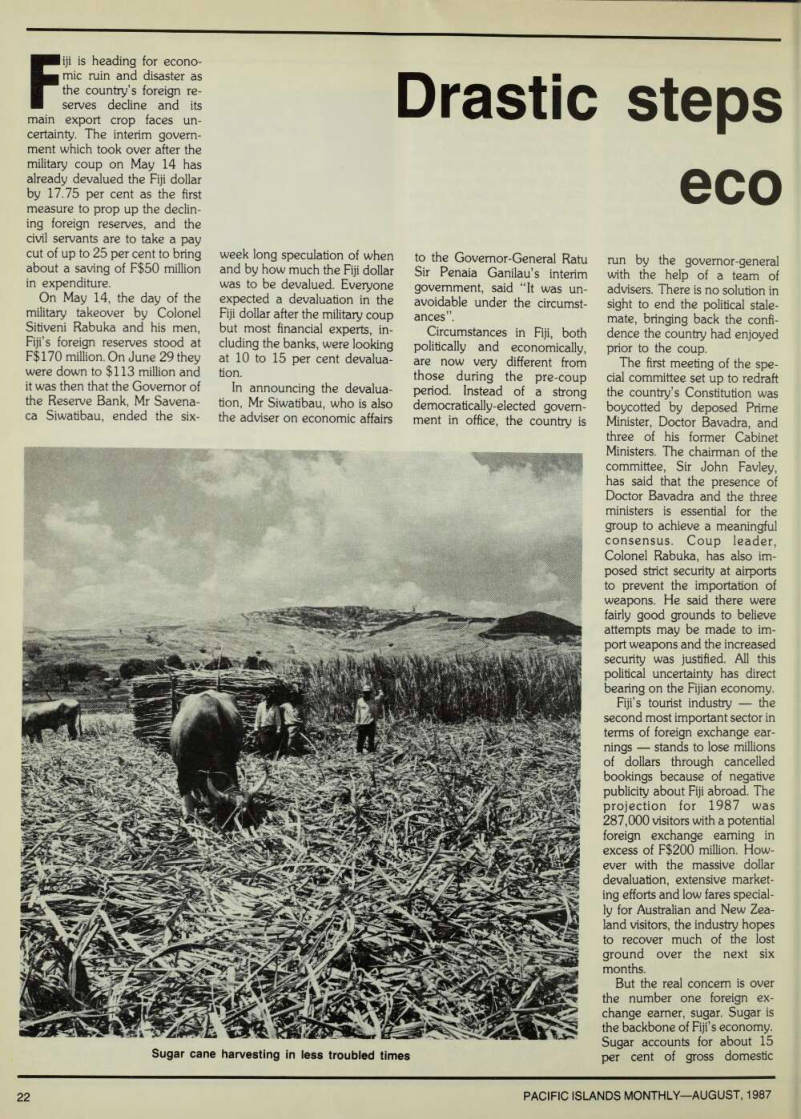
Sugar cane harvesting in less troubled times
product, 60 per cent of total exports and about 25 per cent of the labour force is engaged in sugar-related activities. Ear nings from this year’s sugar crop were forecast at around $2OO million. However, with the present situation, where harvesting has been delayed by three months, the loss in re ceipts may be anywhere be tween $3O-50 million.
Despite persuasion by the governor-general and the Fiji Sugar Corporation, Indian cane farmers, who make up more than 70 per cent of the growers, have refused to harvest their crop in protest against the over throw of the Bavadra govern
ment by the military. Two sugar mills, one at Labasa in the island of Vanua Levu and the Penang Mill on the main island of Viti Levu, began crushing in the last week of June and the beginning of July but only Fijian cane farmers and some Indian farmers supplied cane to the mills. The crushing program could not be maintained and the mills had to close down on several occasions. Finally the Fiji Sugar Corporation announced a shut off of the two mills till the end of July.
It was only after the sugar harvesting and crushing prog ram that the devaluation of the Fiji dollar was announced.
Observers feel that the sugar crushing was the key factor in determining the action of the Reserve Bank and, had the crushing continued without disruption and opposition from Indian cane farmers, Mr Siwati bau would have gambled to keep the Fiji dollar at its former levels. They point out that Fiji’s foreign reserves have reached more critical levels in the past and then the Reserve Bank had not seen fit to devalue the dollar. However, in this inst ance, there is no guarantee that sugar receipts will be released, hence the massive devaluation as a precaution.
The collapse of the industry
will affect every other area of the economy. Last year Fiji earned just under $l3B million from sugar exports amounting to 54 per cent of the value of all exports. In 1984 Fiji’s foreign reserves hit the all-time low of $75 million and this year in January it was a record high of $196 million. Mr Siwatibau said normally “Our foreign reserves are low in the first half of the year and pick up in the second half but this time we are just draining out with no signs of picking up”.
The 17.75 per cent devalua tion is largest in Fiji’s history.
The last devaluation was 5 per cent which was effected be tween April and May last year.
The closure of the mills and cessation of the cane harvesting for a month is designed to give the governor-general breathing space and enough time to bring about a peaceful solution to the political problem the country is facing. Ratu Sir Penaia Ganilau has already announced a con stitutional review committee which is to meet and prepare a report by the end of July.
Sugar and sugar alone holds the key to Fiji’s economic prob lems. A return to normal within the sugar sector is crucial for the recovery of the whole eco nomy. It not only has direct consequences for income and employment in the sugar in dustry itself, but also has negative multiplier effects on the rest of the economy.
Devaluation was not the only measure announced by the Re serve Bank which is designed to contain and maintain Fiji’s fore ign reserves at an acceptable level. The bank also put into effect other measures to put a stop to the drain on Fiji’s foreign reserves.
Fiji citizens can no longer invest overseas. Previously, Fiji residents were allowed to invest $5,000 per year overseas. Also those who have investments abroad may be asked to realise them and switch the proceeds from foreign currencies to Fiji dollars.
Fiji citizens who emigrate now face a restriction on the amount of money they can take with them. The head of the family is allowed only $4,000 and each dependant $2,000.
Mr Siwatibau said those who emigrate would be allowed to buy foreign exchange in “tren ches”, the first trenche upon departure, the balance to be purchased as soon as the situa tion improved sufficiently. Up to 1976, those who emigrated were also restricted and were allowed to convert their Fiji dollars over a period of three years, but since then there has been no restriction. Fiji resi dents were allowed to convert their Fiji dollars into foreign currency even before depar ture.
Despite these tight new con trols, large leakages of money are suspected. The Reserve Bank is investigating reports that a number of buisnessmen have managed to send hun dreds-of-thousands of dollars out of the country, with the gift system being used to get money to overseas relatives.
The Governor of the Reserve Bank also announced changes to its stance on monetary poli cy. “The easy money policy of 1986 and the first half of 1987
has been changed. The mini mum rate was raised from 8 per cent to 9 per cent” he said. Mr Siwatibau said the statutory re serve deposit (for trading banks) would be increased from five per cent to six per cent by the end of July. The outlook for Fiji’s balance of payments situation is bleak, Reaction to the Fiji dollar devaluation from business and commerce was mixed. The tourist, travel, hotel sectors and the main exporters such as pine, gold, ginger, fish and others welcomed the move but the consumers and importers described it as a blow to their livelihood.
Leading economists said de valuation will mean a rise of up to 18 per cent in the rate of inflation and a massive increase in unemployment. They pointed out that imported items will now cost up to 20 per cent more. Fiji’s dollar is tied to a basket of five currencies ... its main trading partners: Austra lia, New Zealand, Japan, Un ited States and Britain.
On the plus side tourism will recover and bring in more receipts and, if and when sugar crushing begins, it will also bring in 18 per cent more revenue. Reacting to comments regarding higher prices for im ported goods, Mr Siwatibau said the objective of the de valuation was also to make the consumers switch to locally produced goods. However some Fiji made products de pend highly on imported ingre dients as such will also reflect increased costs.
Analysts say while tourists, specially Australians and New Zealanders, will find a Fiji holi day much cheaper, the cost of food and travel in Fiji will increase.
Overseas investors will also get a better value for their money in Fiji but they doubt whether a devaluation will act as a sufficient incentive for foreign investors because politi cal stability and confidence in a country’s overall economic structure play a bigger part in deciding where investments should be made.
They feel that Fiji will not attract foreign investors over
night but definitely it was a positive move.
However, for most businesses, the dollar devalua tion is seen as the “last straw”.
Since the coup, the building and construction industry has come to a virtual standstill.
Traders of luxury consumer items and those dealing exclu sively for the tourist market have reported drop in sales of up to 90 per cent. Now the devaluation will virtually cripple them.
The transport industry is ex pecting an increase of up to 20 per cent in the price of fuel, spare parts and tyres. Petrol without the devaluation costs 62 cents per litre in Fiji while diesel costs 40 cents a litre.
Wholesalers and importers ex pect a 20 per cent jump in the price of imported food. They say while the devaluation is 17.75 per cent other accumula tive costs will mean a 20 per cent increase.
The government has already moved to bring the distribution of imported goods and essential foods under its control, with plans afoot to upgrade the National Marketing Authority.
The expanded authority will attempt to break down present importer monopolies, counter the ban on Fiji imports by Australia and New Zealand, and open up new trade oppor tunities. The govemmemt is also considering increasing the duty on goods imported from Australia and New Zealand. As well, a relaxation of immigra tion laws to allow Chinese buisnessmen to enter and establish buisnesses in Fiji is on the drawing board. The timber industry is another sector ex ploring new markets, although considerable effort is being brought to bear to re-open old doors. The government also hopes anew copra pricing for mula will lead to an increase in the production of copra, Fiji’s fifth largest foreign exchange earner.
For the average worker, be he a civil servant or engaged in the private sector,the future looks grim, with the chairman of the Fiji Council of Social Services, Pastor Aisak Kabu, suggesting that the National
Emergency Services Commit tee be revived to monitor the situation and co-ordinate relief assistance.
Firstly, the country is going through a period of political uncertainty. Its main export crop is not being harvested.
The long spell of drought has already had its toll on the sugar crop and a delay will mean a further reduction in the yield of sugar.
The dollar has been de valued which effectively means a reduction of 20 per cent in its purchasing power.
And now a worker faces the prospect of a 20 to 25 per cent pay cut and, if the situation doesn’t improve, loss of employment or part-time employment. Most commercial firms have already started a shorter working week or are planning such a move. Business transactions in every sphere of activity, be it radio advertisting or hardware sales, have taken a nosedive. Temporary and casual staff have been laid off and permanent staff are work ing on the basis of week on, week off. Statutory bodies such as the National Airline, Air Pacific, the national radio sta tion, Radio Fiji and the Fiji Electricity Authority have all announced a reduction in their services and shorter working week for staff.
The Army has already announced a voluntary pay cut of 20 per cent for its men which the military says will bring in a saving of $5 million per annum.
Government services have been cut by 20 per cent and a 25 per cent pay cut across the board for the civil servants is expected to save $5O million per year.
But the question being posed by observers is will this be enough? There are no definite signs of any recovery. Pessim ists paint a gloomy picture with predictions of a further devalua tion of the Fiji dollar and an other pay cut for all civil ser vants and other workers. They talk of starvation and civil un rest. But the optimist still sees light at the end of the tunnel and the flicker of flame is the sugar industry!—