Foreign profile
pp. 19-21 · Read in the full issue
New Zealand elections Foreign profile to change
New Zealand’s distinctive foreign profile of the last three years, particularly in the Pacific, is sure to change whatever the outcome of the August 15 general elec tions. A restored Labour gov ernment would face the end of its political dream ride courtesy of New Zealand’s anti-nuclear affair. A new National govern ment would bring a lurch to the right and a familiar face, that of Sir Robert Muldoon, to the foreign affairs portfolio.
After its July 1984 snap elec tion victory, the Labour Gov ernment shied off the call for nuclear-free legislation, prefer ring the “trust me” policy out lined by the Prime Minister, Mr David Lange. But Labour warmed to the idea and the resulting bullying by the United States and plaudits from around the world convinced the politicians that nuclear-free was bolstering the party’s domestic support. The anti-nuclear legislation was finally passed this year. In the meantime, the United States had unilaterally suspended New Zealand from ANZUS and Britain refused to let New Zealand take part in naval exercises for fear of anti nuclear contamination. The ANZUS fracas caused a few shaky moments for some of the more conservative Pacific gov ernments. New Zealand itself went through the unpre cedented questioning of what defence was desirable. The legislation drew 1500 submis sions. A defence review inquiry drew another 5000. New Zea land’s military was vocal with dire warnings about cuts in defence and intelligence capa bilities.
The cuts were quite real. In 1984 the army spent 10,000 man hours exercising with the
United States military. In 1983 to 1984, New Zealand frigates spent more than 70 days at sea exercising within ANZUS and the airforce spent 200 days overseas exercising with Amer ican forces. All this went by the board and yet the 1985 Budget gave no real increase in defence spending to bolster New Zea land’s military training.
The Labour Government de cided to focus New Zealand’s defence on the South Pacific rather than fighting within a larger and probably nuclear capable force. So in 1986, the military staged counter-in surgency exercises in the Cook Islands. This year they were due to be held in Fiji, but the May 14 coup intervened. New Zealand also called back its 700-strong battalion in Singa pore to upgrade the 1500member Ready Reaction Force.
New Zealand has also begun the search for new military training partners and suppliers.
Australia will supply specially designed naval vessels to re
place New Zealand’s ageing frigates and meet Mr Lange’s aim of a blue water navy.
The Fiji coup brought cold reality into Labour’s plans for a new low-key defence strategy designed to counter exactly that kind of regional threat. It is a moot point whether New Zea land could have done anything about the coup even with a blue water navy or an alert RRF. New Zealand has since suspended military ties with Fiji, once a significant source of training and wargaming for New Zealand officers and sol diers.
The next Labour govern ment would not be able to rest on its anti-nuclear laurels. It plans a Minister for Disarma ment, presumably to work on United Nations arms control resolutions and the South Paci fic Nuclear Free Zone. But the military is restless and enough New Zealanders are still con cerned about the absence of ANZUS to make it necessary for Labour to seek out new de fence links. New Zealand is still
a member of the five power defence pact and could in crease its defence training with Malaysia or Singapore. Labour will also have to make some hard decisions on whether to increase defence spending to compensate for loss of mates rates equipment purchasing from America and fill the gaps in military training left by
Anzus.
New Zealand has stepped up its air force surveillance flights, particularly to help countries like the Solomons and Kiribati keep an eye out for tuna poachers in their exclusive eco nomic waters. But Pacific na tions will be wondering if the next Labour government might adopt a more active military profile in the islands to prove it is not a defence wimp, the disgrace of the Western allied club.
A new National government would try to get New Zealand back into the club. It wants to reinforce New Zealand’s de fence ties with old allies like America, Britain and Australia.
National wants to put New Zealand back in ANZUS and has come up with a tepid anti-nuclear policy to satisfy the Americans as well as the strong anti-nuclear public sentiment.
National proposes to trust America and Britain not to bring nuclear vessels into New Zealand ports. This is the old Nelsonian National policy of the Muldoon era. But National’s new leader, Mr Jim Bolger, will go a step further by promising to state clearly to New Zea land’s nuclear allies that New Zealand does not want any nuclear weapons in Kiwi waters. Nuclear powered ves sels would be okay. National believes this policy would not challenge the neither confirm
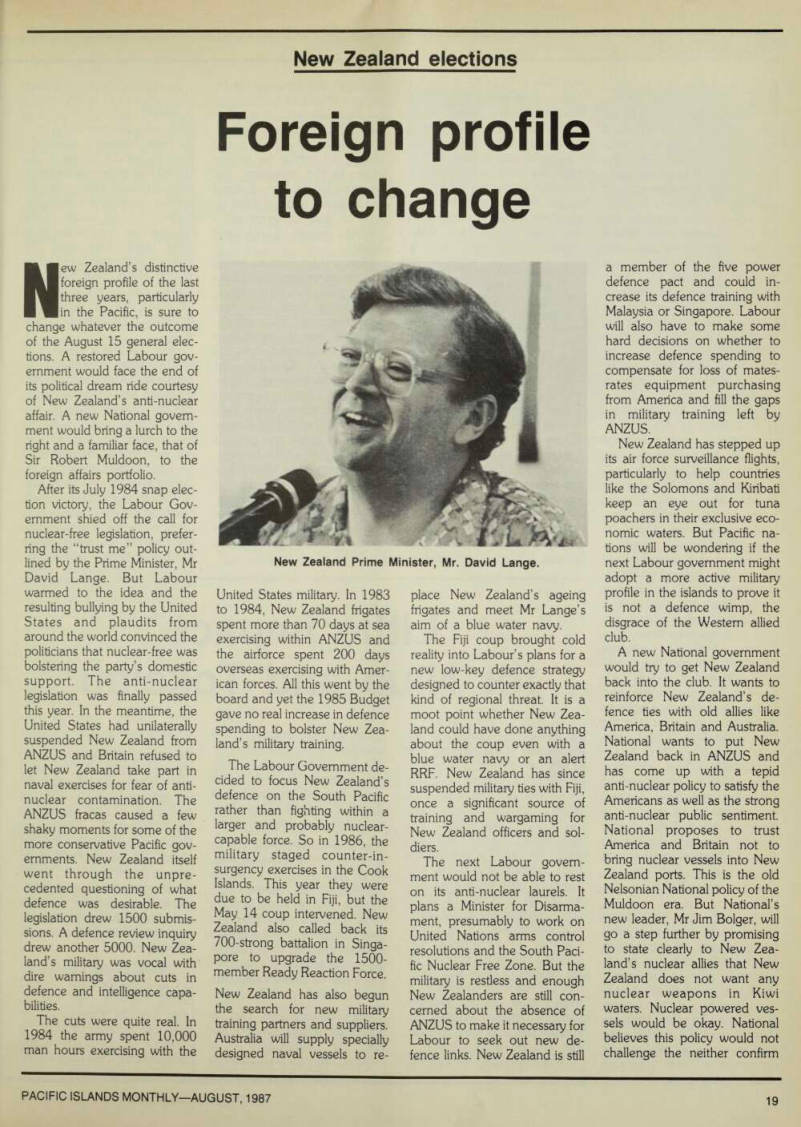
New Zealand Prime Minister, Mr. David Lange.
nor deny policy of the United States.
Most commentators give the new policy little chance of succeeding in restoring New Zealand to ANZUS. First, the nuclear free law would prob ably have to be repealed amid loud public protests. Second, the policy virtually insists that the United States never send a nuclear ship to New Zealand, a contradiction of the whole neith ix confirm nor deny strategy. Third, the National policy precludes New Zealand from saying no, leaving no room for escape if America does send a ship which most sources list as nuclear-capable.
Finally, the United States is unlikely to agree to such a policy overtly by reinstating New Zealand in ANZUS be cause to do so might encourage Australia to get tougher on nuclear vessels to satisfy anti nuclear sentiment in that coun try. However, America might relent enough to let New Zea land back into the sand pit to play with the boys. It remains to be seen whether resumption of joint military training would di lute New Zealand’s new interest in the Pacific or whether that course is already entrenched.
In a more general sense, New Zealand is unlikely to overcome its tendency to play the omnis cient referee in the South Paci fic, blowing the whistle and chewing out players whenever someone steps too far over the line. In the midst of the Libyan scare earlier this year, Vanuatu’s Prime Minister, Father Walter Lini, described Australian and New Zealand neocolonialism as one of the grave threats to South Pacific security, along with the French.
A new National government would change that only by degree, most likely for the worse.
Mr Lange has not proven himself to be adept at making foreign policy on the run; in fact, the only thing that runs is his mouth. Kanaks and French loyalists alike still chortle some what derisively at the memory of Mr Lange flying into Noumea shortly after the July 1984 snap election win to tell the fractious Kanaks to get back talking to
the French. One Pacific leader later commented that one reason why the South Pacific Forum was keen to set up a ministerial committee on New Caledonia was to curb with a little education Mr Lange’s en thusiasm for leaping into the big issues. Now foreign affairs staff say there is little Mr Lange does not know about New Cale donia.
Another faux pas in the early days of the Lange regime was his condemnation of Kiribati’s President, Mr leremia Tabai, for courting the Soviet Union for a fishing deal. Mr Lange con veniently forgot New Zealand does nicely from a similar pact.
He changed his tune several weeks later when Mr Tabai arrived to brief Mr Lange on the fishing deal. To his credit, Mr Lange has proven quite san guine about Libyan overtures in the region. But the same could not be said of his response to the Fiji coup. Not only did it betray an outrageous lack of understanding of indigenous politics, principles not withstan
ding, but the virulence of Mr Lange’s attacks have effectively cut New Zealand off from its major Pacific trading partner.
The Fijians are outraged and unlikely to forgive for a long while. In the meantime, the vaccuum left by New Zealand and Australia is being filled by America and its shopfronts - Taiwan, South Korea and Japan.
Most Forum Nations tacitly understood or approved of the coup’s goals, if not the method of achieving them. New Zea land’s response further empha sised the gap in perceptions between the Island nations and New Zealand. Certainly, the Kanak independence move ment and its Forum supporters must be wondering where New Zealand will baulk if the Kanaks choose an active and perhaps violent boycott of the Septem ber independence referendum in New Caledonia. But while the Pacific leaders take a quizzi cal view of Mr Lange’s verbal gyrations, their response to a new National government would be much cooler.
As prime minister, Sir Robert Muldoon was acclaimed fondly by New Caledonia’s loyalists as their only supporter in the Paci fic. New Zealand’s role in the New Caledonia debate at the United Nations would be much more subdued than under the Labour Government. Similarly, support for the South Pacific Nuclear Free Zone would be in word rather than deed. Mr Bolger’s performances so far on foreign affairs have been col ourless and as prime minister he would probably defer to Sir Robert’s considerable experi ence.
New Zealand’s rating with Pacific nations is not likely to be helped by National’s decision to let South Africa reopen its dip lomatic mission, although this would not be a priority for the new government. Such a diver sion from Commonwealth unity on South Africa as well as Sir Robert’s reputation for behav ing like a rogue elephant and crushing fragile consensus when he is out of sorts would see New Zealand drop several notches in Forum estimation.
The population outflow which was already on a large scale before 1974 had not been stemmed. “Niue has become critically vulnerable as a living community,” the review con tinued. “Dependence on eco nomic and administrative assist ance from New Zealand con tinues to increase as Niue strives to provide a standard and quality of life geared to wards stemming the outflow of population. The fact of a grow ing Niuean community in New Zealand has set up an in-built, self-generating momentum for emigration - chain migration.”
The review recommended that to maintain a living com munity on Niue and avoid the loss of self-respect and self reliance, New Zealand and Niue should promote economic development. It cautions the Niue Government to get on with practical projects to in crease jobs on the island rather than seeking endless overseas reports on schemes. It also suggests cuts in Niue’s public service, which comprises 80 per cent of the paid workforce. But the review stressed that promo tion of economic self-reliance should not be the main purpose of New Zealand’s $7 million annual aid. Rather it should be to improve the living standard of Niueans. New Zealand aid, which provides about 90 per cent of Niue’s budget, should also be kept separate from other aid allocated triennially to improve economic planning and not be reduced at least until life on Niue is of a similar standard to New Zealand. The review called for an urgent look at transport and a guaranteed seafreight link: Air Nauru only operates a weekly return 737 flight to Auckland.
The report was welcomed on both sides and and has led to several profitable official discus sions in New Zealand and Niue.
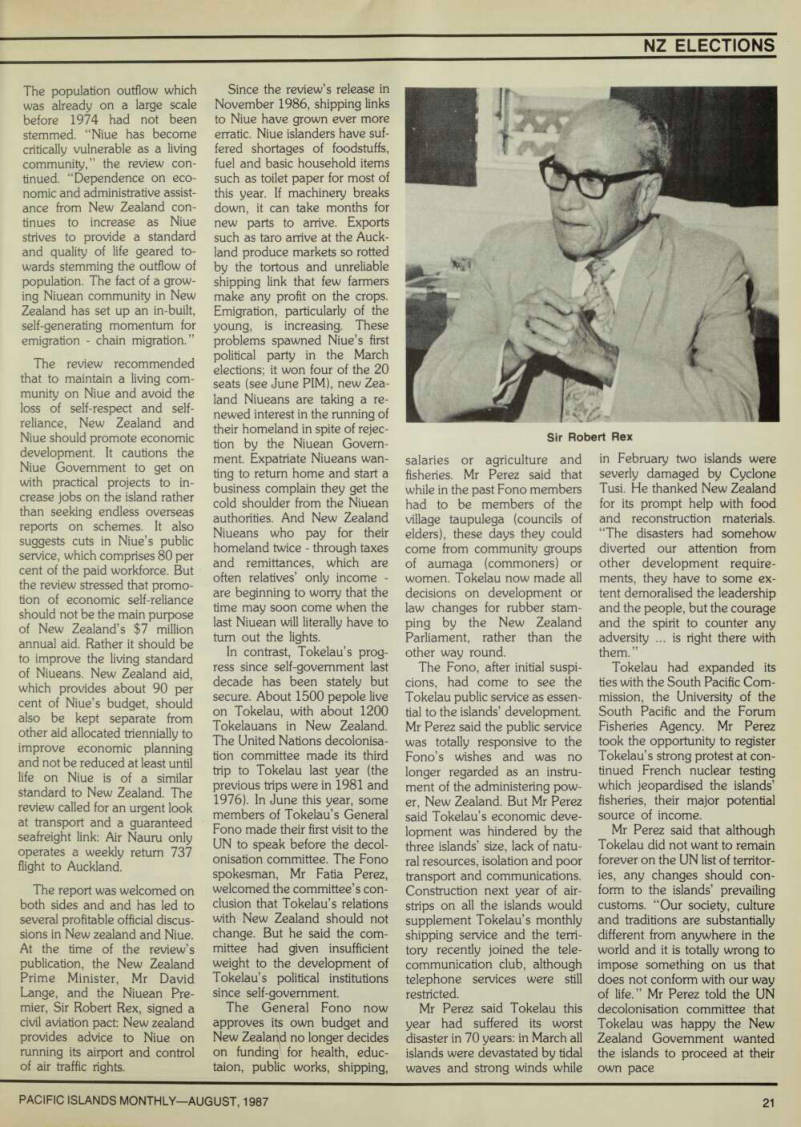
At the time of the review’s publication, the New Zealand Prime Minister, Mr David Lange, and the Niuean Pre mier, Sir Robert Rex, signed a civil aviation pact: New Zealand provides advice to Niue on running its airport and control of air traffic rights.
Since the review’s release in November 1986, shipping links to Niue have grown ever more erratic. Niue islanders have suf fered shortages of foodstuffs, fuel and basic household items such as toilet paper for most of this year. If machinery breaks down, it can take months for new parts to arrive. Exports such as taro arrive at the Auck land produce markets so rotted by the tortous and unreliable shipping link that few farmers make any profit on the crops.
Emigration, particularly of the young, is increasing. These problems spawned Niue’s first political party in the March elections; it won four of the 20 seats (see June PIM), new Zea land Niueans are taking a re newed interest in the running of their homeland in spite of rejec tion by the Niuean Govern ment. Expatriate Niueans wan ting to return home and start a business complain they get the cold shoulder from the Niuean authorities. And New Zealand Niueans who pay for their homeland twice - through taxes and remittances, which are often relatives’ only income are beginning to worry that the time may soon come when the last Niuean will literally have to turn out the lights.
In contrast, Tokelau’s prog ress since self-government last decade has been stately but secure. About 1500 pepole live on Tokelau, with about 1200 Tokelauans in New Zealand.
The United Nations decolonisa tion committee made its third trip to Tokelau last year (the previous trips were in 1981 and 1976). In June this year, some members of Tokelau’s General Fono made their first visit to the UN to speak before the decol onisation committee. The Fono spokesman, Mr Fatia Perez, welcomed the committee’s con clusion that Tokelau’s relations with New Zealand should not change. But he said the com mittee had given insufficient weight to the development of Tokelau’s political institutions since self-government.
The General Fono now approves its own budget and New Zealand no longer decides on funding for health, educ taion, public works, shipping,
salaries or agriculture and fisheries. Mr Perez said that while in the past Fono members had to be members of the village taupulega (councils of elders), these days they could come from community groups of aumaga (commoners) or women. Tokelau now made all decisions on development or law changes for rubber stam ping by the New Zealand Parliament, rather than the other way round.
The Fono, after initial suspi cions, had come to see the Tokelau public service as essen tial to the islands’ development.
Mr Perez said the public service was totally responsive to the Fono’s wishes and was no longer regarded as an instru ment of the administering pow er, New Zealand. But Mr Perez said Tokelau’s economic deve lopment was hindered by the three islands’ size, lack of natu ral resources, isolation and poor transport and communications.
Construction next year of air strips on all the islands would supplement Tokelau’s monthly shipping service and the terri tory recently joined the tele communication club, although telephone services were still restricted.
Mr Perez said Tokelau this year had suffered its worst disaster in 70 years: in March all islands were devastated by tidal waves and strong winds while
in February two islands were severly damaged by Cyclone Tusi. He thanked New Zealand for its prompt help with food and reconstruction materials.
“The disasters had somehow diverted our attention from other development require ments, they have to some ex tent demoralised the leadership and the people, but the courage and the spirit to counter any adversity ... is right there with them.”
Tokelau had expanded its ties with the South Pacific Com mission, the University of the South Pacific and the Forum Fisheries Agency. Mr Perez took the opportunity to register Tokelau’s strong protest at con tinued French nuclear testing which jeopardised the islands’ fisheries, their major potential source of income.
Mr Perez said that although Tokelau did not want to remain forever on the UN list of territor ies, any changes should con form to the islands’ prevailing customs. “Our society, culture and traditions are substantially different from anywhere in the world and it is totally wrong to impose something on us that does not conform with our way of life.” Mr Perez told the UN decolonisation committee that Tokelau was happy the New Zealand Government wanted the islands to proceed at their own pace
Sir Robert Rex