Pacific stamp box
p. 52 · Read in the full issue
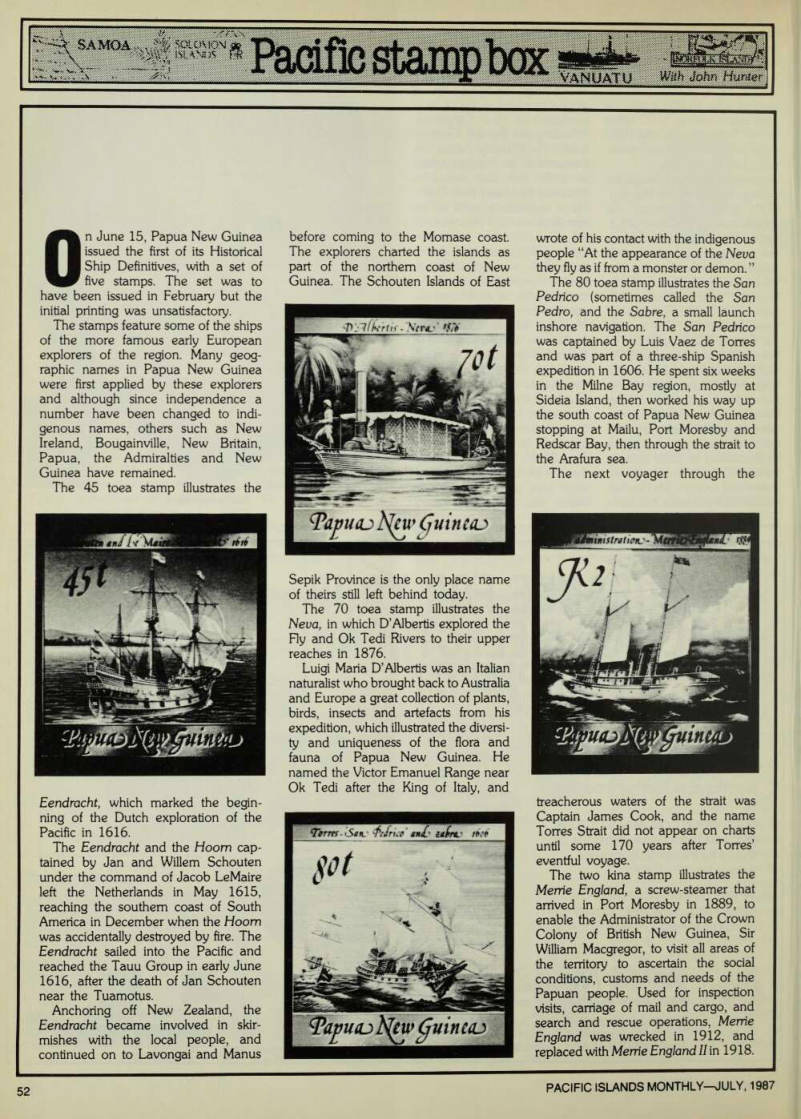
On June 15, Papua New Guinea issued the first of its Historical Ship Definitives, with a set of five stamps. The set was to have been issued in February but the initial printing was unsatisfactory.
The stamps feature some of the ships of the more famous early European explorers of the region. Many geog raphic names in Papua New Guinea were first applied by these explorers and although since independence a number have been changed to indi genous names, others such as New Ireland, Bougainville, New Britain, Papua, the Admiralties and New Guinea have remained.
The 45 toea stamp illustrates the
Eendracht, which marked the begin ning of the Dutch exploration of the Pacific in 1616.
The Eendracht and the Hoom cap tained by Jan and Willem Schouten under the command of Jacob LeMaire left the Netherlands in May 1615, reaching the southern coast of South America in December when the Hoom was accidentally destroyed by fire. The Eendracht sailed into the Pacific and reached the Tauu Group in early June 1616, after the death of Jan Schouten near the Tuamotus.
Anchoring off New Zealand, the Eendracht became involved in skir mishes with the local people, and continued on to Lavongai and Manus
before coming to the Momase coast.
The explorers charted the islands as part of the northern coast of New Guinea. The Schouten Islands of East
Sepik Province is the only place name of theirs still left behind today.
The 70 toea stamp illustrates the Neva, in which D’ Albertis explored the Fly and Ok Tedi Rivers to their upper reaches in 1876.
Luigi Maria D’Albertis was an Italian naturalist who brought back to Australia and Europe a great collection of plants, birds, insects and artefacts from his expedition, which illustrated the diversi ty and uniqueness of the flora and fauna of Papua New Guinea. He named the Victor Emanuel Range near Ok Tedi after the King of Italy, and
wrote of his contact with the indigenous people “At the appearance of the Neva they fly as if from a monster or demon. ”
The 80 toea stamp illustrates the San Pedrico (sometimes called the San Pedro, and the Sabre, a small launch inshore navigation. The San Pedrico was captained by Luis Vaez de Torres and was part of a three-ship Spanish expedition in 1606. He spent six weeks in the Milne Bay region, mostly at Sideia Island, then worked his way up the south coast of Papua New Guinea stopping at Mailu, Port Moresby and Redscar Bay, then through the strait to the Arafura sea.
The next voyager through the
treacherous waters of the strait was Captain James Cook, and the name Torres Strait did not appear on charts until some 170 years after Torres’ eventful voyage.
The two kina stamp illustrates the Merrie England, a screw-steamer that arrived in Fort Moresby in 1889, to enable the Administrator of the Crown Colony of British New Guinea, Sir William Macgregor, to visit all areas of the territory to ascertain the social conditions, customs and needs of the Papuan people. Used for inspection visits, carriage of mail and cargo, and search and rescue operations, Merrie England was wrecked in 1912, and replaced with Merrie England II in 1918.