Nihau shell leis a class
pp. 47-48 · Read in the full issue
of their own
Ni’ihau Shell Leis. By Linda Paik Moriarty. Published by University of Hawaii, Honolu lu, 1986. 104 pp. ISBN 0-8248- 0998-X. U 5539.95.
The lei is the most popular souvenir for more than four million tourists who visit Hawaii every year. Common shells, plastic beads, wooden beads, magnificent orchids, fragrant frangipani, flowers fresh and plastic are all threaded and twisted into garlands worn by tourists and locals alike. Millions of leis hang in shops; children hawk them around the streets; tour companies place them around the necks of arriving tourists; shop assistants; wait resses, barmen, office staff and taxi drivers can be seen wearing
them. The lei is symbolic of Hawaii.
But Ni’ihau shell leis are in a class all of their own. Only the very discerning visitor will leave Hawaii with one of these, their price being a very inhibiting factor. Ni’ihau shell leis have been known to change hands for several thousands of dollars.
Linda Paik Moriarty writes that the most well known visitor of all, Captain Cook, collected several which now grace the British Museum. In the late 1800 s, Hawaiian royalty, adap ting the Victorian fashions of the day, wore long strands of ivory coloured ni’ihau leis with their stiff taffeta gowns. Nearly one hundred years later, in post World War II Hawaii, fashion again brought the leis to the
attention of those who followed its dictates, The informal “aloha style” revived the wearing of leis and the people of Ni’ihau began marketing their product on a definite commercial basis.
As tourism rapidly increased to the Hawaiian Islands, so did the demands for leis. During the 1970 s lei production reached the masses as the puka shell, (worn down cone shell) jewel lery became almost a national craze. While this rush of pro duction established a low cost commodity, it also helped to elevate the status of the high quality Ni’ihau product. On 1 March, 1968, the final seal of approval was given to the wear ing of leis when the State House of Representatives announced that Friday was to be known in future as Aloha Friday when the woman of the business district of downtown Honolulu would be encouraged to wear the distinctive muu muu as a display of state pride.
The wearing of a good quality
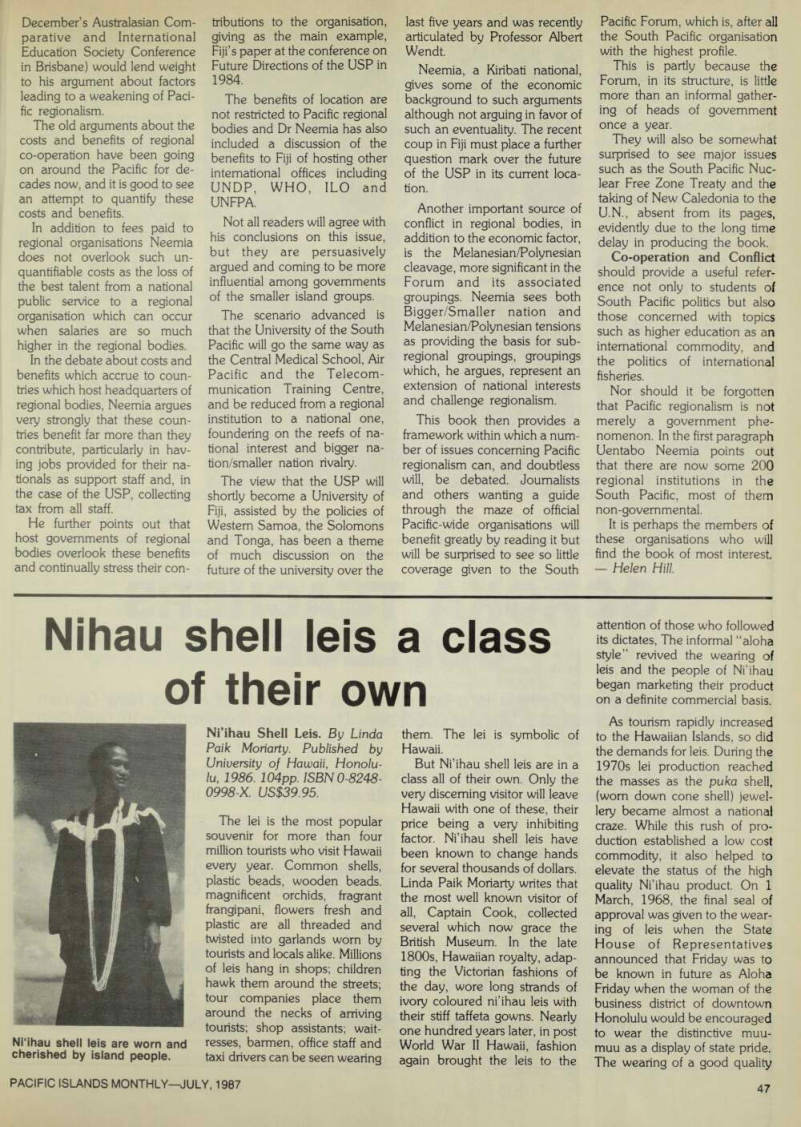
Ni‘ihau shell leis are worn and cherished by island people.
Ni’ihau lei as an accessory is now a status symbol.
Ni’ihau leis are distinctive because of the very tiny shells from which they are made.
While these shells are found in many other Pacific Islands it is on Ni’ihau that they are found in such abundance. To the layman they are tiny shells ranging in colour from pure white through to ivory, grey, yellow and red with many variations in between. To the conchologist they are shells from the families turbinidae, strombidae, cypraeidae, col umbellidae, architectonidae, melampidae and pectinidae.
The islanders collect only shells which have been vacated by their sea snail tenants during the winter months. Thousands of the tiny shells are required for one long multi-stranded lei, the most popular design, but twice as many must be col lected because up to fifty per cent will be wasted during pre paration for threading. Shells are graded for colour, size, lustre and presence of flaws and then a selection is made accor-
ding to the style and quality of lei to be made.
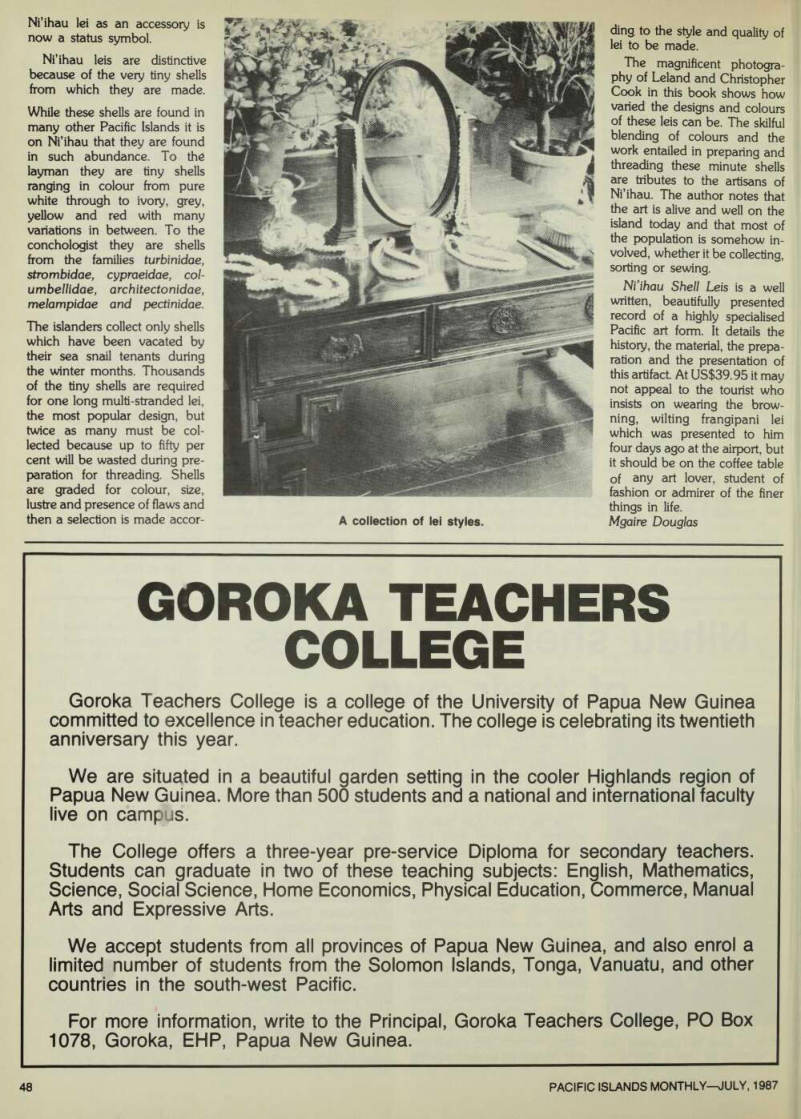
The magnificent photogra phy of Leland and Christopher Cook in this book shows how varied the designs and colours of these leis can be. The skilful blending of colours and the work entailed in preparing and threading these minute shells are tributes to the artisans of Ni’ihau. The author notes that the art is alive and well on the island today and that most of the population is somehow in volved, whether it be collecting, sorting or sewing.
Ni’ihau Shell Leis is a well written, beautifully presented record of a highly specialised Pacific art form. It details the history, the material, the prepa ration and the presentation of this artifact. At U 5539.95 it may not appeal to the tourist who insists on wearing the brow ning, wilting frangipani lei which was presented to him four days ago at the airport, but it should be on the coffee table of any art lover, student of fashion or admirer of the finer things in life.
Mgaire Douglas
A collection of lei styles.