Another South Pacific
pp. 25-42 · Read in the full issue

headache for France
Le Monde’s specialist writer on French territories Alain Rollat writes for PIM on political developments French Polynesia.
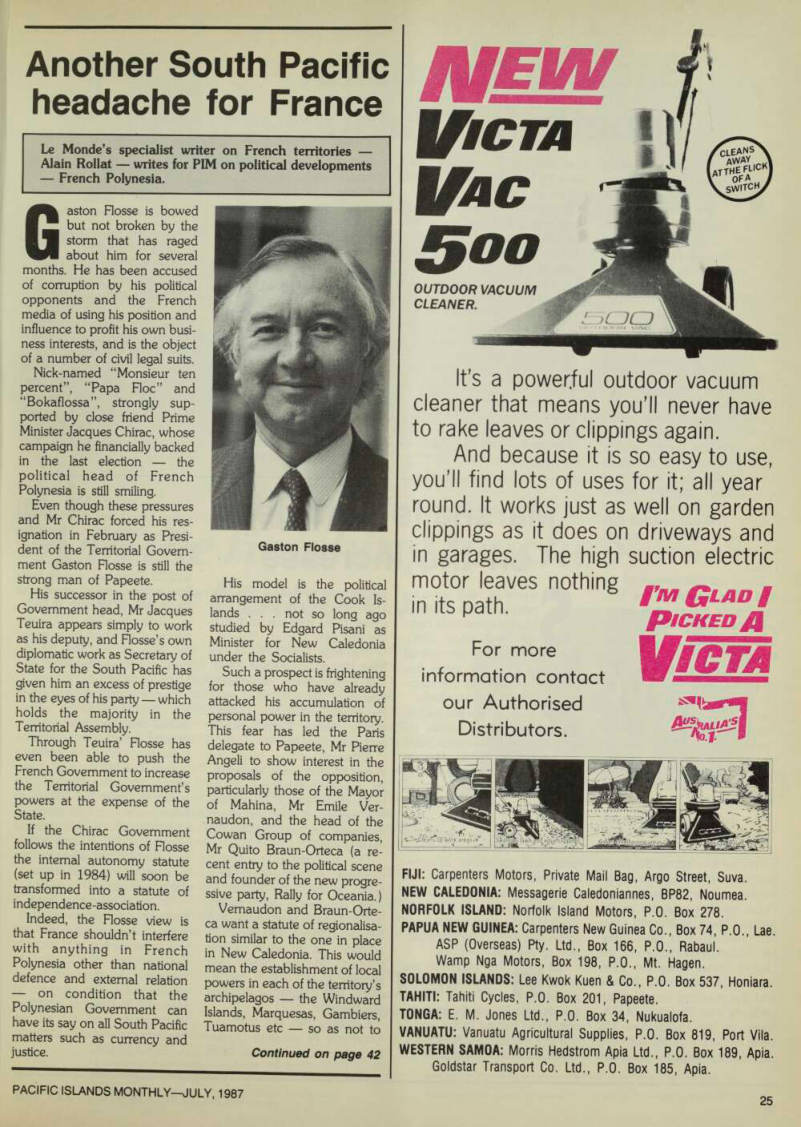
Gaston Flosse is bowed but not broken by the storm that has raged about him for several months. He has been accused of corruption by his political opponents and the French media of using his position and influence to profit his own busi ness interests, and is the object of a number of civil legal suits.
Nick-named “Monsieur ten percent”, “Papa Floe” and “Bokaflossa”, strongly sup ported by close friend Prime Minister Jacques Chirac, whose campaign he financially backed in the last election the political head of French Polynesia is still smiling.
Even though these pressures and Mr Chirac forced his res ignation in February as Presi dent of the Territorial Govern ment Gaston Flosse is still the strong man of Papeete.
His successor in the post of Government head, Mr Jacques Teuira appears simply to work as his deputy, and Flosse’s own diplomatic work as Secretary of State for the South Pacific has given him an excess of prestige in the eyes of his party which holds the majority in the
Territorial Assembly.
Through Teuira’ Flosse has even been able to push the French Government to increase the Territorial Government’s powers at the expense of the State.
If the Chirac Government follows the intentions of Flosse the internal autonomy statute (set up in 1984) will soon be transformed into a statute of independence-association.
Indeed, the Flosse view is that France shouldn’t interfere with anything in French Polynesia other than national defence and external relation on condition that the Polynesian Government can have its say on all South Pacific matters such as currency and justice.
His model is the political arrangement of the Cook Is lands . . . not so long ago studied by Edgard Pisani as Minister for New Caledonia under the Socialists.
Such a prospect is frightening for those who have already attacked his accumulation of personal power in the territory.
This fear has led the Paris delegate to Papeete, Mr Pierre Angeli to show interest in the proposals of the opposition, particularly those of the Mayor of Mahina, Mr Emile Ver naudon, and the head of the Cowan Group of companies, Mr Quito Braun-Orteca (a re cent entry to the political scene and founder of the new progre ssive party, Rally for Oceania.) Vemaudon and Braun-Orte ca want a statute of regionalisa tion similar to the one in place in New Caledonia. This would mean the establishment of local powers in each of the territory’s archipelagos the Windward Islands, Marquesas, Gamblers, Tuamotus etc so as not to
Continued on page 42
Gaston Flosse
allow unlimited power in Papeete.
The politically experienced Angeli also knows that if the opposition is not drawn into the local power structure it could take up the independence cause to try and remove those currently in power. The most moderate members of the opposition have already made it known they won’t be suppor ting Chirac’s candidature in next year’s presidential election but rather that of former Prime Minister, Raymond Barre or the Socialist Francois Mitterrand anyone other than a supporter of Gaston Flosse.
The pro-independence par ties are gaining ground, even though they are very small (they totalled only 15% of votes in the March 1986 elections) and suffer from disunity.
Quick growth of the inde pendence movement is ham pered only by the massive financial benefits brought to the local economy by the nuclear testing centre at Mururoa giving French Polynesia one of the highest standards of living in the South Pacific region.
But the gap between incom es of mixed race and full blooded Polynesians is growing wider and wider as the former take a share of political and economic power and a poor
working class delops amongst the latter.
Even if they don’t lead to independence, nationalist claims tend to grow in a society which is locked into artificial prosperity. Polynesians are now calling for a halt to European immigration and land claims are more numerous along the lines of the FLNKS example in New Caledonia.
For his part, Oscar Temaru, the main independence leader, is calling for a referendum of self-determination, and now in the corridors of the UN the question of French Polynesia is beginnning to be discussed in conjunction with the New Caledonian question.