US reaction to seizure
pp. 23-24 · Read in the full issue
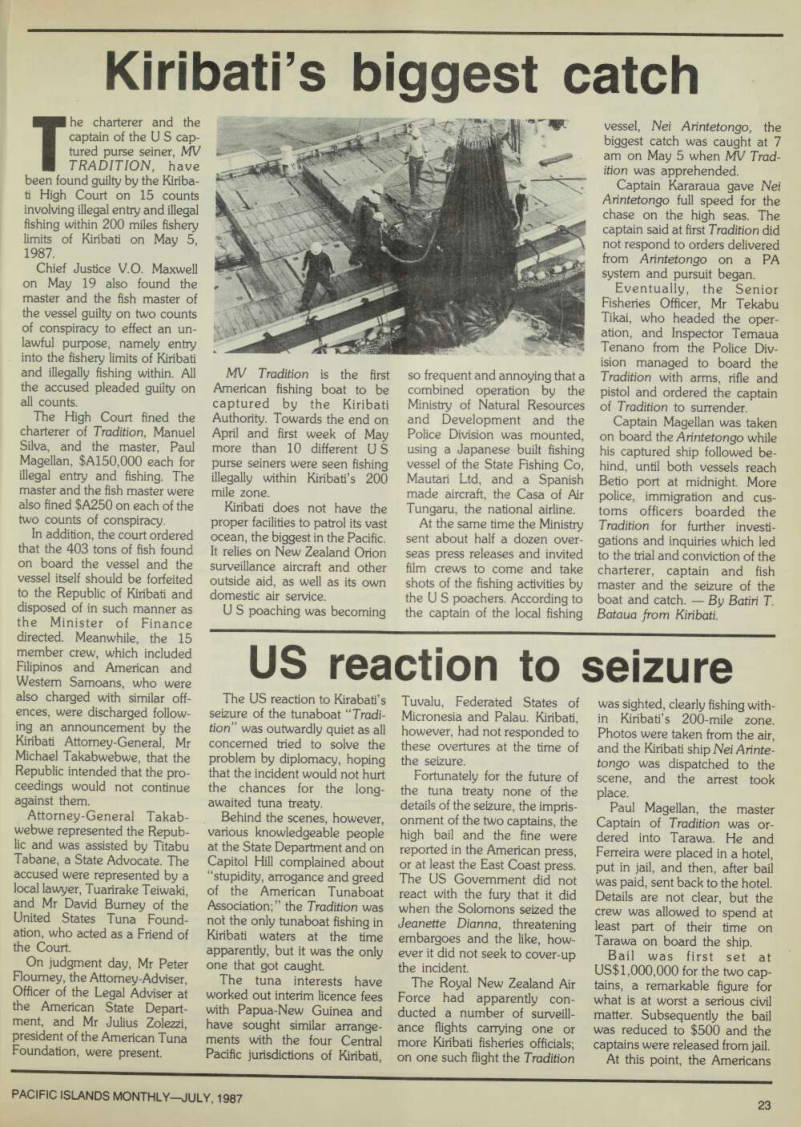
The US reaction to Kirabati’s seizure of the tunaboat “Tradi tion” was outwardly quiet as all concerned tried to solve the problem by diplomacy, hoping that the incident would not hurt the chances for the long awaited tuna treaty.
Behind the scenes, however, various knowledgeable people at the State Department and on Capitol Hill complained about “stupidity, arrogance and greed of the American Tunaboat Association;” the Tradition was not the only tunaboat fishing in Kiribati waters at the time apparently, but it was the only one that got caught.
The tuna interests have worked out interim licence fees with Papua-New Guinea and have sought similar arrange ments with the four Central Pacific jurisdictions of Kiribati,
Tuvalu, Federated States of Micronesia and Palau. Kiribati, however, had not responded to these overtures at the time of the seizure.
Fortunately for the future of the tuna treaty none of the details of the seizure, the impris onment of the two captains, the high bail and the fine were reported in the American press, or at least the East Coast press.
The US Government did not react with the fury that it did when the Solomons seized the Jeanette Dianna, threatening embargoes and the like, how ever it did not seek to cover-up the incident.
The Royal New Zealand Air Force had apparently con ducted a number of surveill ance flights carrying one or more Kiribati fisheries officials; on one such flight the Tradition
was sighted, clearly fishing with in Kiribati’s 200-mile zone.
Photos were taken from the air, and the Kiribati ship Nei Arinte tongo was dispatched to the scene, and the arrest took place.
Paul Magellan, the master Captain of Tradition was or dered into Tarawa. He and Ferreira were placed in a hotel, put in jail, and then, after bail was paid, sent back to the hotel.
Details are not clear, but the crew was allowed to spend at least part of their time on Tarawa on board the ship.
Bail was first set at US$l,OOO,OOO for the two cap tains, a remarkable figure for what is at worst a serious civil matter. Subsequently the bail was reduced to $5OO and the captains were released from jail.
At this point, the Americans
began to arrive. First on the scene was Richard Sherman, Deputy Chief of Mission in Suva, the US embassy which relates to Kiribati. Soon he was joined by Peter Flournoy of the State Department’s Washing ton legal staff, and by David Burney, the well travelled ex ecutive director of the Washing ton-based US Tuna Foundation.
Meanwhile Manuel Silva, the San Diego tunaboat owner who leases Tradition from the Van Camp interests, got as far as Majuro in FSM. He was told to go no further by the State Department, on the grounds that he might be arrested if he arrived in Tarawa.
The trial was held, and the two captains pleaded guilty on their own behalf, and that of Silva, to charges of conspiracy to enter the Economic Enter prise Zone (EEZ), conspiracy to fish illegally and to fishing illegally.
Although Silva paid the fine in Tarawa, it is likely that he will be repaid ultimately by an obscure (and, at the moment nearly empty) State Depart ment trust fund. Established by Section 3 of the Fishermen’s Protective Act, the “Full faith and credit” of the US Govern ment assures fishing boat own ers that if fined for poaching the taxpayers will repay the fines.
US Government repayment of fines is not automatic; an arm of the US State department’s Office of the Legal Adviser must be satisfied that the seizing country’s fishing laws are more restrictive than those of the US; and that other legal require ments are met. From David S. North in Washington.