Referendum
pp. 21-22 · Read in the full issue
to go ahead
Alain Rollat, specialist writer on French territories for the authoritative daily Le Monde writes for PIM on New Caledonia’s political future.
The dice are now thrown; in principle nothing can prevent the French Government’s referendum for New Caledonia from taking place in the territory on September 13 the re ferendum bill became law on June 6.
Voters with more than three years residence in New Caledo nia at the date of the law’s promulgation will be given the following choice: “Do you want New Caledo nia to obtain independence or to remain in the heart of the French Republic?”
And we already know the result: more than 90% of the current 91,609 enrolled who will go and vote will declare
themselves for the continuation of New Caledonia within the heart of the French Republic and against independence.
This result is already known because the independence movement, represented by the Kanak Socialist National Liberation Front (FLNKS) long ago made it clear that it will not participate in this poll.
This means that the Kanak community, of which over 80% is “independantiste” , will de liberately stay away on the day
of the poll, and the referendum will therefore solve nothing.
The Caledonian problem will remain but this is a surprise for no-one. Even the French Gov ernment has admitted that this poll will have, in itself, only a relative value.
It reckons, however, that the poll is essential in order to clarify the political future of the territory. The Prime Minister, Jacques Chirac and the Over seas Territories Minister Ber nard Pons, have totally
espoused, until now, the argu ments of the local conservative majority, which is led by the President of the Rally for Cale donia in the Republic (RPCR), Mr Jacques Lafleur.
They think that the electoral test of the referendum will be enough to stifle the independ ence movement for a long time.
But Mr Chirac and his friends are the only ones in France to show such optimism. Within the parliamentary majority there are many moderates who dis agree, as do the Socialists and the Communists, and feel that the Government is playing with fire by organising a referendum that is unwanted by Kanaks since they know that in its
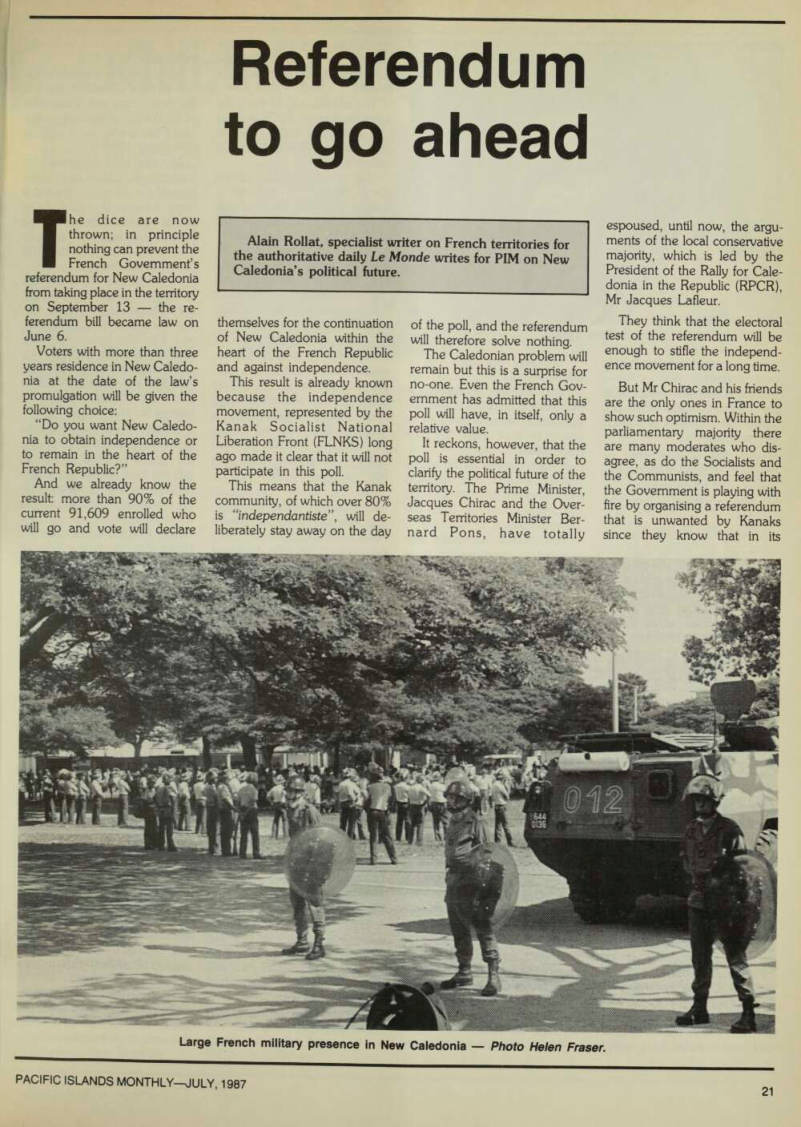
Large French military presence in New Caledonia Photo Helen Fraser.
present form it can in no way benefit them.
That is why the certainty of the arithmetic result of the poll really opens up a lot of political uncertainties.
And that is also why the prospect of these uncertainties seems now to be shaking . . . the tidy certainties of the Gov ernment.
Indeed, the FLNKS has de cided, at the recent congress held at Goa tribal village (near Ponerihouen on the east coast), to put its boycott instruction in terms which can give rise to fears of troubles before, during and after the referendum.
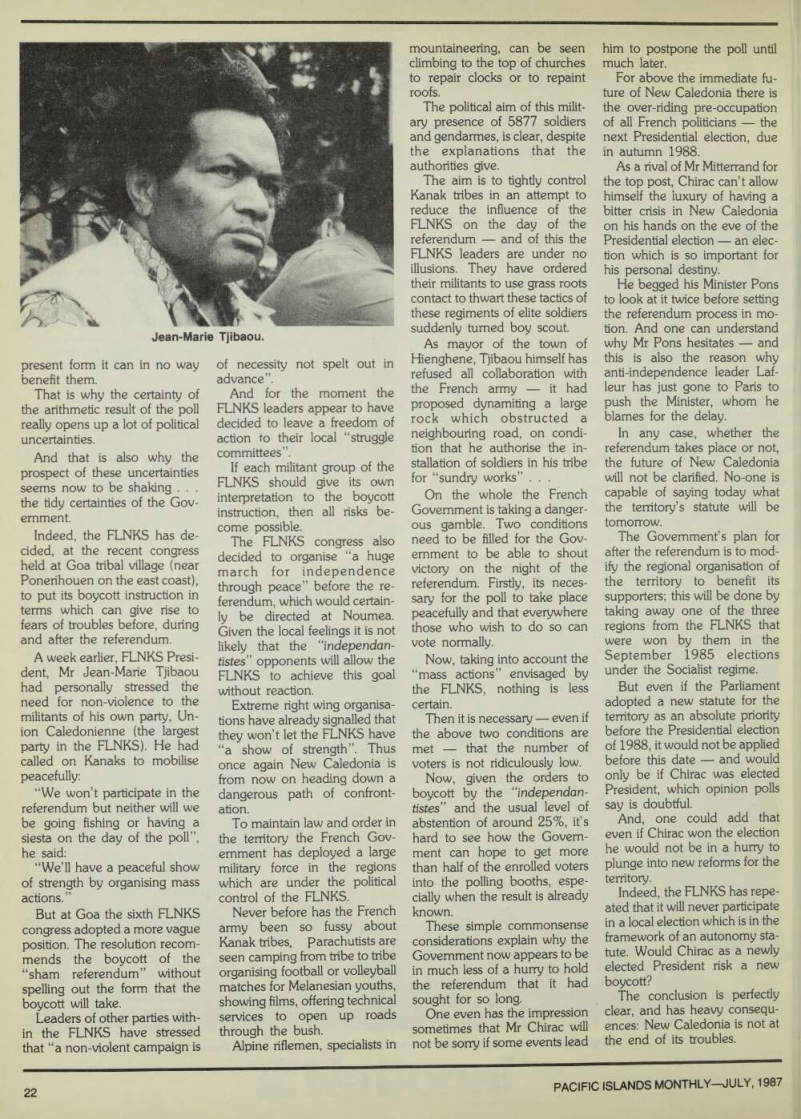
A week earlier, FLNKS Presi dent, Mr Jean-Marie Tjibaou had personally stressed the need for non-violence to the militants of his own party, Un ion Caledonienne (the largest party in the FLNKS). He had called on Kanaks to mobilise peacefully: “We won’t participate in the referendum but neither will we be going fishing or having a siesta on the day of the poll”, he said: “We’ll have a peaceful show of strength by organising mass actions.”
But at Goa the sixth FLNKS congress adopted a more vague position. The resolution recom mends the boycott of the “sham referendum” without spelling out the form that the boycott will take.
Leaders of other parties with in the FLNKS have stressed that “a non-violent campaign is
of necessity not spelt out in advance”.
And for the moment the FLNKS leaders appear to have decided to leave a freedom of action to their local “struggle committees”.
If each militant group of the FLNKS should give its own interpretation to the boycott instruction, then all risks be come possible.
The FLNKS congress also decided to organise “a huge march for independence through peace” before the re ferendum, which would certain ly be directed at Noumea.
Given the local feelings it is not likely that the “independan tistes” opponents will allow the FLNKS to achieve this goal without reaction.
Extreme right wing organisa tions have already signalled that they won’t let the FLNKS have “a show of strength”. Thus once again New Caledonia is from now on heading down a dangerous path of confront ation.
To maintain law and order in the territory the French Gov ernment has deployed a large military force in the regions which are under the political control of the FLNKS.
Never before has the French army been so fussy about Kanak tribes. Parachutists are seen camping from tribe to tribe organising football or volleyball matches for Melanesian youths, showing films, offering technical services to open up roads through the bush.
Alpine riflemen, specialists in
mountaineering, can be seen climbing to the top of churches to repair clocks or to repaint roofs.
The political aim of this milit ary presence of 5877 soldiers and gendarmes, is clear, despite the explanations that the authorities give.
The aim is to tightly control Kanak tribes in an attempt to reduce the influence of the FLNKS on the day of the referendum and of this the FLNKS leaders are under no illusions. They have ordered their militants to use grass roots contact to thwart these tactics of these regiments of elite soldiers suddenly turned boy scout.
As mayor of the town of Hienghene, Tjibaou himself has refused all collaboration with the French army it had proposed dynamiting a large rock which obstructed a neighbouring road, on condi tion that he authorise the in stallation of soldiers in his tribe
for “sundry works” . . .
On the whole the French Government is taking a danger ous gamble. Two conditions need to be filled for the Gov ernment to be able to shout victory on the night of the referendum. Firstly, its neces sary for the poll to take place peacefully and that everywhere those who wish to do so can vote normally.
Now, taking into account the “mass actions” envisaged by the FLNKS, nothing is less certain.
Then it is necessary even if the above two conditions are met that the number of voters is not ridiculously low.
Now, given the orders to boycott by the “independan tistes” and the usual level of abstention of around 25%, it’s hard to see how the Govern ment can hope to get more than half of the enrolled voters into the polling booths, espe cially when the result is already known.
These simple commonsense considerations explain why the Government now appears to be in much less of a hurry to hold the referendum that it had sought for so long.
One even has the impression sometimes that Mr Chirac will not be sorry if some events lead
him to postpone the poll until much later.
For above the immediate fu ture of New Caledonia there is the over-riding pre-occupation of all French politicians the next Presidential election, due in autumn 1988.
Asa rival of Mr Mitterrand for the top post, Chirac can’t allow himself the luxury of having a bitter crisis in New Caledonia on his hands on the eve of the Presidential election an elec tion which is so important for his personal destiny.
He begged his Minister Pons to look at it twice before setting the referendum process in mo tion. And one can understand why Mr Pons hesitates and this is also the reason why anti-independence leader Laf leur has just gone to Paris to push the Minister, whom he blames for the delay.
In any case, whether the referendum takes place or not, the future of New Caledonia will not be clarified. No-one is capable of saying today what the territory’s statute will be tomorrow.
The Government’s plan for after the referendum is to mod ify the regional organisation of the territory to benefit its supporters; this will be done by taking away one of the three regions from the FLNKS that were won by them in the September 1985 elections under the Socialist regime.
But even if the Parliament adopted anew statute for the territory as an absolute priority before the Presidential election of 1988, it would not be applied before this date and would only be if Chirac was elected President, which opinion polls say is doubtful.
And, one could add that even if Chirac won the election he would not be in a hurry to plunge into new reforms for the territory.
Indeed, the FLNKS has repe ated that it will never participate in a local election which is in the framework of an autonomy sta tute. Would Chirac as a newly elected President risk anew boycott?
The conclusion is perfectly clear, and has heavy consequ ences: New Caledonia is not at the end of its troubles.
Jean-Marie Tjibaou.