French Ambassador challenged
pp. 11-12 · Read in the full issue
letters
French Ambassador challenged to public debate
In your June issue you pub lished a speech by Mr Bernard Follin, French Ambassador to Australia, entitled “Exodus would follow FLNKS takeover, says Ambassador”. AS his view is biased and partisan I would like to reply.
Who is Mr Follin? A French Ambassador to Australia. What does he know of New Caledo nia and the Kanaks? Almost nothing, except what the French Secretary of State for the South Pacific, Mr Flosse, and the French High Commis sioner to New Caledonia, Mr Montpezat, choose to tell him during their recent three-day meeting in Noumea. The aim of this meeting was to try to rebuild French standing in the eyes of Pacific countries, if it is still possible.
Mr Follin says French policies are marked by “a very great continuity”; this is very true in regard to the stupid and pro fiteering colonialism that France is so intent on maintaining in New Caledonia and French Polynesia. But the assertion of “stability in the region” is more questionable, because despite over 134 years presence France has not been able to bring about real development in New Caledonia, and this is clear in several areas.
At the economic level New Caledonia is certainly one of the South Pacific countries with the highest per capita income, (SUS 6,156). But this is a superficial figure since the money’s source is not the coun try’s productivity, but subsidies from France of SUS 450 million per year as the Ambassador says. This standard of living is not evenly distributed but only benefits the colonisers, and stu dies show that Europeans have
an average income over five times that of the Kanak.
The economy is totally centralised on Noumea and structured in a way to guaran tee the continuation of colonial monopolies, the prerogatives of several rich families, especially Lafleur and Frogier. The prob lem is so serious that it led to an argument on this profiteering between Lafleur and Minister Pons during the latter’s last visit.
So “Kanaks don’t have an incentive to work and make a profit” is because they know the profit only goes to the businessmen. Contrary to what Mr Follin says its is not time that is needed to change things for “Kanaks to be part of the economy”, but rather a radical change of power the day when the Kanaks have power in their own land is the day they will become a part of the economy. And while this de mand is not met there is always a risk of instability in the region.
Culturally, we find the same process. France has only known how to stifle the Kanak people; instead of helping cultural development France has denied and killed it. We note the same thing again in reading Mr Follin his dream is that Kanaks will be like him.
“What we want is for them to come up to the same stage as Europeans”, he says. He is the one who decides and there is no doubt that only his criteria are valid.
Such statements and others (its very important to have training of the Kanak people as part of the economy” . . .
“Kanaks can’t earn money or profit”) are perfectly racist and worthy of Mr Le Pen.
It’s true that for many years France tried a policy of assimila
tion, then integration, and failed miserably. When will France have a policy that allows the Kanak people the right to be responsible for themselves and to live their traditions as they understand them?.
There is also instability poli tically, as France envisages its fourth statute in three years, and has still not managed to bring calm to the territory.
There are now 7,340 troops, mostly in the interior, which practise “nomadisation”, ie im pose themselves on Kanak tribes to gain information and wage psychological campaigns, or to repress Kanaks with the judicial process this total of military is hardly less than dur ing the Pisani period and equals one armed man for every three Kanak adults.
Mr Follin says the referen dum will be democratic pro cess, but can we talk about democracy in a country which is under military occupation?
Can we talk about democra cy when the “majority” was obtained by importing a popu lation a short while ago in order to drown out the Kanak popu lation numerically, (Messmer letter of 1972), and when a good number of voters in the pseudo referendum won’t be here in three years, the mini mum for eligibility.
Can we talk about democra cy when the electoral ways have been falsified in several ways (dead people not re moved from the rolls, others not removed who are no longer residents, excluding 2,500 Kanaks who have been sent enced when there are never repercussions against Euro peans who commit crimes).
Can we talk about democra cy when votes are bought
(Montpezat tours tribes with money for tractors, generators and churches), and when the judicial system discriminates in its judgments, investigations and conditions of detention? (two years jail for a European who kills a Kanak in cold blood and 15 for a Kanak accused of killing a man who probably suicided).
Yes, the security for the poll can be guaranteed by France with military force, but its sincerity will always be ques tioned under the above condi tions.
Moreover, studies show that the French is likely to get a majority against independence but it is now probable this won’t equal 50% of the enrolled voters what credibility will such a poll have?
How can Mr Follin have the cheek to say they are asking the people what they want when Mr Pons has never discussed the country’s future with the FLNKS and has never prop osed a meeting or an agenda
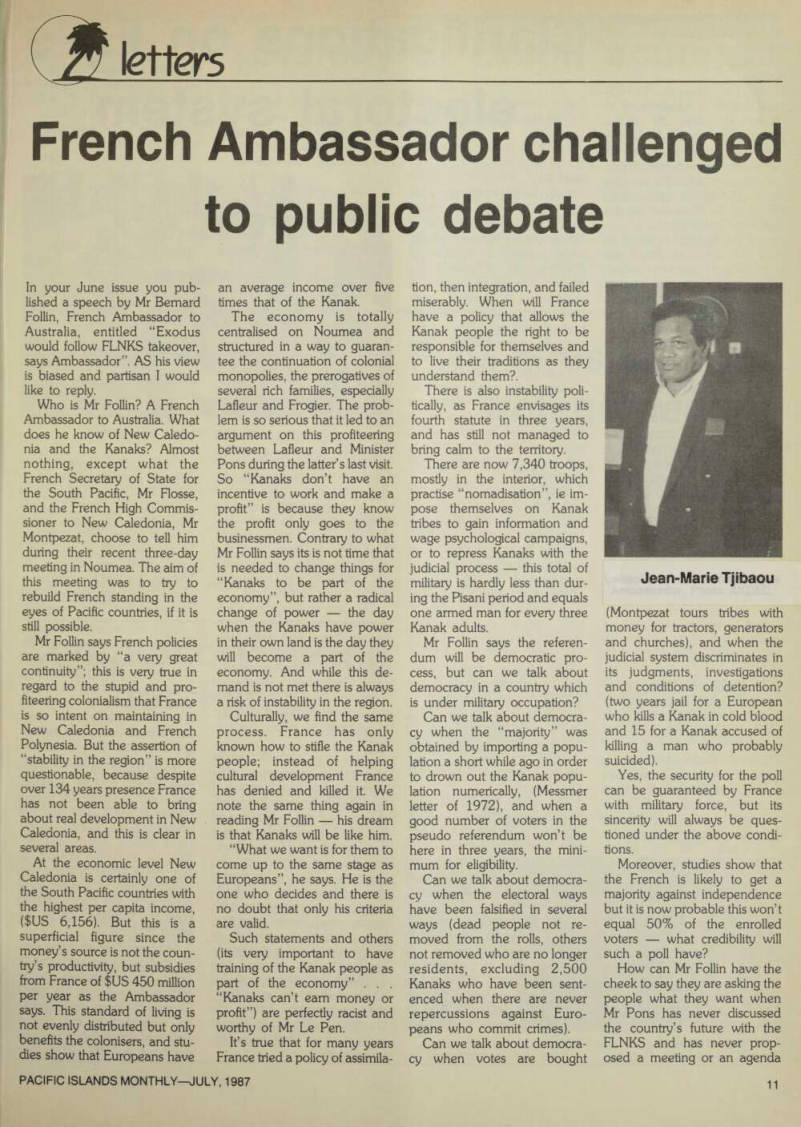
Jean-Marie Tjibaou
with Mr Tjibaou, despite re quests. Dialogue was cut off because of Mr Pons’ clear bias in following the policies of Mr Lafleur.
The only thing the FLNKS demands is a referendum in accordance with UN resolu tions, ie in which only the colonised people are asked for their view on the future of their country which is the exercise of an inalienable right recog nised by the France under the Socialist Government.
But the FLNKS is ready to talk with Mr Pons about the posssibility of long term settlers taking part in the referendum a concession which demons trates an overture to the settlers.
Mr Follin does France a dis service by dishonestly claiming that the FLNKS would throw out Europeans in the case of independence. The FLNKS has never envisaged an exodus of Europeans.
Indeed, to the contrary we have repeatedly stressed the possibilities of cohabitation; in 1984 we called on non-Kanaks to recognise our legitimacy and to support our struggle and from this to have citizenship rights in an independent Kanak state. In 1985 we spelt out terms for nationality, with long term settlers having the right to demand nationality from the day of independence, and stressing that economic and professional activities would be open to all regardless of nation ality.
Mr Follin would have done better to come and visit tribes and see how the people live.
He is certainly loyal to his masters, but he has done France a disservice because if it wanted to keep to its traditions France would have encouraged a true democracy and deve lopment in New Caledonia, achieving this through the emancipation of the Kanak people.
France has a future only in a Pacific that is free, decolonised and nuclear free.
In conclusion, I challenge Mr Follin to debate these issues during my forthcoming trip to Australia then Australians would be able to see where he stands for themselves.
Leopold Joredie,
President of Central Region, Secretary-General of Union Caledonienne, Noumea.