more racially intolerant?
pp. 47-49 · Read in the full issue
books
White women more racially intolerant?
White Women in Fiji 1835- 1930: The Ruin of Empire?
By Claudia Knapman Published in 1986 by Allen and Unwin, Sydney, 226 pp.
FOR many years there has been a widely held assumption that white women in multi racial societies are more racially intolerant than men creating tensions between black and white communities. Academic studies have suggested that it was the arrival of white women in the newly established col onies in Asia, Africa, and the Pacific that led to a deteriora tion in relationships between indigenous blacks and Euro peans. It has even been claimed that it was white women’s racial intolerance that led to the downfall of empires. This academic assumption is characterised by Young (1968) who writes of Fiji: It was not. . . the attitudes of the male settlers, nor the Fijian authorities, but the arrival in Fiji of an influential number of European women which led to developing racial antagonism . . . (with the arrival of white women) inter-racial conviviality was accordingly abandoned.
This negative perspective of white women in multi-racial societies has been popularised by a number of widely-read novelists including Somerset Maugham, Rudyard Kipling and George Orwell, all of whom portrayed colonial white women as mentally or physical ly weak, indolent, frivolous, ra cist, jealous of black women and unable to manage their black servants. This stereotype has at last been challenged.
Dr Knapman’s excellent book on the social history of
European women in Fiji shows that these women were often less racist than their husbands and that the deterioration of black/white relations was a complex combination of events which included the increased number of European settlers and the resulting establishment of European communities, growing pressure for land, and not least, European perceptions of white women’s roles. It is obvious from this book that
much of the literature on Euro pean women in multi-racial societies tells more about the values of the authors, usually male, and their own societies, than about the behaviour of men and women in colonial settings. The doctoral thesis upon which this book is based won the coveted Australian Na tional University J. G. Crawford Medal for academic excellence and the Jean Martin Award from the Sociological Associa-
tion of Australia and New Zea land.
With scholarship and sensitivity Dr Knapman ex plores the relationship between the daily lives of white women living in Fiji between 1835 and 1930 and the underlying Euro pean ideology of black and white, male and female. She stresses that the subjects of white women and race relations must be assessed with an understanding of the structural differentiation between races and between men and women and of the beliefs of white society in general. Using inter views with relatives of early settlers, private diaries and let ters, official reports and archival material, Dr Knapman investi gates four major types of Euro pean women in Fiji the wives of missionaries, settlers and administrators, and women who had paid employment.
These women’s private lives, their work inside and outside the home, their relationships with Fijian men and women, their leisure and social activities arc analysed against the Fijian physical and social setting and European perceptions of white women’s roles within this set ting. In dispelling the myth about weak, frivolous, racist, white women Dr Knapman not only provides remarkable in sights into the lives of early settlers in Fiji, but adds an important dimension to Fiji’s colonial history.
The first white women to live in Fiji were the wives of mis sionaries. Two families arrived in 1835 and until the 1850 s only a handful of white women regarded Fiji as their home. The lives of these women and the wives of other early settlers provide ample evidence of
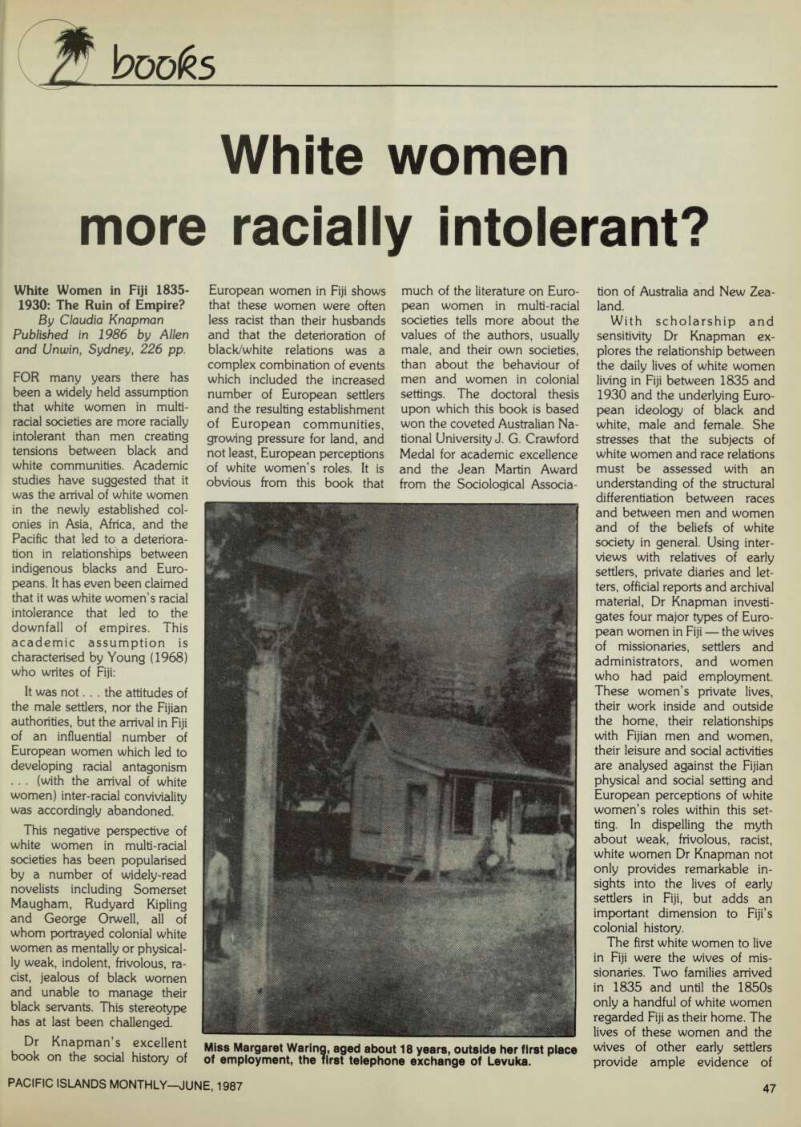
Miss Margaret Waring, aged about 18 years, outside her first place of employment, the first telephone exchange of Levuka.
female strengh, tolerance and adaptability in circumstances which were physically and psychologically difficult. The lives of mission wives were particularly hard. They were not only expected to maintain a civilised Christian home which would serve as a model for the Fijians, but were expected to support their husbands in their mission duties, educate their own children, teach Fijians the rudiments of cooking, literacy, sanitation and hygiene, provide basic medical services for the Fijian population and act as nurses within their own house holds. They were also expected to bear and rear a number of children who had to be brought up so they would fit back into English society. Living in iso lated Fijian villages, with no medical assistance and with in experienced husbands acting as midwives, women lived in the knowledge that pregnancy was a constant threat to their lives.
The first European child to be bom in Fiji provides an exam ple of the difficulties. Augusta Cargill was bom in Lakemba in December 1835 with her father acting as midwife. A week later a hurricane struck and the house was destroyed. With the roof of a small bure tied down with ropes the baby and a two-year-old daughter huddled with their mother in a wet bed for two nights, rain pouring in everywhere and neither child being washed or dressed for two days.
Contrary to the popular im age of the colonial lifestyle, housing was generally poor and nearly all early missionaries and settlers outside Levuka started with one-roomed Fijian houses with coconut mats over a dirt floor and mats over openings for doors and window. Most were built in low swampy areas where it was “airless, the heat oppressive, and flies and mos quitoes numerous. ” Women and children suffered constant health problems. Whilst death in childbirth, infant mortality and inadequate medical help were not unique to women in Fiji, these difficulties were aggravated by flimsy housing, frequent hurricanes, inadequ ate food supplies and the emotional stress caused by ex treme isolation, lack of family support and constant fear of
war and cannibalism. Few women had time to keep writ ten records but the material Dr Knapman had access to indi cated their remarkable courage, resilience and self-control. Con fronted with large piles of hu man bodies being cut up and cooked within two yards of the mission house fence, Hannah Hunt did not resort to the vapors as the literature would indicate, but closed the doors and windows to keep out the sight and smell, and successful ly dealt with the son of a Fijian chief who threatened her family with a fate similar to those piled outside the fence. Women ven tured into warring villages to try and save the lives of the wives of deceased chiefs or those taken in war often being forced to witness extreme cruelty. The
emotional shock of these ex periences was accepted as part of the ordinary performance of their duties. Some however admitted to finding their experi ences too distressing to commit to paper.
In this early period of Fiji’s colonial history good relations with Fijians were essential and it was mandatory that Fijians were able to inspect European households. Mission wives reg ularly invited Fijians into their houses and contact was gener ally harmonious. There is no evidence to suggest that women’s attitudes or behavior towards Fijians differed from that of their husbands. If any thing women were more com passionate, most particularly to wards wonen and children. It is amply evident that women worked extremely hard both in
the home and outside it, and that to categorise them as idle is a gross misrepresentation.
Although the problems associ ated with hard physical work and frequent pregnancies made them more prone to infection and physical illness than their husbands, they suffered no more than men from mental problems. There is no evidence in these early years of racial disharmony.
Until 1858 there were an estimated 40 to 50 families in Fiji, however news of Fiji’s agricultural potential, most par ticularly for growing cotton, led to a rapid influx of settlers from Australia, New Zealand and Britain. By 1866 about 400 Europeans had settled in Fiji and by 1870 nearly two thousand. The settlers included
women and children. The “Fiji rush” brought not only planters but traders, professional people and an increasing number of civil servants. Cession to Britain in 1874 was accompanied by a growing civil service organised along strictly hierarchical lines.
The rush for land, the establish ment of the Colonial Sugar Refinery in 1880 and the intro duction of Solomon Island, New Hebridean and Indian in dentured labor together with the establishment of European communities in Levuka, Suva, Nadi and Nausori, brought about changes in the social climate and in race relations.
With the growth of the white settler society the scope for social differentiation increased and as the European urban population grew settlers aspired to European social institutions.
Although Levuka in 1872 was little more than a single row of single-storeyed “mean and coarse” weatherboard houses and Suva in 1880 a “shanty town”, clear status distinctions arose. The major divisions were between English and Colonial, business and professional, Fi jian and Indian, black and white. Part-Europeans were accepted depending upon their “degree of color.”
In time this ranking system extended to rural planters.
Those from Taveuni were con sidered “better” than those from Savusavu.
In Suva the social ranking system was presided over by the English civil servants and in the sugar areas by the CSR top-ranked staff. Both CSR and the civil service had clear be havioral expectations of their employees. The social snob bery that accompanied these expectations was not rooted in female whims as much of the literature suggests, but in the organisational division of Euro pean men into “officers” and “men”. Officers were expected to behave in a superior manner and to associate only with su perior people. Wives were ex pected to follow this pattern.
Their choice of friends, their activities and their relationships with Fijians and Indians con formed to the rules laid down by men. Relationships with Fi jians or Indians were strictly those of mistress/servant. There was however formal and infor mal social involvement be tween high-ranking Europeans and chiefly Fijians, who were accepted as equals. The atti tude of most Europeans how ever was that they were pioneers of a superior civilisa tion, who had the right to use lands left “unused” by Fijians and who assumed European control of Fijian labor.
Dr Knapman shows that throughout the colonial history of Fiji there were limits to the choice European women had over their lives. These limits were imposed by the ideals of white women’s roles and de volved on the concept of de pendence. Even an econo mically independent wife was her husband’s unequal partner.
In analysing white women in Fiji in terms of gender and race Dr Knapman maintains that in European ideology and his
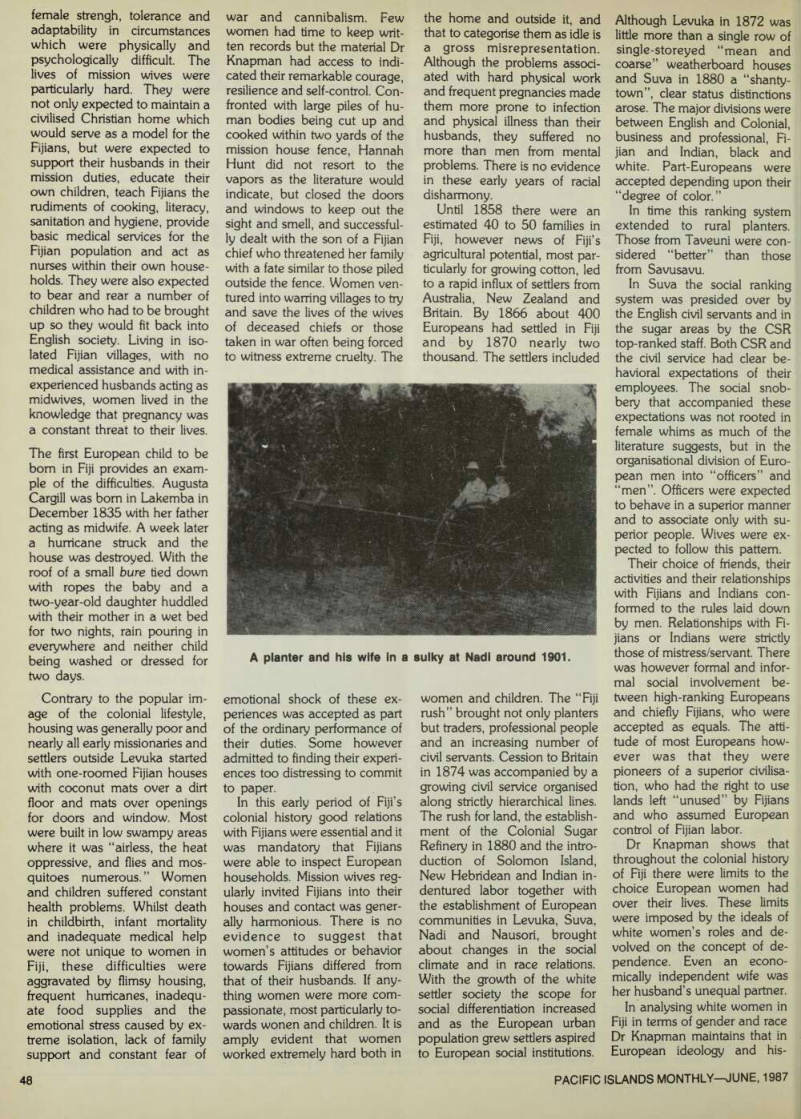
A planter and his wife in a sulky at Nadi around 1901.
torical opposition between black and white, male and female, good and evil, the European female was the polar opposite of the Fijian and In dian male. She was white not black, good not bad. Both white women and black men were defined by contrast and opposition to white men. The European woman was her father’s or her husband’s prop erty. The black laborer was similarly his master’s property.
Even in enlightened thinking a black man was a minor in relationship to a white man.
This ideology permeated race relations and what was ex pected of white women at the time.
As Dr Knapman conclusively shows the arrival of white women was not the most in fluential factor in hardening race relations. It was the ambi tions of the new settlers, most of whom were male, but whose women shared their aspirations.
Had women caused a de terioration in race relations it would have become apparent well before the “Fiji rush”. Dr Knapman’s analysis shows that white women from the time of first contact attempted to estab lish good relations with Fijians.
Indeed the wives of the plan ters, traders and missionaries often had better relationships with Fijians than their hus bands.
Dr Knapman concludes by stating that 20th century writers have given too much attention to present values and have had too little compassion and understanding of the complex ities of colonial women’s lives.
They have therefore made the error of accepting the image of “white ladies” and its express ion in literary constructions, as an accurate depiction of real lives. “Without shared aware ness of the past a social group suffers from a kind of collective amnesia which makes it vulner able to the imposition of du bious stereotypes.”
This story of white women in Fiji makes fascinating reading.
For those interested in the history of Fiji and the Pacific, and for those concerned with gender and race relations this book should be compulsory reading. Pamela Thomas, National Centre for Deve lopment Studies, Australian National University.