Problems of development
p. 37 · Read in the full issue
Visiting Sydney for the Royal Easter Show was a group of mayors and town councillors from the Association of Mayors of New Caledonia. The associa tion has 22 members (16 FLNKS) since 10 anti-inde pendence mayors quit to form a separate organisation called the Association of French Mayors of New Caledonia.
Messrs Edouard Wapae, FLNKS Mayor of Lifou Island, Hamu Cono, an FLNKS coun cillor from Lifou Island and also a member of the Regional Council, Paul Kokoetha, also an FLNKS Lifou councillor, Eloi Tchoeaoua, FLNKS mayor of Ouegoa, and Clement Vende gou, FLNKS Mayor of Yate talked to PIM about their aims and their problems of economic development at the municipal level in New Caledonia.
Clement Vendegou’s municipality of Yate is in the far south of the main island of New Caledonia, hemmed in be tween the sea and the moun tain chain. He said: “We’re very restricted with land because of our position, so we’re doing small projects raising poultry, experimenting with rice (which is going well), and above all, fishing. We have a fishermen’s cooperative which handles transport and deliveries.
“Our objective is to create an
economic tissue at the grass roots level. With the regions we’ve worked with a deve lopment plan, at the municipal level our aim is to create the economic tissue, so we are moving forward step by step.”
At Ouegoa in the moun tainous far north of the main island mayor Tchoeaoua said his focus is largely on raising Charolais and Limousin beef cattle.
Hamu Cono said: “Since the regions were established we’ve been concentrating on deve lopment at the grass roots, municipal level and with the regions, to encourage and initi ate development so we brought this group to the Easter Show to learn about Australian agriculture and animal hus bandry.
“In the Loyalty Islands we’ve launched micro development projects, such as pig and poul try farming, cattle raising, fishing and agriculture, and we’re researching and experi menting better ways of growing crops.
“For example, with yams, which are a cyclical crop, some are trying to get two cycles in a year, with potatoes we’re trying to grow them in the counter season. We’re also running tests in coffee growing (normal ly not grown in the islands) to see if it is productive. We’ve
also started reafforestation and orchard projects,” Cono said.
“With the nickel boom (of the early 19705), the regions of the interior and the islands were emptied as people stopped basic development to go and work in the mines or in Noumea. We think it was a deliberate policy to allow the concentration of the population in Noumea all the better to keep us down. Now our aim is to get the Kanak people at their rightful place in the economy, to create work at this level.
“It’s not easy people have habits which are difficult to shake off, such as subsistence living in the tribal villages. In the territory, 90% of goods are imported, only 10% are local produce, so Kanak products are excluded from the market and local initiatives are stifled.
“In Lifou, for example, the transport and freight costs penalise us, and, following changes made by the French Government, our budget for the islands has been reduced to cfp 600 million (about $A 4.5 million) from a projected cfp 1,200 million (about SA9 mil lion). The budgets for the Loyalty Islands and the Centre region were blocked for two months by the French High Commissioner, so the situation was allowed to deteriorate, then the budget was approved but was cut by 50% . . . “So then
we had to do our projections all over again.”
Cono said Kanak efforts at production of copra and coffee, for example, were being frus trated by the large importers at Noumea; “To be clear, the problem of obstacles whether at the administrative, political, or eco nomic level was linked with the territory’s political prob lems. Kanaks control three of the four regional councils set up under the Pisani/Fabius plan with this we gained a large measure of regional autonomy.
“For us in the FLNKS we fought for this as a political and economic tool for building inde pendence. But for the right wing this is a danger because they know that economic inde pendence for Kanaks leads to political independence, so they block us at all levels.”
Cono alleged that the French High Commissioner allowed the treasury to deliberately de lay or block the funding of projects approved by the regio nal councils under Kanak con trol. However, despite these impediments a Kanak aware ness of the importance of eco nomic development is growing, and an economic militancy “the green revolution” is there. But, Cono warned, Kanak participation in econo mic development would be thrown into question if the FLNKS decided to boycott the French Government referen dum and autonomy plans.
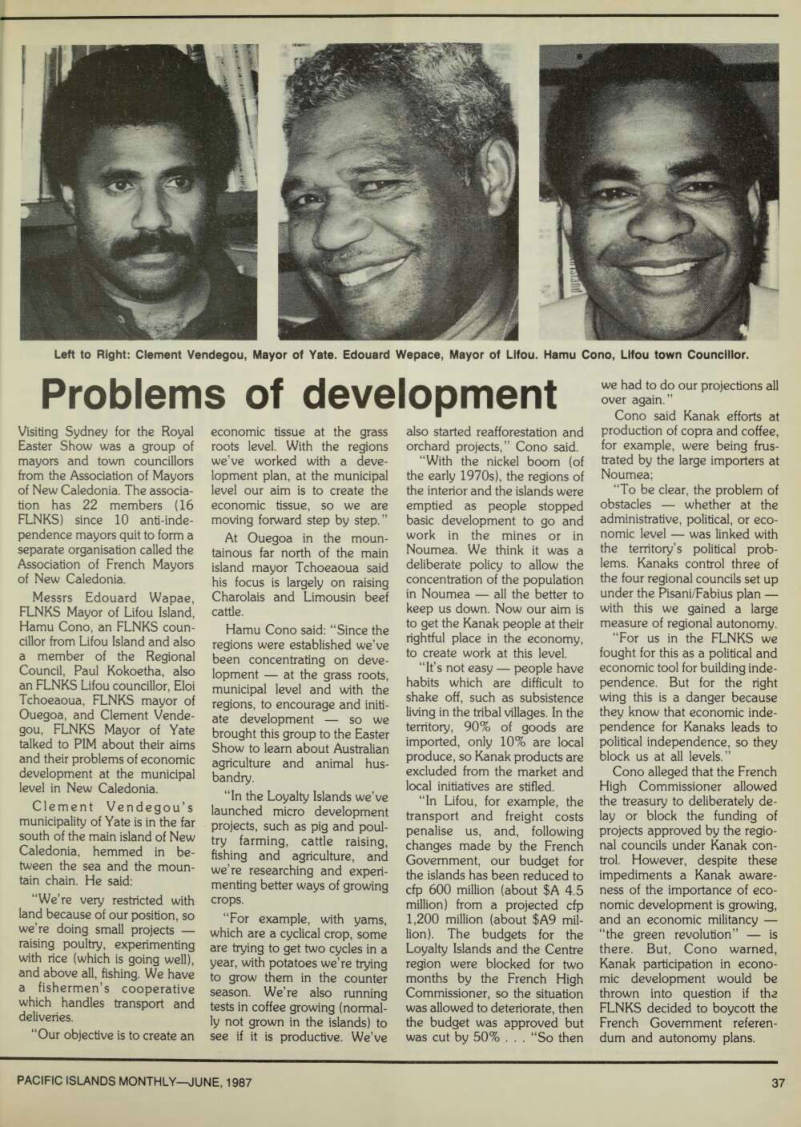
Left to Right: Clement Vendegou, Mayor of Yate.
Edouard Wepace, Mayor of Lifou.
Hamu Cono, Lifou town Councillor.