Subsistence First
My comments on an article in the March 1987 issue of PIM: “Food for the People: A Grow ing Crisis,” may represent the summary of another tautologi cal exercise that has plagued South Pacific Fisheries deve lopment for many years. I sincerely hope the Fakahau et al. reports will become more meaningful.
Frequently, managers of South Pacific coastal fisheries are blinded by a capitalist drive to commercialise this resource.
What they fail to see is the subsistence level dependence many people place on this resource.
Many past research projects projecting sustainable yields have been calculated into dol lars and cents without first realising the large proportion of the catch which is consumed at the subsistence level. Based on an upbeat economic forecast purported to stimulate the eco nomy, planners initiate an eco nomic push to expand the coastal fishing effort, through the introduction or increase of fishing vessels and ice boxes; the end result has been failure
and frustration because of an unsupportive social and econo mic infrastructure. A cooling off and reassessment period en sues before another process of evaluation begins anew.
People familiar with SIACO in the Solomon Islands can recall the gallant plans to com mercially process a calculated harvest of coastal catches. The same holds true for the Vava’u, Tonga, Asian Development Bank, funded, freezer complex at Nieafu. In both cases plan ners failed to realise the subsist ence take of the catch plus an unsupportive infrastructure.
Undoubtedly a challenge lies ahead for managing a fairly hardy resource that for a mille nia has supported Pacific islan ders on one of this planet’s most fragile ecosystems. Avoid ing the same mistakes, realising that subsistence must come be fore commercialisation, and realistic economics are issues that must not be overlooked as fisheries development planners and managers look to the future.
Gus Comstock
California, USA.
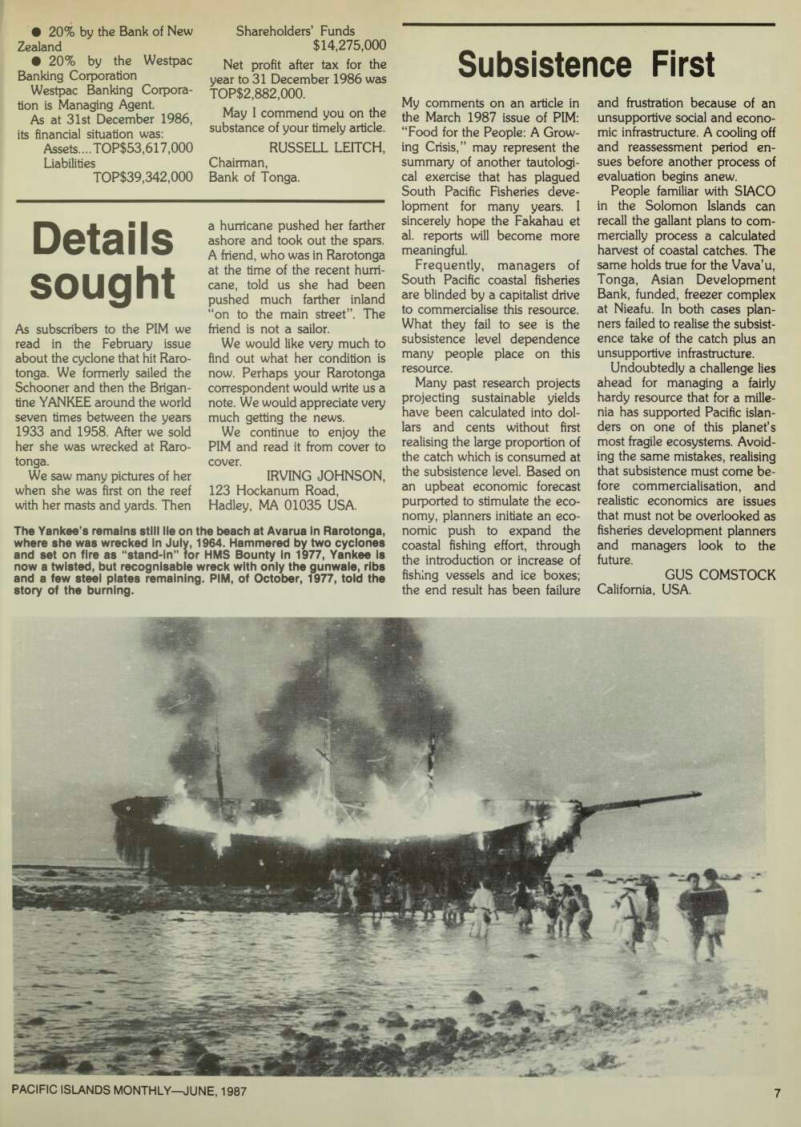
The Yankee’s remains still lie on the beach at Avarua in Rarotonga, where she was wrecked in July, 1964. Hammered by two cyclones and set on fire as "stand-in" for HMS Bounty in 1977, Yankee is now a twisted, but recognisable wreck with only the gunwale, ribs and a few steel plates remaining. PIM, of October, 1977, told the story of the burning.