Ethnic Samoan
p. 37 · Read in the full issue
named judge
A native of Samoa the first in history has been appointed to the High Court of Amer ican Samoa. All previous judges have been palagis (mainland ers).
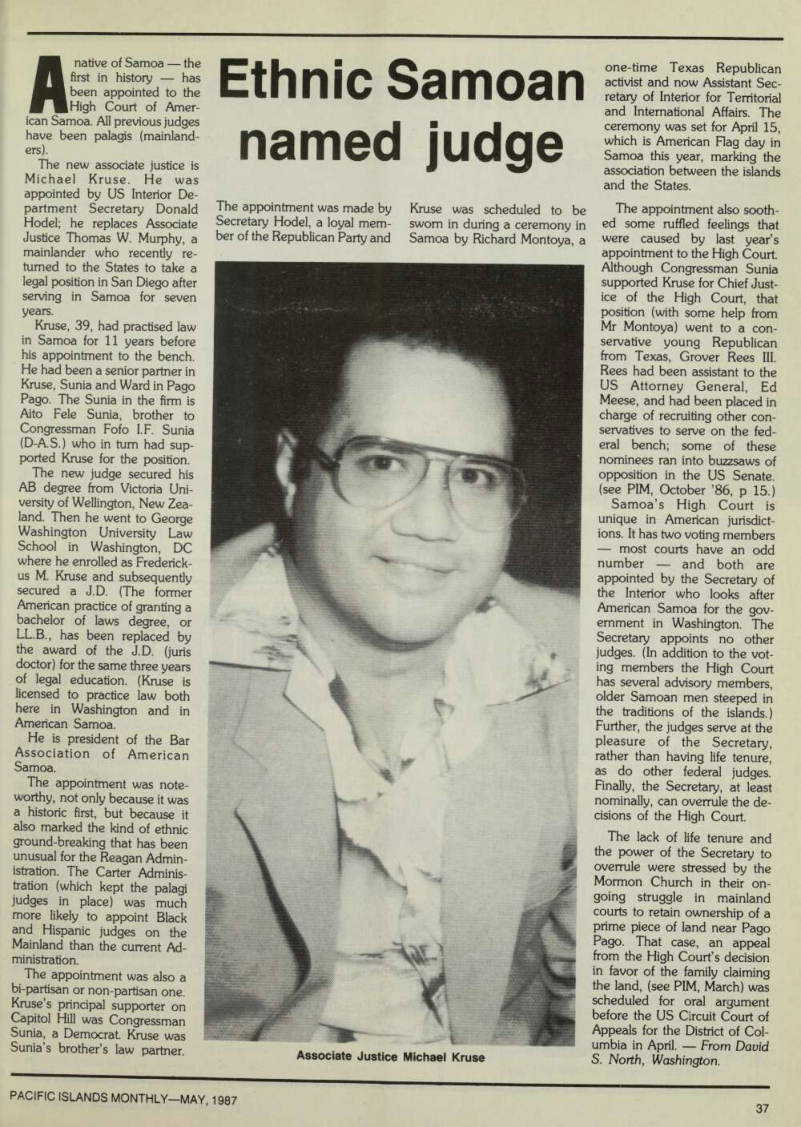
The new associate justice is Michael Kruse. He was appointed by US Interior De partment Secretary Donald Hodel; he replaces Associate Justice Thomas W. Murphy, a mainlander who recently re turned to the States to take a legal position in San Diego after serving in Samoa for seven years.
Kruse, 39, had practised law in Samoa for 11 years before his appointment to the bench.
He had been a senior partner in Kruse, Sunia and Ward in Pago Pago. The Sunia in the firm is Aito Fele Sunia, brother to Congressman Fofo I.F. Sunia (D-A.S.) who in turn had sup ported Kruse for the position.
The new judge secured his AB degree from Victoria Uni versity of Wellington, New Zea land. Then he went to George Washington University Law School in Washington, DC where he enrolled as Frederick us M. Kruse and subsequently secured a J.D. (The former American practice of granting a bachelor of laws degree, or LL.B., has been replaced by the award of the J.D. (juris doctor) for the same three years of legal education. (Kruse is licensed to practice law both here in Washington and in American Samoa.
He is president of the Bar Association of American Samoa.
The appointment was note worthy, not only because it was a historic first, but because it also marked the kind of ethnic ground-breaking that has been unusual for the Reagan Admin istration. The Carter Adminis tration (which kept the palagi judges in place) was much more likely to appoint Black and Hispanic judges on the Mainland than the current Ad ministration.
The appointment was also a bi-partisan or non-partisan one.
Kruse’s principal supporter on Capitol Hill was Congressman Sunia, a Democrat. Kruse was Sunia’s brother’s law partner.
The appointment was made by Secretary Hodel, a loyal mem ber of the Republican Party and
Kruse was scheduled to be sworn in during a ceremony in Samoa by Richard Montoya, a
one-time Texas Republican activist and now Assistant Sec retary of Interior for Territorial and International Affairs. The ceremony was set for April 15, which is American Flag day in Samoa this year, marking the association between the islands and the States.
The appointment also sooth ed some ruffled feelings that were caused by last year’s appointment to the High Court Although Congressman Sunia supported Kruse for Chief Just ice of the High Court, that position (with some help from Mr Montoya) went to a con servative young Republican from Texas, Grover Rees 111.
Rees had been assistant to the US Attorney General, Ed Meese, and had been placed in charge of recruiting other con servatives to serve on the fed eral bench; some of these nominees ran into buzzsaws of opposition in the US Senate, (see FIM, October ’B6, p 15.) Samoa’s High Court is unique in American jurisdict ions. It has two voting members most courts have an odd number and both are appointed by the Secretary of the Interior who looks after American Samoa for the gov ernment in Washington. The Secretary appoints no other judges. (In addition to the vot ing members the High Court has several advisory members, older Samoan men steeped in the traditions of the islands.) Further, the judges serve at the pleasure of the Secretary, rather than having life tenure, as do other federal judges.
Finally, the Secretary, at least nominally, can overrule the de cisions of the High Court.
The lack of life tenure and the power of the Secretary to overrule were stressed by the Mormon Church in their on going struggle in mainland courts to retain ownership of a prime piece of land near Pago Pago. That case, an appeal from the High Court’s decision in favor of the family claiming the land, (see PIM, March) was scheduled for oral argument before the US Circuit Court of Appeals for the District of Col umbia in April. From David S. North, Washington.
Associate Justice Michael Kruse