strains relations with islands
pp. 26-27 · Read in the full issue
NZ immigration scheme strains relations with islands
Relations between New Zealand’s Labour Gov ernment and the coun try’s large Pacific Island communities are at their lowest ebb since the dawn overstayer raids of the 19705. The big chill was caused by the sudden axing of a fledgling immigration scheme which let Tongans, Western Samoans and Fiji na tionals visit for up to three months without a visa, (see PIM, April, p 9). Visa -free entry was the last in a hurried series of moves to counter a race relations report which con demned immigration laws and enforcement as discriminating against Pacific Islanders, (see box).
The door stayed ajar just ten weeks, from December 1 to February 18. Cabinet estimates put arrivals at 11, 500- up to five times the arrivals during the same period the previous year.
Official figures for December/ January showed 9036 arrived
for short visits while in January, the second month of the scheme, 2520 returned home to Fiji, Samoa or Tonga. Im migration Minister Kerry Burke and Pacific Islands Affairs Minis ter Richard Prebble both stated they had clear evidence that visa-free entrants intended to deliberately overstay. Yet when the scheme was knocked on the head, no-one had overstayed.
The first of the entry permits expired on March 1 and were renewable up to 12 months.
Burke defended the U-tum, saying that “the sheer force of pressure from people rushing here has caused the Govern ment to say ‘this is not good enough’”. Burke also claimed local Pacific Island communities had complained they could not cope with the strain of hosting all the extra visitors.
Prebble said visa-free visitors had abused the rules by enroll ing children in schools, seeking free medical treatment and
jobs. People do not buy $5OO school uniforms just to enrol for three months schooling. The act of enrolment is clear evidence of an intention to overstay. ” Prebble added the Government faced the “unpleasant but necessary task” of sending every one home when their time expired.
Auckland’s Pacific Island communities angrily denied complaining of any strain in housing relatives. Most had enjoyed an extended Christmas break who normally had to queue for months or years for a New Zealand visa. They accused the Government of breaking its promise, of being panicked by Opposition propaganda of a “brown horde”taking jobs from New Zealanders, The Fiji Government, incensed after being warned of the scheme’s demise only two hours before Burke went public, raised the issue at bilateral talks in March. The Western
Samoan Government let fly - Attorney General Misa Foni Retzlaff said that NZ had never been genuine in promoting a freer entry policy for Pacific Islanders. Sceptics had said at the scheme’s inception last November that it would not last. “But we did not believe them”, Retzlaff said. “There was a suggestion in the Samoan Parliament at the time that we should make some statement that the policy was not genuine so when it was dropped we could say, ‘I told you so’”, Retzlaff predicted the about face would damage New Zea land’s credibility in the Pacific. If the visa-free policy had been a genuine attempt to ipmrove relations with Pacific Island countries and give Islanders a “semblance of responsibility we had never been given before,” why had the scheme been chopped when no-one had overstayed? ’’When it comes down to the nitty-gritty, despite
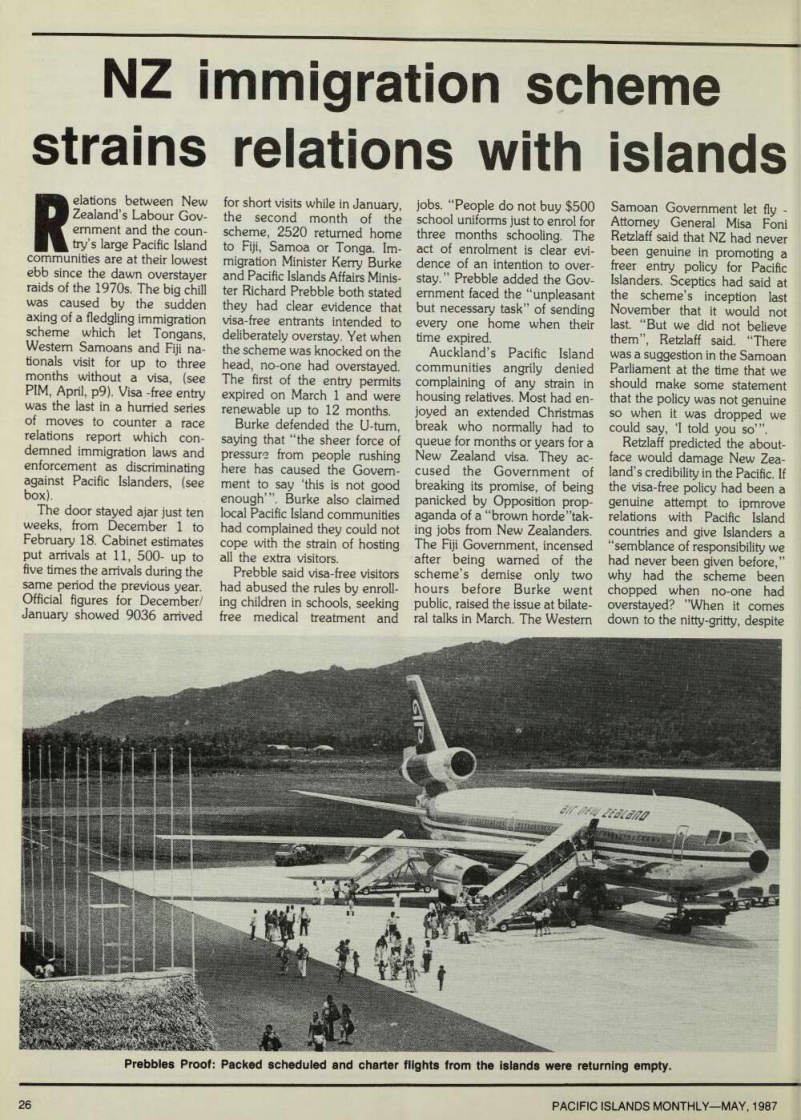
Prebbles Proof: Packed scheduled and charter flights from the islands were returning empty.
Burke and Prebble initially threatened that visa-free visitors would have to prove they had not taken jobs or enrolled their children at school before being granted extensions. Visitors who had violated the ruleswould be “removed”from New Zealand and kept out for five years. But Education officials discovered that visitors under 15 years could not be found guilty of overstaying and schools were obliged under NZ law to enrol anyone of school Similarly, despite hundreds of applications for work permits only 10 had been 3^" t ® d A c ucW ,? nd ' f ° r skilled jobs. Finally, in March, Prebble sent a letter to Pacific Wand communities: Indicahons are that the vast majority of visitors are not intending to overstay but are either returning or applying to have their permits extended.
All of which prompted one young Pacific Island community
worker to ask: “So what’s new?
That’s the history of immigration relations between New Zealand and Pacific Islands. ”
This cynicism has permeated deep into the Pacific Island communities, disillusioning even those who work for the Labour Party. For all the Govemment’s recent reasonableness, the damage has been done. As Prebble noted racial bigots have had a field day Conspiracy theories abound after all, it s election year and racial backlash is always good for a few marginal rural votes.
But it seems the visa-free as , sabotaged by shoddy planning and by the inheritance of decades of defects in New Zealand s immigraton laws and enforcement. The Government raade no approach to those who had the most to gain from policing abuses - the local Pacific Island communities who were enjoying a rare spell of peace. In
August last year the Govern ment announced an amnesty and offer of permanent resi dence for all overstayers in New Zealand since 1983. By year’s end one third of the 6000 overstayers affected had got permanent residency. Over stayer prosecutions had been suspended until passage of a new Immigration Bill.
Instead, the Government has compounded suspicion on all sides. The legs have been chop ped from under the Pacific Island communities after years of patient lobbying for more equitable immigration policies.
The very move to portray Paci fic Islanders as responsible and mature has painted them as incapable of disciplining them selves, and as undeserving of normal privileges. And just for taking advantage of what the New Zealand law allowed.
all it says,the Labour Party is not prepared to stand by Pacific Islanders. ” Retzlaff said the majority of visa-free visitors had been given ” a fair shake”.
The NZ Government had not provided specific examples of abuse of the scheme, nor had it asked the Western Samoan Government for help in preven tion of abuse. Western Samoa had planned to set up a policing system through the matais (chiefs) in New Zealand, but not until the first three months was up. Earlier action would have implied a distrust of Samoa’s motives. The Samoan, Tongan and Fijian Governments all stressed that the majority of visitors would have been genuine.
Gradually the NZ Govern ment began leaking its “proof”.
Up to 1100 primary and secondary students enrolled, most with insufficient English skills, which placed intolerable strains on scarce specialist teaching resources. Employers apparently reported hundreds of Pacific Islanders fronting for jobs without work permits.
Packed scheduled and charter flights from the Islands were said to be returning empty, and passengers were not turning up fro pre-booked charter flights.
Auckland immigration official were processing 100 applica tions a day for visa extensions and the South Auckland office was in crisis. But the contradic tions also surfaced.
Burke said a potentially su perb permanent entry policy had been corrupted by large numbers arriving under temporary entry permits but seeking to stay permanently. (If you read that twice it makes even less sense). The airlines, annoyed at being described as the “principal agents for the destruction of the system”, riposted that most charter flights had already been organised for Christmas traffic from New Zea land to the Islands. The Gov ernment suddenly had liftedy ears of entry restrictions at peak demand with rock- bottom fares on offer, so what else did it expect? Moreover, the Govern ment could have regulated the numbers of charters, but chose not to.
From Karen Mangnall,
Auckland.