urgent review
pp. 13-14 · Read in the full issue
Electoral system needs urgent review
The 1987 general elec tion in Fiji has proved one thing beyond doubt - that the system of conducting the election and registering voters is very much out of date. The present system leaves too many loopholes to be exploited by voters and political parties.
Firstly there is no compulsory registration or voting in Fiji - the responsibility for registering vo ters is largely left to the political parties, and they are also ex pected to coerce and transport the voters to polling stations during elections.
The Elections Office automa tically puts the names of those voters who had registered themselves for the previous election 5 years ago on the new roll plus those who had attained the voting age of 21 years since then. Before a new election the rolls are open for new registra tion, change of residence and also deletion of those voters who died in the period or had emigrated.
However all this is done manually and only if the Elec tion Office is informed about these alterations. There is no organised system of deleting or adding names to the rolls.
Neither is there any provision to cross check for double registra tion. Also there is no way for guaranteeing that all the eligible names on the ‘old’ roll have been transferred to the ‘new’ roll. The onus of checking these is left to the voters once the provisional rolls are prepared and are open for inspection for a limited period.
If the omissions or additions
are not picked up during this time there is no way of correc ting these once the final rolls are prepared.
Thus quite a number of people who had voted in the 1982 election were in for a rude shock when they turned up at the polling stations to cast their votes.
Some also found out to their
horror they had been shifted to another polling station and missed out completely because voting at that polling station had already closed.
Everyone the political parties as well as the Supervisor of Elections, Mr Michael Scott admitted that there were serious shortcomings in the systern which needed action be-
fore the next elections, There is no identification sys tern in Fiji; voters don’t carry ID cards and thus a voter can cast his vote more than once first in person and then through postal ballots. However, there were no reports of any major misuse of this system, Spokesmen for both main political groups, Alliance and
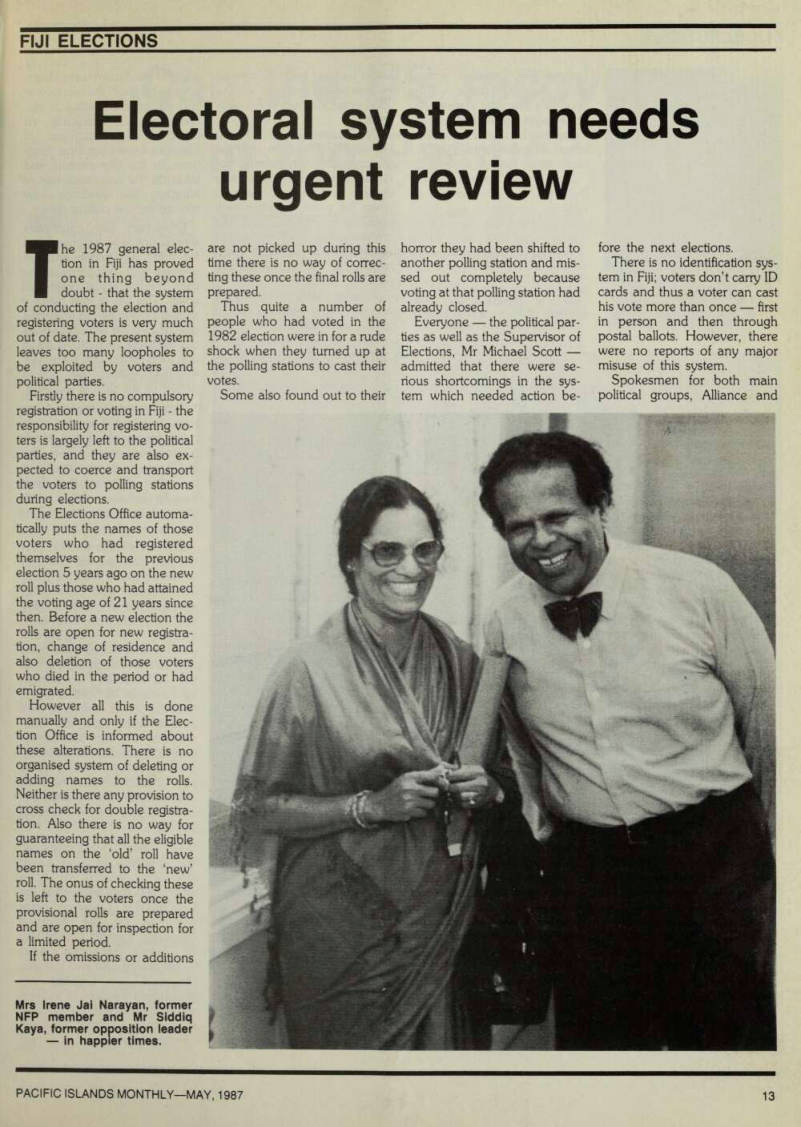
Mrs Irene Jai Narayan, former NFP member and Mr Siddiq Kaya, former opposition leader - in happier times.
Labour/NFP Coalition, agreed on at least one issue the country’s electoral system dis advantages not only the politi cal parties but it does not allow voters to exercise their demo cratic rights without restriction.
Ratu David Toganivalu, the Deputy Prime Minister and an Alliance candidate, said com pulsory registration and voting was perhaps the answer, but he
said it had not been thought to be necessary because of the good voter turnouts in Fiji elec tions.
Dr Tupeni Baba of the Labour/NFP Coalition, said the responsibility of registering vo ters should be taken over solely by the Government. He said when the political parties took over the registration task the tendency has been to ‘dump’ the registration papers of voters belonging to the opposite camp.
Without doubt it is now time for the whole electoral system to be computerised and the
office of the Supervisor of Elec tions to be given the manpower and equipment needed to dis charge its job efficiently. At present Fiji’s Supervisor of Elections carries out other func tions for the Government and takes on the enormous task of handling the elections only months before polling date.
Observers say computers should not only be introduced for voter registration and roll updates but also should be used for the actual casting of votes. This will in turn mean a shorter polling period or even a one day voting with the results out the same evening. All agree that for a country Fiji’s size with 400,000 voters, the polling period of six days is too long.
This long polling period has been highlighted as the main cause for the skirmishes which marred this year’s election. The 1987 election saw a drawn out campaign of more than four months followed by a very vigorous campaign for a fort night.
While the main political par ties had pledged the campign would be clean, with the focus on issues, and character assassination and mud-slinging kept to a minimum, they failed to live up to this. During the one week polling period while there was no active campaigning and the self-imposed moratorium by the media on political repor ting, the parties continued their tirades with paid advertise ments in the two daily news papers. This added to the fever pitch campaign, and at some polling stations minor incidents and scuffles were reported be tween supporters of opposing camps.
Mr Viliame Vakarewakuile, 46, appeared in Suva Court after one incident in Suva where two men supporting the Labour/NFP Coalition were punched by the Alliance supporter. Presiding magistrate Mr James Sabharwal jailed Vakerewakuile for two months.
He said the Constitution guaranteed freedom to express political views without recourse to violence. From our Suva correspondent.
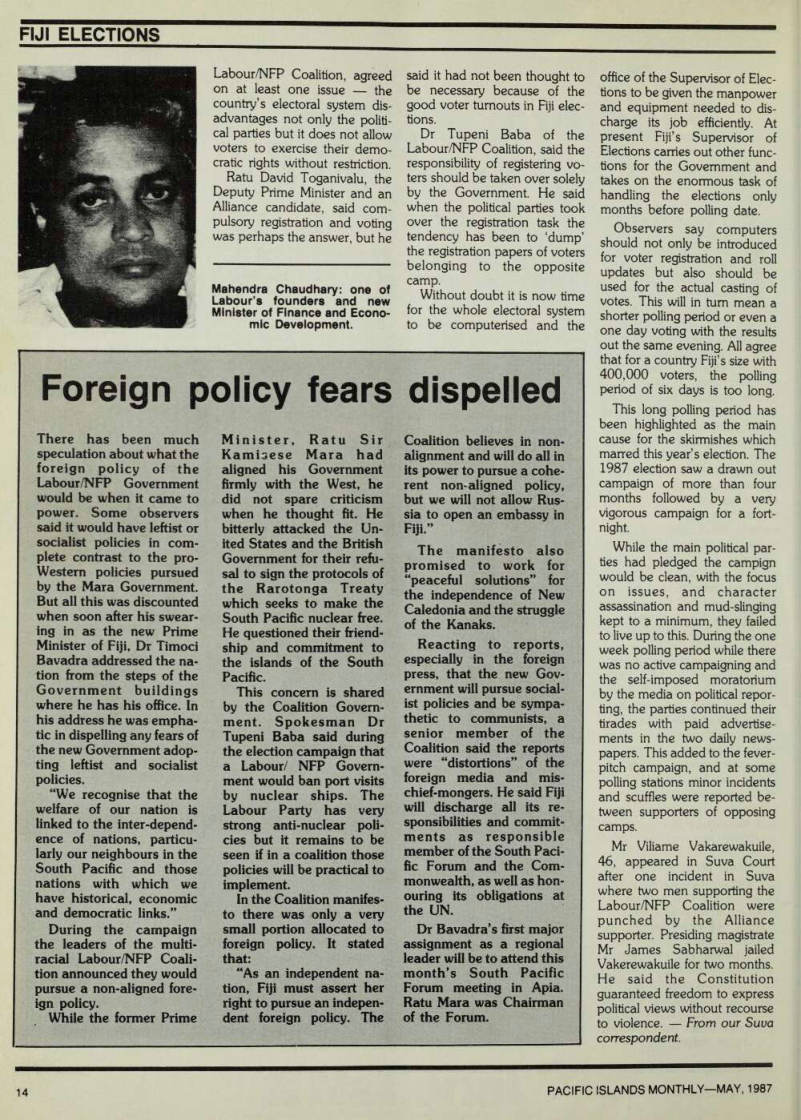
Mahendra Chaudhary: one of Labour’s founders and new Minister of Finance and Econo mic Development.