Mara Government defeated
pp. 10-11 · Read in the full issue
Fiji Elections
n , e w 3°v er nment The Coalition of National Federation Party and Labour Party has replaced the Alliance Government of Ratu Sir Kamisese Mara which had ruled the country continuously for seven years after independence in 1970 ho ™ Ihe NFP Coalition won 28
seats to Alliance s 24. The result surpnsed many political pundits but it didn’t come as a complete surprise. For the first time in Fiji s history the Coalition had put up the most formidable and best organised election cam paign to topple the Alliance Government. The Coalition of Indian- backed National Federation Party and the un
ion-backed Labour Party caphired four crucial national seats in the Suva city and peri-urban centre near Suva previously held by the Alliance.
Every election in Fiji is fought on these four seats until now always held by the Alliance but this year the there has been a complete reversal of the situation. According to the make-up
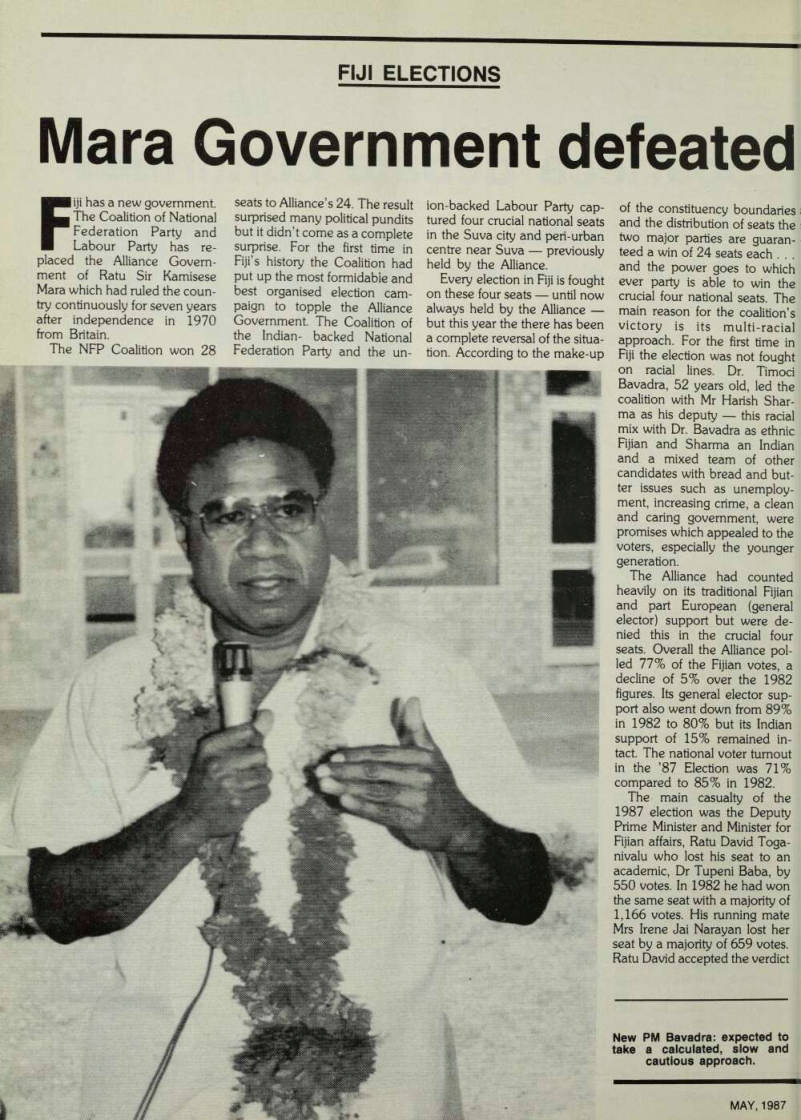
of the constituency boundaries and the distribution of seats the two major parties are guaran teed a win of 24 seats each and the power goes to which ever party is able to win the crucial four national seats. The main reason for the coalition’s victory is its multi-racial approach. For the first time in Fiji the election was not fought on racial lines. Dr. Timoci Bavadra, 52 years old, led the coalition with Mr Harish Shar ma as his deputy this racial mix with Dr. Bavadra as ethnic Fijian and Sharma an Indian and a mixed team of other candidates with bread and but ter issues such as unemploy ment, increasing crime, a clean and caring government, were promises which appealed to the voters, especially the younger generation.
The Alliance had counted heavily on its traditional Fijian and part European (general elector) support but were de nied this in the crucial four seats. Overall the Alliance pol led 77% of the Fijian votes, a decline of 5% over the 1982 figures. Its general elector sup port also went down from 89% in 1982 to 80% but its Indian support of 15% remained in tact. The national voter turnout in the ’B7 Election was 71% compared to 85% in 1982.
The main casualty of the 1987 election was the Deputy Prime Minister and Minister for Fijian affairs, Ratu David Toga nivalu who lost his seat to an academic, Dr Tupeni Baba, by 550 votes. In 1982 he had won the same seat with a majority of 1,166 votes. His running mate Mrs Irene Jai Narayan lost her seat by a majority of 659 votes.
Ratu David accepted the verdict
May, 1987
New PM Bavadra: expected to take a calculated, slow and cautious approach.
of the people graciously and said he would now bow out of politics after 23 years and prob ably go into business. Ratu David, 53, was first elected to the Legislative Council in 1966 and had remained a member of Parliament since then. His first appointment was as Par liamentary Secretary to the Minister for Fijian Affairs, 1966- 68. He was appointed a cabinet Minister in 1973 and later held the portfolios of Information, Labour and Commerce and Industry. In 1984 he was appointed as Fiji’s first Deputy Prime Minister and also the Minister for Fijian Affairs. He comes from the chiefly clan “Massau” of Bau.
Mrs Irene Jai Narayan, 54, had crossed the floor earlier this year to join the Alliance party after being with the National Federation Party for 20 years.
She had served the NFP as President and Deputy Opposi tion Leader. However, after differences with the former
leader of the opposition Mr S.M. Koya, she resigned from the party and sat as an indepen dent. Mrs Narayan, an Indian national, came to Fiji after mar rying a high school teacher and herself pursued a teaching career before entering politics.
From 1977 she had been returned to Parliament with huge majorities on an NFP ticket. She was the most articu late and vocal critic of the Alliance Government’s policies and enjoyed tremendous personal support with at the grass roots level. It was this factor which had greatly influ enced the Alliance leader Ratu Mara to accept her in the Alliance despite her past record of venemous attacks on the Alliance.
Ratu Mara had said she would bring the Indian voice in
the party and was sure to get a cabinet ministry if the Alliance had won. Mrs Narayan’s defec tion was seen by many as a ‘prize catch’ by the Alliance, and one which would bring Indian voters to the Alliance but the strategy backfired. In dian voters could not digest a betrayal by an Indian woman whom they regarded as a per son of high principles and in tegrity.
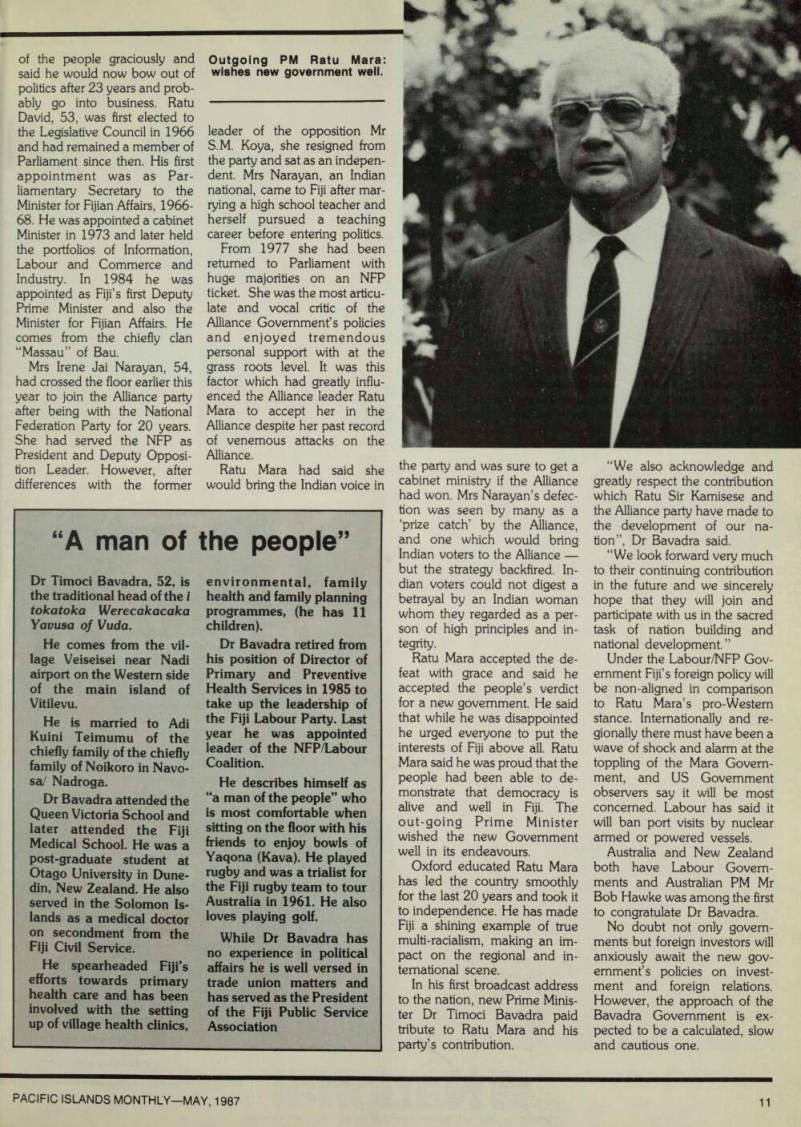
Ratu Mara accepted the de feat with grace and said he accepted the people’s verdict for a new government. He said that while he was disappointed he urged everyone to put the interests of Fiji above all. Ratu Mara said he was proud that the people had been able to de monstrate that democracy is alive and well in Fiji. The out-going Prime Minister wished the new Government well in its endeavours.
Oxford educated Ratu Mara has led the country smoothly for the last 20 years and took it to independence. He has made Fiji a shining example of true multi-racialism, making an im pact on the regional and in ternational scene.
In his first broadcast address to the nation, new Prime Minis ter Dr Timoci Bavadra paid tribute to Ratu Mara and his party’s contribution.
“We also acknowledge and greatly respect the contribution which Ratu Sir Kamisese and the Alliance party have made to the development of our na tion”, Dr Bavadra said.
“We look forward very much to their continuing contribution in the future and we sincerely hope that they will join and participate with us in the sacred task of nation building and national development.”
Under the Labour/NFP Gov ernment Fiji’s foreign policy will be non-aligned in comparison to Ratu Mara’s pro-Western stance. Internationally and re gionally there must have been a wave of shock and alarm at the toppling of the Mara Govern ment, and US Government observers say it will be most concerned. Labour has said it will ban port visits by nuclear armed or powered vessels.
Australia and New Zealand both have Labour Govern ments and Australian PM Mr Bob Hawke was among the first to congratulate Dr Bavadra.
No doubt not only govern ments but foreign investors will anxiously await the new gov ernment’s policies on invest ment and foreign relations.
However, the approach of the Bavadra Government is ex pected to be a calculated, slow and cautious one.
Outgoing PM Ratu Mara: wishes new government well.