The nurses’story
p. 39 · Read in the full issue
Captives. Australian Army Nurses in Japanese Prison Camps. Catherine Kenny.
Published by University of Queensland Press, 1986.
Isbn 0 7022 1926 6.
Catherine Kenny has achieved something quite rare with the publicaion of this book: she has managed to get what is basical ly her honours thesis out of the ivory tower and into the “com mon” market.
In popular form it is the story of 38 Australian nurses who were captured by the Japanese in World War II and made prisoners of war thirty-two in Sumatra and six in Japan itself.
In the author’s own words it “is a chronological narrative of the wartime experiences of these women.”
The material has been gathered from the Australian War Memorial and various arc hives as well as from personal interviews with several of the women who survived the ex perience.
Vivian Bullwinkel, who was the only survivor of the group of 23 nurses who were herded into the sea off Banka Island and directly fired upon by the Japanese, writes in the fore word that for many years the
women chose not to speak publicly about their experiences apart from giving evidence at the Australian War Crimes Board of Inquiry.
However, after 41 years, those interviewed by Catherine Kenny recalled events in mi nute detail, as though they happened yesterday.
While in no way wishing to disparage the horrific experi ences of these nurses, I feel the book reveals some of the short falls of oral history, particularly when such an enormous length of time has lapsed between the event and the retelling.
At the end of the story one is left with the feeling that of all the female prisoners of war, only the Australians maintained their dignity, sanity, superiority and chastity in the face of such
adversity.
There is absolutely no doubt about their incredible courage and will to survive but perhaps a hint of human fraility may have made the book more appealing for the open market.
This aside, the story is a remarkable one and should be read by all post War Australians who are mainly ignorant of the horrors of war. It may inspire some to work a little harder for
peace.
Ngaire Douglas.
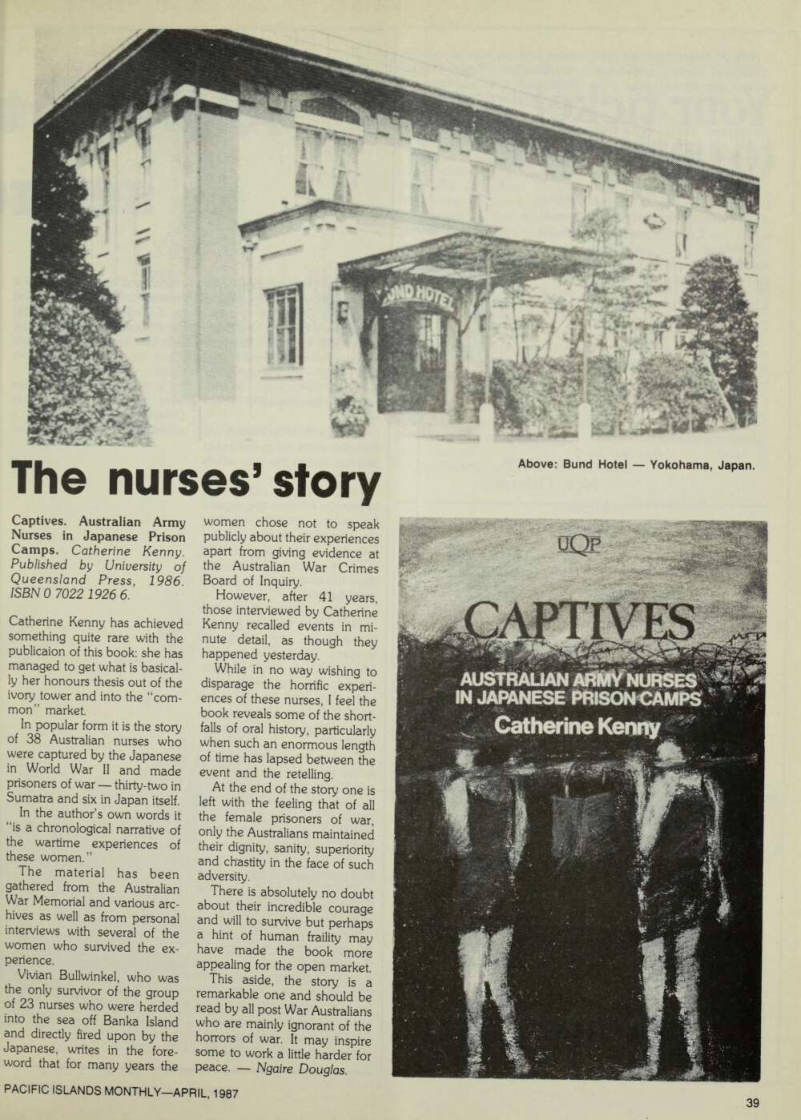
Above: Bund Hotel Yokohama, Japan.