chiefs struggled
pp. 35-36 · Read in the full issue
books
When the great chiefs struggled for power
Mananitu; The Struggle for Power in Early Fiji. By David Routledge. Published 1985 fay Institute of Pacific Studies, Uni versity of the South Pacific, Suva, Fiji. 247 pp.
Matanitu is a single volume treatment of the “struggle for political dominance between the great chiefdoms of Fiji until the end of the first half of the nineteenth century and then between Fijians, Tongans and Europeans in the years from 1855 to 1874.”
Politicial power in Fiji eman ated from the outcome of war and through the intricacies of kinship obligations, both of which constituted a basis for a system of alliances and tributary relationships among the preda tory chiefdoms. This “federat ing principle” or matanitu en abled the most powerful chiefs to “further the sphere of their influence by conquest and the formalisation of tributary or even less dignified relationship for the conquered.”
“Eventually the contest for paramountcy in the islands arose between the chiefs of Rewa and Bau. By the 1840 s, the “inevitability of a major trial of strength between Rewa and Bau became obvious” and a climatic point” was reached in the structuring of matanitu prin ciples.
Yet this contest came to be complicated by the presence of Europeans and by the intrusion of the Tongans. By 1855 in the auspicious battle of Kaba, the power of Rewa was “per manently weakened” with Bau being “confirmed paramount in
central Fiji, but at considerable cost. ”
The victory of Bau, moreov er, “spelt final defeat for the traditional religion” and a “demonstration of the ineffica cy of the old beliefs.”
Out of this momentous con frontation, Cakobau, the para mount chief of Bau and Ma’afu, the Tongan chief, emerged as paramount personalities in the struggle for political suprema cy. The diversity of interests of contending groups, especially the British, were eager to accept Cakobau as the legitimate source of Fijian authority and the Bauan chief himself was willing to cede the islands to Great Britain for such legitima cy and protection.
As the Tui Viti, Cakobau earnestly wished to secure Bau against any external threat, European and Tongan.
W. T. Pritchard, the first British consul, attempted to bring about cession and in the process created the myth of Cakobau’s absolute para mountcy. Pritchard, if nothing else, “wanted annexation, European settlement and the inflow of capital.”
Indeed, expatriate settlers and European economic in terests were becoming in creasingly influential, if not problematic to the resolution of legitimate authority in the is lands. Similarly, the establish ment of a threatening Tongan presence in the Lau islands under Ma’afu were clear indica tions that the ambitious chief intended to “create a perma nent position for himself in Fiji. ”
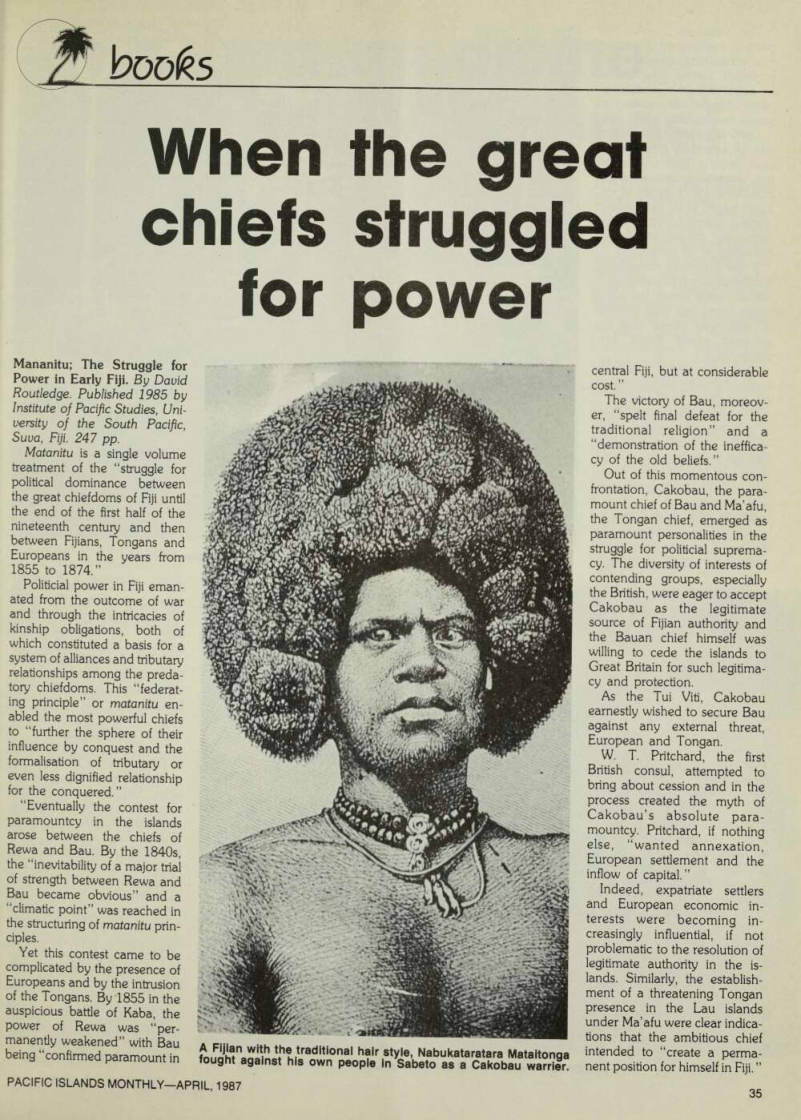
A Fijian with traditional halr style, Nabukataratara Mataitonga fought against his own people In Sabeto as a Cakobau warrier.
The vexations created by political manoeuvering among the contending interests en couraged formal intervention by Great Britain in a situation where the “whole question of power was at issue.”
Land as an object of dispute was an especially troublesome issue inviting British interven tion. Ambitious Europeans im bued with the “thought of for tune” began to be disruptive in making claims to land which seemingly eluded satisfactory resolution to all concerned.
If the European community was perplexed in its search for a way to create power, the ruling chiefs found that their exercise of traditional power was be coming even more cir cumscribed. ”
The Fijian chiefs “were no longer the main protagonists in Fijian political processes.”
The search for law and order in the islands required more vigorous and decisive action.
Though an indigenous govern ment was formed about Cako bau in 1871 detailing the order and allocation of power and authority, the chiefs came to realise “the impossibility of con tinuing to govern themselves” without the direct assistance of
Britain. If the islands were not ceded to the British, Fiji would “become like a piece of drift wood on the sea to be picked up by the first passer-by.”
With the quickly concluded Deed of Cession of 1874 secur ing the annexation of Fiji to the British crown, the struggle for power in the islands ceased without any formality.
Though a “national history” of Fiji has yet to be written in comprehensive form, Rout ledge has made a valuable contribution in identifying a ma jor historical issue of a deser ving nature. What is char acteristically noteworthy of this work is its comfortale style and a disciplined focus on power relationships.
It, however, would have been quite helpful if a kinship and descent chart had been provided outlining and identify ing the major title holders among the plethora of principal chiefs.
This book, nonetheless, re mains an exciting contribution to Pacific islands history
William Tagupa.
A Fijian burial cave - Photo Cheree Lipton.
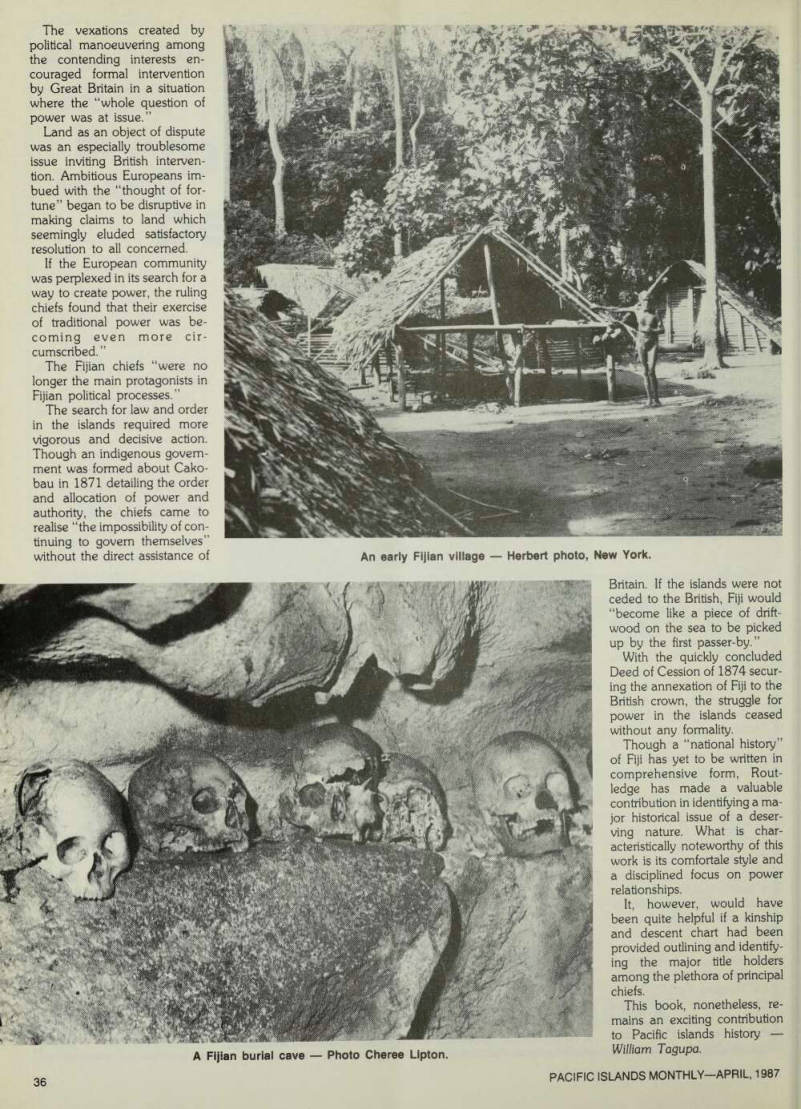
An early Fijian village - Herbert photo, New York.