Tuna deal goes
p. 28 · Read in the full issue
in slow motion
Despite the strong interest of island governments, there has been only the slowest forward motion in Washington on the tuna treaty, a visa-waiver prog ram for Guam, and nationality status for some residents of American Samoa.
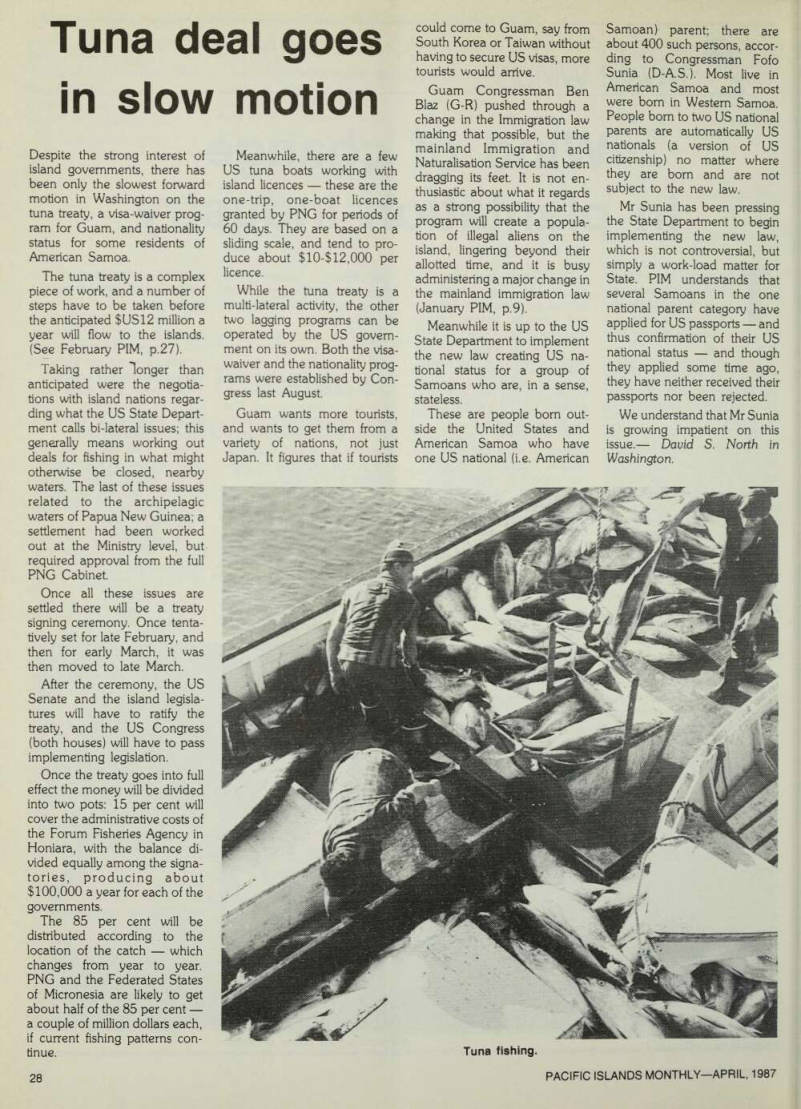
The tuna treaty is a complex piece of work, and a number of steps have to be taken before the anticipated SUSI 2 million a year will flow to the islands. (See February PIM, p. 27).
Taking rather longer than anticipated were the negotia tions with island nations regar ding what the US State Depart ment calls bi-lateral issues; this generally means working out deals for fishing in what might otherwise be closed, nearby waters. The last of these issues related to the archipelagic waters of Papua New Guinea; a settlement had been worked out at the Ministry level, but required approval from the full PNG Cabinet.
Once all these issues are settled there will be a treaty signing ceremony. Once tenta tively set for late February, and then for early March, it was then moved to late March.
After the ceremony, the US Senate and the island legisla tures will have to ratify the treaty, and the US Congress (both houses) will have to pass implementing legislation.
Once the treaty goes into full effect the money will be divided into two pots: 15 per cent will cover the administrative costs of the Forum Fisheries Agency in Honiara, with the balance di vided equally among the signa tories, producing about $lOO,OOO a year for each of the governments.
The 85 per cent will be distributed according to the location of the catch which changes from year to year.
PNG and the Federated States of Micronesia are likely to get about half of the 85 per cent a couple of million dollars each, if current fishing patterns con tinue.
Meanwhile, there are a few US tuna boats working with island licences these are the one-trip, one-boat licences granted by PNG for periods of 60 days. They are based on a sliding scale, and tend to pro duce about $lO-$12,000 per licence.
While the tuna treaty is a multi-lateral activity, the other two lagging programs can be operated by the US govern ment on its own. Both the visa waiver and the nationality prog rams were established by Con gress last August.
Guam wants more tourists, and wants to get them from a variety of nations, not just Japan. It figures that if tourists
could come to Guam, say from South Korea or Taiwan without having to secure US visas, more tourists would arrive.
Guam Congressman Ben Blaz (G-R) pushed through a change in the Immigration law making that possible, but the mainland Immigration and Naturalisation Service has been dragging its feet. It is not en thusiastic about what it regards as a strong possibility that the program will create a popula tion of illegal aliens on the island, lingering beyond their allotted time, and it is busy administering a major change in the mainland immigration law (January PIM, p. 9).
Meanwhile it is up to the US State Department to implement the new law creating US na tional status for a group of Samoans who are, in a sense, stateless.
These are people bom out side the United States and American Samoa who have one US national (i.e. American
Samoan) parent; there are about 400 such persons, accor ding to Congressman Fofo Sunia (D-A.S.). Most live in American Samoa and most were bom in Western Samoa.
People born to two US national parents are automatically US nationals (a version of US citizenship) no matter where they are born and are not subject to the new law.
Mr Sunia has been pressing the State Department to begin implementing the new law, which is not controversial, but simply a work-load matter for State. PIM understands that several Samoans in the one national parent category have applied for US passports — and thus confirmation of their US national status — and though they applied some time ago, they have neither received their passports nor been rejected.
We understand that Mr Sunia is growing impatient on this issue.— David S. North in Washington.
Tuna fishing.