pacific report
pp. 6-9 · Read in the full issue
Britain Will Not
Sign Nuclear Pact
Britain has followed the United States and decided not to sign the protocols of the South Pacific Nuclear Free Zone Treaty aimed at removing nuclear weapons from the South Pacific. The treaty’s three protocols call for a ban on nuclear tests and the stockpiling of nuclear weapons and nuclear waste in the South Pacific. France has cam paigned against the treaty charging that it is aimed at bringing an end to French nuclear testing on Moruroa Atoll and would isolate it diplomatically.
Australia Gathers
Data On Soviets
Australian aircraft and warships have been involved in a massive intelligence gathering operation on Soviet activities in the Asia-Pacific region. According to Australia’s defence minister, Mr Beazley, the operation is independent, very sub stantial and effective. Mr Beazley told parliament that his government had recently concluded an agreement with Malaysia for Australian aircraft to oper ate long-distance surveillance patrols out of Butterworth air base. Coupled with the air patrols, Australian warships had been regularly deployed in the Singa pore region. The minister was respon ding to a question in parliament concer ning Soviet activities at Cam Ranh Bay in Vietnam, Earlier, the Prime Minister, Mr Hawke, said the Government’s policy paper on defence would deal with the Cam Ranh Bay issue. The Opposition spokesman on foreign affairs, Mr Peacock, later strongly criticised Mr Beazley’s answer as inadequate and dismissive. He said figures from the Joint Intelligence Organisation and the Office of National Assessments showed the Soviet Pacific fleet was that country’s largest. The figures also showed that Cam Ranh Bay was a powerful, fully operational Soviet military base which had aircraft capable of striking a wide radius, including Australia.
Australia Plans
Defence Effort
Australia’s defence minister, Mr Beazley, has outlined a multi-million dollar prog ram for closer defence relations with the South Pacific island nations. Mr Beazley told parliament that Australia would now give the same priority to defence co operation with the Pacific as it had given
to South-East Asia over the last four decades. Mr Beazley said the govern ment had decided to provide patrol boats to the Pacific Islands, increase the number of naval-ship visits to the region, deploy long-range Australian air force patrol aircraft, and provide technical support to island defence and security forces. The patrol boat project was now well advanced and the first of the boats was undergoing sea trials off Fremantle in Western Australia. Papua New Guinea and Fiji are each to be provided with four boats, while the other vessels will be distributed to the Solomon Islands, Vanuatu, Western Samoa and the Cook Islands.
Airline Apologises
To Fr Lini
The Australian airline Qantas has apolo gised to the Prime Minister of Vanuatu, Father Walter Lini, after he was searched boarding a Qantas aircraft in Honolulu.
Father Lini had been resting in Honolulu after medical treatment in Washington where he suffered a stroke. United States officials said Qantas’s conduct was outrageous. A foreign affairs spokesman in Canberra said Qantas had apologised to the Prime Minister who was still confined to a wheelchair after his treatment. Honolulu Airport officials said the search was apparently
the result of a misunderstanding be tween the agents and airport security men, and there was no suspicion con cerning Father Uni.
Minister Accused
Of Bribery
A pro-independence leader in New Caledonia has accused the French minister for overseas territories of trying to bribe tribal chiefs during a visit to the South Pacific territory. Reuters news agency in Paris said Mr Yeiwene Yeiwene who is the president of one of the territory’s regional councils made the allegation in letters written to the French Government. In the letters, he says the overseas territories minister, Mr Bernard Pons, gave envelopes stuffed with cash to 10 chiefs in New Caledo nia’s Loyalty Islands. On his return to Paris, Mr Pons said New Caledonia’s traditional chiefs had supported a con troversial plan by the French Govern ment for a referendum on independ ence. Mr Yeiwene said the envelopes contained as much as $lBOO. He said the gifts were far beyond traditional gift-giving practices, and he claimed that Mr Pons was trying to bribe the traditional authorities. A spokeswoman for Mr Pons confirmed that he had given money to the chiefs, but the amounts were far less than those suggested by Mr Yeiwene.
Patrol boat similar to those soon to be deployed in the Pacific.
Israel Gives
Libya Warning
The retiring Israeli ambassador to Aus tralia, Mr Ben-Yaacov, warned the South Pacific of the dangers of any Libyan involvement in the region. Mr Ben- Yaacov was also accredited to Papua New Guinea, Fiji and Kiribati. The ambassador said Israel was among the first nations to give recognition to Vanuatu, but Vanuatu had not re sponded positively to Israel’s proposals to establish diplomatic relations. Mr Ben-Yaacov said Vanuatu’s diplomatic recognition of Libya was a growing cause of concern in the South Pacific.
He said Libya’s involvement in Vanuatu could not help peace in the area.
Ex-President
In New Party
A former president of Nauru, Mr Kennan Adeang, has announced the formation of the Democratic Party of Nauru the first formal political grouping in the country since 1976. Mr Adeang said eight of the 18 members of Nauru’s parliament have joined the party. He said the party will aim to curtail what he called the exten sion of presidential powers, and return the country to parliamentary democracy.
Mr Adeang will be the parliamentary leader of the party.
Envoy To Face
Charges
Disciplinary charges are to be laid against the former Papua New Guinea ambassador to Washington and the United Nations, Mr Kiatro Abisinito.
Papua New Guinea’s foreign minister, Mr Ted Diro, told parliament that his govern ment would also review the appoint ments of other ambassadors and com missioners. He was commenting on the recall of Mr Abisinito, who, the minister said, had been involved in an accident in Washington, which has caused damage and injury to a number of people and embarrassed the Papua New Guinea Government. The American State De partment said that the ambassador apologised for the accident. The ambas sador has had his driving licence can celled by the State Department and the Papua New Guinea Government has recalled him. The State Department said Mr Abisinito would leave Washington as soon as travel arrangements could be made. The department said Mr Abisinito had apologised to the family of the victim and expressed deep regret for the accident. Before the accident it was alleged Mr Abisinito had been drinking and he would have faced criminal charges, but for his diplomatic immunity.
Election Brings
New Members
Final results of Tonga’s election have been announced with half the elected members of parliament being replaced.
Of the nine people’s representatives elected, six are newcomers. They in clude some of the Government’s strong est critics, and political observers in Nuku’alofa, say the first session of the new parliament in June is likely to be a fiery one. Three of the new members are from Tonga’s largest island, Tongatapu.
They are a popular airline agent, Mr Sione Matekihefuka Lemoto, a newslet ter editor, Mr Samiuela, ’Akilisi Pohiva, and a lawyer, Mr Laki Niu. Mr Niu and two other newly elected people’s mem bers have been involved in bringing legal cases alleging improper par liamentary proceedings last year. Ear lier, the election of nine representatives of the kingdom’s nobles resulted in three changes from the previous parliament.
The 28-seat assembly will be completed by a 10-man cabinet appointed by King Taufa’ahau Tupou and led by his brother, the Prime Minister, Prince Fatafehi Tu’ipelhake.
Japanese Boats
Halt Fishing
Japanese tuna boats were to stop fishing in Papua New Guinea’s waters from March 10. This follows the suspen sion of talks after the government and Japanese fishing associations failed to reach agreement on the cost of licences.
Japan has paid up to As 3 million annually in licence fees, but Papua New Gunea has proposed a 10 per cent increase in the fees, based on the value of fish caught in the country’s waters.
The Japanese refused to accept the proposed increases, saying they were too high. The fisheries and marine resources minister, Mr Bourne, said the licence fee is low, considering Japan usually earns about AsBom. annually from Papua New Guinea’s tuna. Mr Bourne said the termination of the Japanese agreement in March opened the door to interested parties from America, Italy, South Korea and the Philippines. Japan has said it wishes to promote and protect Papua New Guinea’s fishery resources in the 200mile economic zone. In Tokyo the foreign minister, Mr Kuranari said Japan under stood that for economic reasons, Austra lia could not provide as much aid to Port Moresby as it would like. However, Japan wished to extend aid and espe cially technical co-operation to Papua New Guinea. Mr Kuranari, who visited the South Pacific in February, said that Japan’s interest in the region would be expressed by respecting independence among the island states and by helping after natural disasters.
Wife Beating
“Has To Stop”
Papua New Guinea’s police chiefs have been told to stop beating their wives.
Police Commissioner David Tasion told his provincial commanders that they had to stop beating their wives as an exam ple to the rest of the country, and to reduce domestic violence. Mr Tasion warned the commanders that anyone found guilty of wife beating would be harshly disciplined. According to official figures, nearly three quarters of all the women murdered in Papua New Guinea are killed by their husbands.
Island Technology
For Export
A Papua New Guinea business has made sales of portable sawmilling sys tems to Solomon Islands. The South Pacific Appropriate Technology Founda tion, celebrating its 10th anniversary, said t is the first Papua New Guinea business to export technology. The port able sawmill, called the Wokabaut Somil, is designed for village use, and can be carried by several men into the bush for sawmilling operations. The units sell for A 55,500 and 120 of them are being used in Papua New Guinea, The executive director of the Appropriate Technology Foundation, Mr Andrew Kauleni, said sales of the sawmills had begun in Solomon Islands, and inquiries had been received from Fiji and Vanuatu. The foundation has also exported metal recycling systems to Kiribati and Tuvalu.
Mr Kauleni says sales of scrap metal gathered through the systems earned the foundation A 5150,000 last year. The foundation, which was set up by the Papua New Guinea government in 1977, now earns about three-quarters of its annual budget of As2m.
Air Link
Is Restored
Ansett commenced its new 727 services to Port Vila from Sydney and Brisbane on March 1. Under the name Ansett Vila Services and subject to government approval the Boeing 727 will fly every Sunday from Sydney and Brisbane to Port Vila returning the same day. Ansett general manager, Mr Ted Forrester, said that although many resort hotels will not be ready to take tourists until April or May there was an immediate need for seats for builders, businessmen, electri cians and others who were needed to get Vanuatu back on its feet after the recent cyclone.
Ex-Governor
Found Guilty
In Guam, a former governor has been found guilty of corruption involving illegal payments totalling US$2OO,OOO. The jury in the case deliberated for four days after a five-week trial before finding Ricardo Bordallo guilty of 10 of the 17 charges against him. Bordallo was ac cused of receiving bribes from both Guam and Japanese businessmen. He served a total of eight years as governor of Guam which is an American territory in the Marianas. Bordallo said he would appeal.
Women Protest At
Rape Penalties
About 200 people marched through the streets of the Fiji capital Suva, in support of calls for stricter rape laws and penalties. The march was organised by the women’s rights move ments on rape laws and penalties. The marchers later handed a petition to the minister for justice and attorney general, Mr Qoroniasi Bale, who undertook to consider the submissions. Following a spate of rapes in the country, concern has been expressed that the penalties given to offenders are too lenient.
Church Leader
Denied Visa
Papua New Guinea's foreign affairs department refused to grant a visa to an Irian Jayan church leader who was to attend a church meeting in Port Mores by. Reverend Chaay of the Evangelical Church was invited by the Melanesian Council of Churches to its annual meet ing. Accompanied by his wife, Reverend Chaay arrived at the border town of Vanimo where their passports were withdrawn by migration officials. The couple remained in Vanimo for a week before being told to return to Jayapura as their passports did not have proper visas for entry into Papua New Guinea.
The general secretary of the Melanesian Council of Churches, Reverend Leva Pat, said the council was annoyed and disappointed with the decision not to grant visas. He said that in the past, church leaders from Irian Jaya were granted visas on arrival at Port Mores by’s Jackson’s Airport. However, a for eign affairs official said the department’s action was correct because Reverend Chaay and his wife should have obtained visas from Papua New Guinea’s embassy in Jakarta.
Population Up
45 Per Cent
The population of Solomon Islands has jumped 45 per cent in the past 10 years.
Provisional counting of Solomon Islands census held last November shows the country's population is now almost
286,000. The census office said the annual rate of growth in the past ten years is double the world average. The provisional census returns show a steady increase in the number of people moving from the surrounding islands to Guadalcanal and Honiara.
Chan Denies
Soviet Proposal
Papua New Guinea’s deputy prime minister, Sir Julius Chan, denied propos ing a fishing agreement with the Soviet Union. And he accused the Australian media of sensationalism. Sir Julius de nied that at any point he considered licensing Soviet vessels to fish in Papua New Guinea waters and that no pro posals on the matter had been received from the Soviet Union. However, Sir Julius did say Papua New Guinea would treat the Soviet Union on the same basis as it assessed other commercial prop ositions. He said whenever Papua New Guinea entered a new agreement, it had to cover all aspects when it considered the proposition and would not be con fined to strict commercialism. Earlier, the Soviet naval attache in Tokyo, Captain Nikolai Usov, said his country would like to negotiate a fishing agreement with
Papua New Guinea and generally in crease its links with South Pacific states.
And the second secretary of the Soviet embassy in Australia, Mr Vladimir Val kov, also said the Soviet Union would probably be interested in a fishing agreement with Papua New Guinea.
These statements followed comments by Sir Julius in Australia in which he said he would welcome a Soviet proposal on 'hing in Papua New Guinea waters.
Visa Decision
Shocks Leaders
New Zealand’s government slammed the door on visa-free entry for citizens of Fiji, Tonga and Western Samoa after just a 10-week period. The scheme, which began on December 1, allowed those island visitors three months’ stay with the option to extend for a further nine months. However, the policy was ditch ed because of alleged abuse by some Fijians, Tongans and Samoans. Im migration minister Kerry Burke said, ’The force of people rushing here has caused the government to say ’this is not good enough’,” Immigration officials estimated 11,500 islanders entered the country under the scheme that included 5,000 Tongans, 4,500 Samoans and 2,000 Fijians. Angry Pacific island leaders in Auckland denied the minister’s claim that the number of arrivals had placed undue strain on relatives in New Zea land. The re-imposition of sponsorship and visa requirements came before the visitors had even officially over stayed. Mr Foni Retzlaff, Western Samoa's attorney-general, said many in the islands community had told him the policy was an empty gesture when it was instituted in early December. At that time, he didn’t believe it. “For the New Zealand government to revoke this scheme in anticipation of Pacific islan ders overstaying speaks for the govern ment’s attitude,” he said. Mr Retzlaff said Pacific islanders realised that there was no future in overstaying because of the stiff penalties involved. “I am shocked because I never believed such a scheme would be prematurely shut off before it was given a fair go,” he said.
Mike Lane.
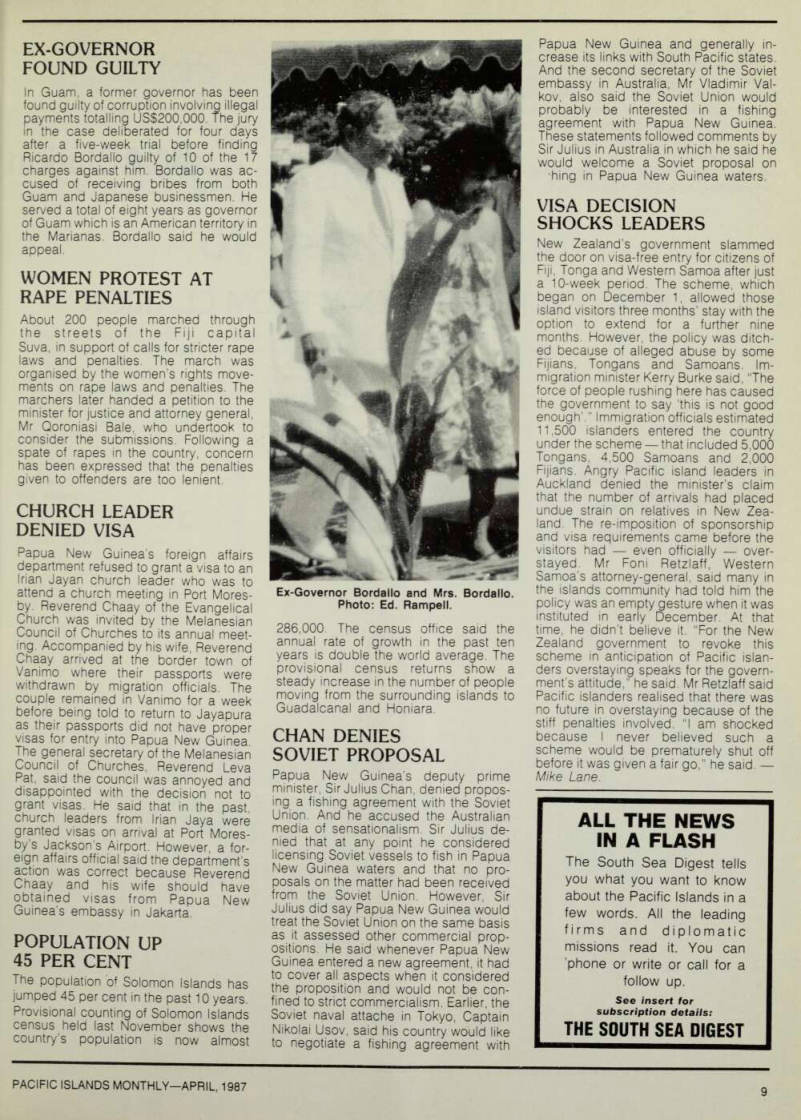
Ex-Governor Bordallo and Mrs. Bordallo.
Photo: Ed. Rampell.