Malaria: The killer that
p. 57 · Read in the full issue
comes in the night
■ n the developed world AIDS I is the vogue epidemic of the ’Bos. Nothing can touch it. It’s lethal, so far incurable and the most committed atheist cannot help but reflect on the image of an Old Testament God of vengeance.
But, measured against the victims of malaria, the death toll from AIDS even at its worst in Central Africa, is minuscule.
Malaria is also lethal. It too attacks the human immunity system so that the victim suc cumbs to a process of slow debilitation, eventually falling to other, often simple, ailments to which the body has lost its defences.
For malaria, again as for AIDS, there is no sure cure.
Certain drugs and repeated DDT spraying programs reduce its penetration, but the malarial parasite has survived, adjusted, adapted and returned more virulent than ever.
Africa alone suffers 100 mil lion deaths each year from malaria and it is a dominant cause of infant mortality in populations of hundreds of mil lion more.
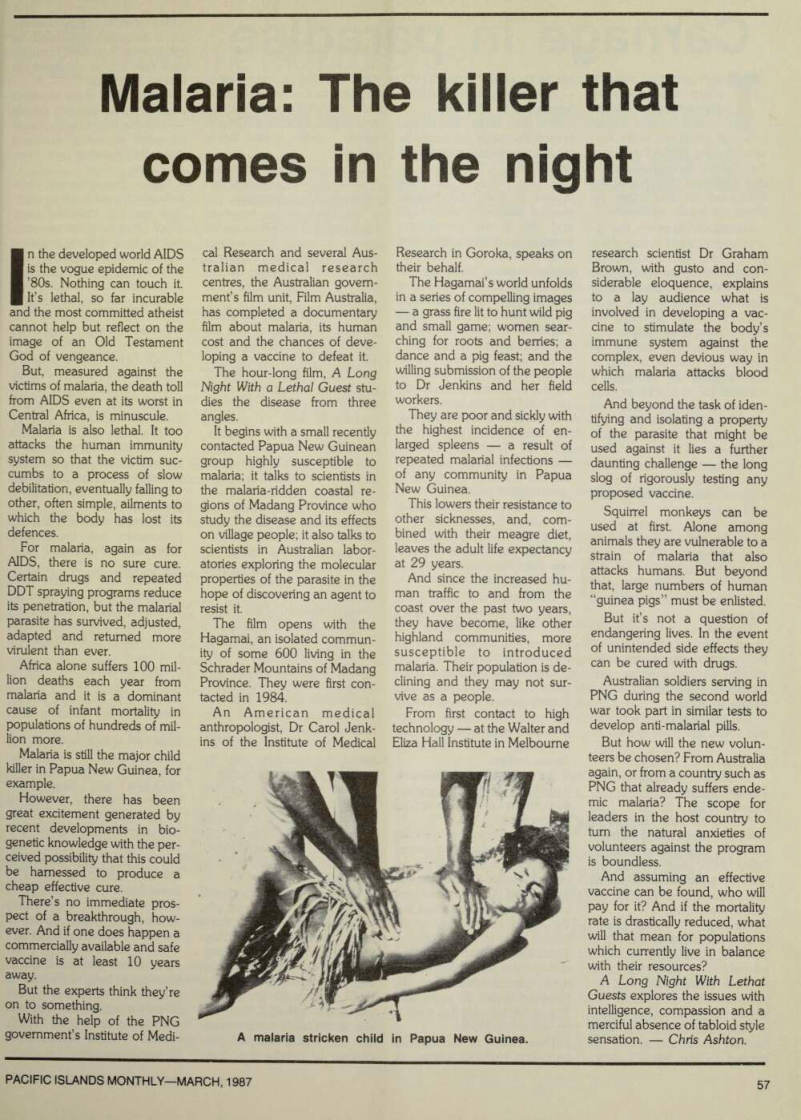
Malaria is still the major child killer in Papua New Guinea, for example.
However, there has been great excitement generated by recent developments in bio genetic knowledge with the per ceived possibility that this could be harnessed to produce a cheap effective cure.
There’s no immediate pros pect of a breakthrough, how ever. And if one does happen a commercially available and safe vaccine is at least 10 years away.
But the experts think they’re on to something.
With the help of the PNG government’s Institute of Medi
cal Research and several Aus tralian medical research centres, the Australian govern ment’s film unit, Film Australia, has completed a documentary film about malaria, its human cost and the chances of deve loping a vaccine to defeat it.
The hour-long film, A Long Night With a Lethal Guest stu dies the disease from three angles.
It begins with a small recently contacted Papua New Guinean group highly susceptible to malaria; it talks to scientists in the malaria-ridden coastal re gions of Madang Province who study the disease and its effects on village people; it also talks to scientists in Australian labor atories exploring the molecular properties of the parasite in the hope of discovering an agent to resist it.
The film opens with the Hagamai, an isolated commun ity of some 600 living in the Schrader Mountains of Madang Province. They were first con tacted in 1984.
An American medical anthropologist, Dr Carol Jenk ins of the Institute of Medical
Research in Goroka, speaks on their behalf.
The Hagamai’s world unfolds in a series of compelling images a grass fire lit to hunt wild pig and small game; women sear ching for roots and berries; a dance and a pig feast; and the willing submission of the people to Dr Jenkins and her field workers.
They are poor and sickly with the highest incidence of en larged spleens a result of repeated malarial infections of any community in Papua New Guinea.
This lowers their resistance to other sicknesses, and, com bined with their meagre diet, leaves the adult life expectancy at 29 years.
And since the increased hu man traffic to and from the coast over the past two years, they have become, like other highland communities, more susceptible to introduced malaria. Their population is de clining and they may not sur vive as a people.
From first contact to high technology at the Walter and Eliza Hall Institute in Melbourne
research scientist Dr Graham Brown, with gusto and con siderable eloquence, explains to a lay audience what is involved in developing a vac cine to stimulate the body’s immune system against the complex, even devious way in which malaria attacks blood cells.
And beyond the task of iden tifying and isolating a property of the parasite that might be used against it lies a further daunting challenge the long slog of rigorously testing any proposed vaccine.
Squirrel monkeys can be used at first. Alone among animals they are vulnerable to a strain of malaria that also attacks humans. But beyond that, large numbers of human “guinea pigs” must be enlisted.
But it’s not a question of endangering lives. In the event of unintended side effects they can be cured with drugs.
Australian soldiers serving in PNG during the second world war took part in similar tests to develop anti-malarial pills.
But how will the new volun teers be chosen? From Australia again, or from a country such as PNG that already suffers ende mic malaria? The scope for leaders in the host country to turn the natural anxieties of volunteers against the program is boundless.
And assuming an effective vaccine can be found, who will pay for it? And if the mortality rate is drastically reduced, what will that mean for populations which currently live in balance with their resources?
A Long Night With Lethat Guests explores the issues with intelligence, compassion and a merciful absence of tabloid style sensation. Chris Ashton.
A malaria stricken child in Papua New Guinea.