making confusion
p. 48 · Read in the full issue
Strikes reveal decision making confusion
The official line is that French Polynesia has been blessed with genuine and complete internal self government since September 1984. However, a chain reaction of labour dis putes in the territory have once again shown that Paris still pulls the strings.
Finally, it fell to the Evangeli cal Church, to which 80 per cent of the Polynesian popula tion belongs, to solve the argu ment.
The first to strike in early November last year were unexpectedly the smart UTA cabin crews. Their complaint was clearly spelled out on their posters in Tahitian, French and English: “UTA discriminates against Polynesians.”
To those who cared to stop and listen, the strikers claimed that they receive lower salaries and fewer fringe benefits than their colleagues in France and New Caledonia for doing the same job. They were equally critical of the the company’s policy of hiring locals on a temporary basis.
The strike which lasted one month did not impress the company which repeated in the local media that there were plenty of Polynesians willing to take the jobs on the conditions rejected by the strikers which was true.
But before the stewards and stewardesses abandoned their struggle, public attention had shifted to another group of workers the much tougher and more loud-mouthed Pape ete dockers.
Not only did they refuse to unload several cargo ships at the Motu Uta wharf, they also blocked the entrance to the harbour area, thus preventing previously unloaded goods from leaving the warehouses.
The spur for the strike was the decision made in Paris to permit the Compagnie Gen
erale Maritime to set up its own Papeete stevedoring company instead of using a local com pany as had been done in the past.
The threatened company is the oldest of its kind in Tahiti, having been founded in 1924 by the famous Pacific boxing champion Jack Cowan who moved from Rarotonga to Tahi ti shortly after World War One and married there.
For the past ten years the company, which also operates
the Bounty shipping service
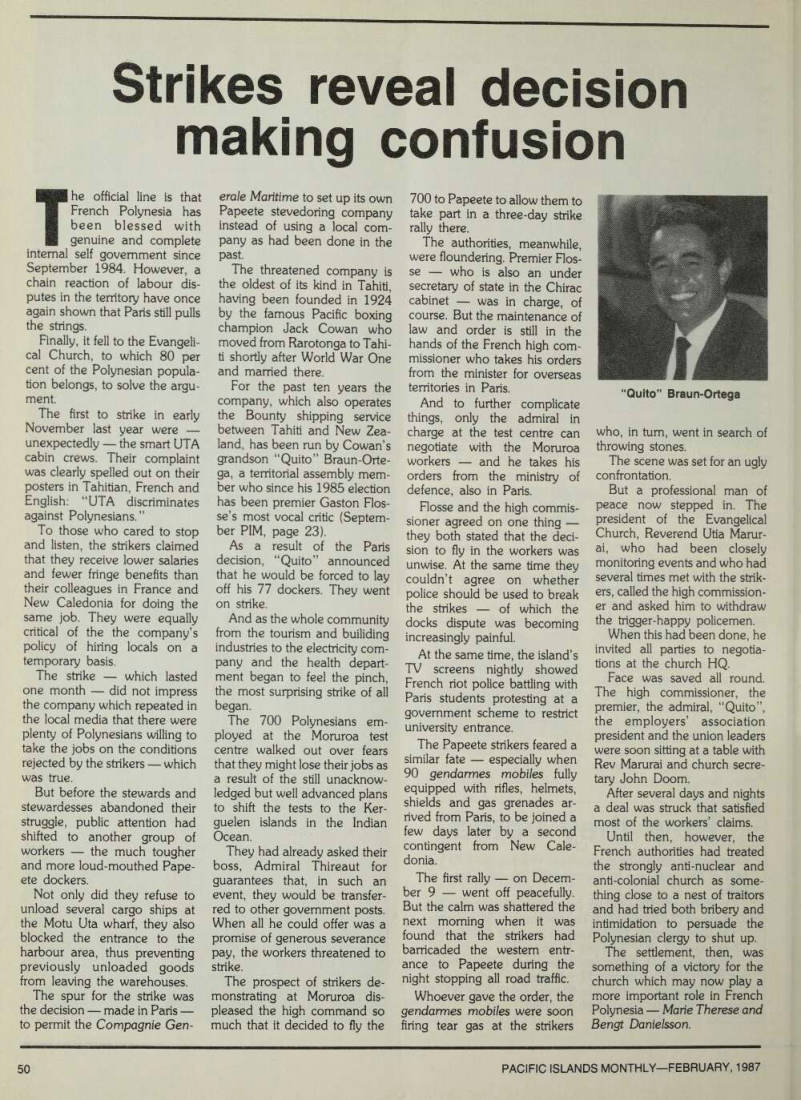
between Tahiti and New Zea land, has been run by Cowan’s grandson “Quito” Braun-Orte ga, a territorial assembly mem ber who since his 1985 election has been premier Gaston Flos se’s most vocal critic (Septem ber PIM, page 23).
As a result of the Paris decision, “Quito” announced that he would be forced to lay off his 77 dockers. They went on strike.
And as the whole community from the tourism and builiding industries to the electricity com pany and the health depart ment began to feel the pinch, the most surprising strike of all began.
The 700 Polynesians em ployed at the Moruroa test centre walked out over fears that they might lose their jobs as a result of the still unacknow ledged but well advanced plans to shift the tests to the Ker guelen islands in the Indian Ocean.
They had already asked their boss, Admiral Thireaut for guarantees that, in such an event, they would be transfer red to other government posts.
When all he could offer was a promise of generous severance pay, the workers threatened to strike.
The prospect of strikers de monstrating at Moruroa dis pleased the high command so much that it decided to fly the
700 to Papeete to allow them to take part in a three-day strike rally there.
The authorities, meanwhile, were floundering. Premier Flos se who is also an under secretary of state in the Chirac cabinet was in charge, of course. But the maintenance of law and order is still in the hands of the French high com missioner who takes his orders from the minister for overseas territories in Paris.
And to further complicate things, only the admiral in charge at the test centre can negotiate with the Moruroa workers and he takes his orders from the ministry of defence, also in Paris.
Flosse and the high commis sioner agreed on one thing they both stated that the deci sion to fly in the workers was unwise. At the same time they couldn’t agree on whether police should be used to break the strikes of which the docks dispute was becoming increasingly painful.
At the same time, the island’s TV screens nightly showed French riot police battling with Paris students protesting at a government scheme to restrict university entrance.
The Papeete strikers feared a similar fate especially when 90 gendarmes mobiles fully equipped with rifles, helmets, shields and gas grenades ar rived from Paris, to be joined a few days later by a second contingent from New Cale donia.
The first rally on Decem ber 9 went off peacefully.
But the calm was shattered the next morning when it was found that the strikers had barricaded the western entr ance to Papeete during the night stopping all road traffic.
Whoever gave the order, the gendarmes mobiles were soon firing tear gas at the strikers
who, in turn, went in search of throwing stones.
The scene was set for an ugly confrontation.
But a professional man of peace now stepped in. The president of the Evangelical Church, Reverend Utia Marur ai, who had been closely monitoring events and who had several times met with the strik ers, called the high commission er and asked him to withdraw the trigger-happy policemen.
When this had been done, he invited all parties to negotia tions at the church HQ.
Face was saved all round.
The high commissioner, the premier, the admiral, “Quito”, the employers’ association president and the union leaders were soon sitting at a table with Rev Marurai and church secre tary John Doom.
After several days and nights a deal was struck that satisfied most of the workers’ claims.
Until then, however, the French authorities had treated the strongly anti-nuclear and anti-colonial church as some thing close to a nest of traitors and had tried both bribery and intimidation to persuade the Polynesian clergy to shut up.
The settlement, then, was something of a victory for the church which may now play a more important role in French Polynesia Marie Therese and Bengt Danielsson.
“Quito” Braun-Ortega