Salii runs into referendum trouble
pp. 46-47 · Read in the full issue
referendum trouble
When voters of Palau failed for the fourth time to ratify a com pact of free associa tion with the United States, it was seen as a stunning political upset both for the US adminis tration and for Palau president Lazarus Salii.
The latest poll December 2 was an important setback.
The referendum results show that 65 per cent of the voters favoured the compact; 34 per cent were against.
The Supreme Court had ear lier ruled that the compact required 75 per cent of the votes to overturn Palau’s non nuclear constitution.
However, the previous polls had showed a steady increase in the ‘yes’ vote with an accom panying decrease in the num ber of votes cast.
In contrast, at the last re ferendum, more voters went to the polls (nearly 80 per cent)
As Palau’s voters again failed to muster the required majority to enable ratification of the Compact of Free Association with the United States, the tide may be turning against the government of President Salii. ED RAMPELL also reports that the latest vote has unleashed a number of unlikely allegations that have much wider implications.
and more said ‘no’.
The significant drop in the ‘yes’ vote may indicate growing disenchantment with the Salii administration. Minister of State John Ngiraked (who was also election commissioner) said later that “internal politics” played an important role in the referendum.
“Voting against the ‘Yes’ group was an expression of dissent against the Salii admin istration,” he said in an inter view.
And Salii’s government has been coming under increasing attack. After he certified the
compact as being ratified last February, Palau’s paramount traditional leader, Ibedul High Chief Yutaka Gibbons, took the case to court over the 75 per cent rule.
Part of the Palau constitution states: “Harmful substances such as nuclear, chemical, gas or biological weapons intended for use in warfare, nuclear power plants and waste materials therefrom shall not be used, tested, stored or disposed of within the territorial jurisdic tion of Palau without the ex press approval of not less than three fourths of the votes cast in
a referendum submitted on this specific question.”
That effectively rules out the compact with its military provi sions and the court upheld the chiefs case.
After that the painstakingly orchestrated consensus Salii had achieved in February when most of the national leadership publicly endorsed the compact began to erode.
As well as the compact im passe, Salii had inherited other pressing problems from his pre decessor, Haruo Remeliik who was assassinated on June 30, 1985.
Chief among those is the Ipseco power project crisis (PIM, August pl 2), which has led to Palau’s defaulting on its international debt.
Allegations of massive corruption have dogged the project the latest of these have come from the American Civil Liberties Union (ACLU)
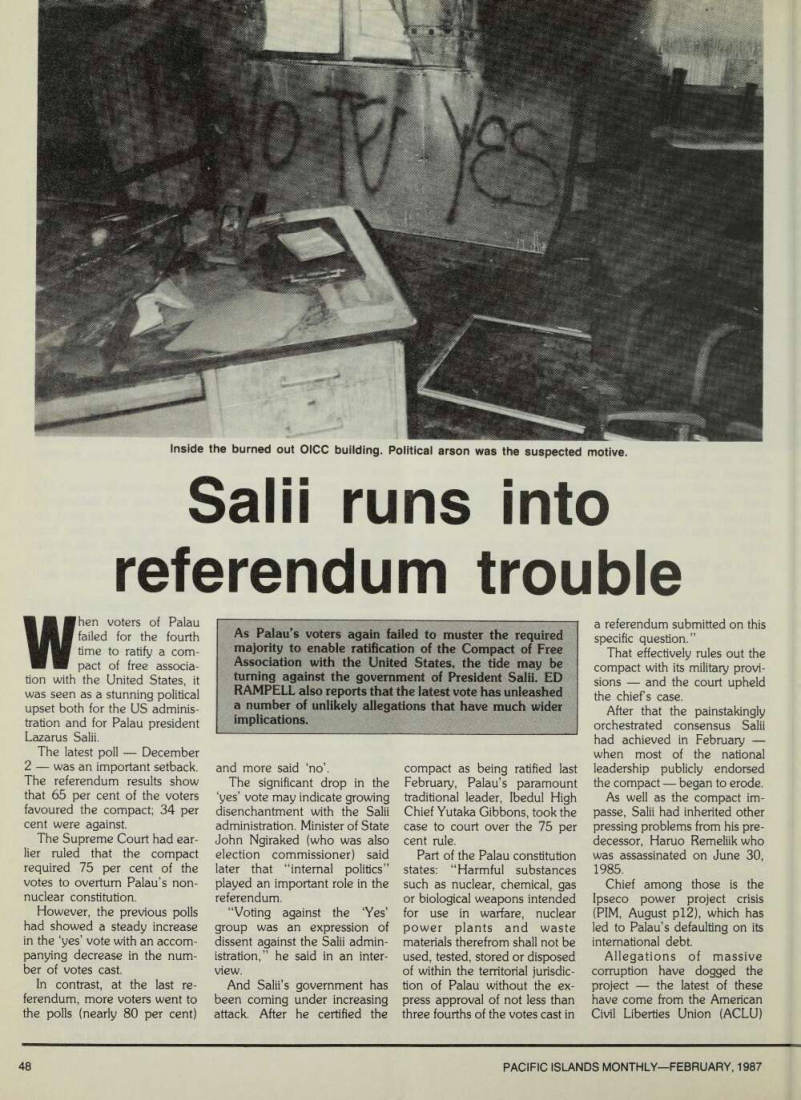
Inside the burned out OICC building. Political arson was the suspected motive.
and the House of Delegates in Palau.
The president’s brother, De legate Carlos Salii has been under investigation for allegedly accepting a US$l.5 million bribe from the British power firm.
And the fact that TTPI High Commissioner Janet McCoy and President Reagan’s perso nal representative to Mic ronesia, Ambassador Fred Zed er strongly supported the Ipse co project has led to speculation from the ACLU among others that the power plant proposal was a plan to bankrupt Palau in order to force ratification of the compact as a means of re paying the $37 million debt.
The US military, the specula tion goes, would then con veniently find an outsize power generator and fuel farm waiting for any future bases on TTPI’s biggest island, Babeldaob.
By October national consen sus was dead. A change in the Senate leadership which purged itself of officers and chairmen opposed to the com pact infuriated many leaders and citizens.
Anonymous government employees distributed a letter condemning the administration for “Marcos style corruption.”
And allegations of electoral irre gularities leading up to the December plebiscite clouded the issue.
The Palauan opposition and a 5-member delegation repre senting human rights groups from Australia, New Zealand, USA, Canada and the EC filed formal complaints with the UN observer mission (with repre sentatives from the UK, France, Papua New Guinea and Fiji)
and the president.
The complaint claimed that the administration “violated the neutrality of the civil service, misused government funds and resources,” and questioned the security of the ballot. All this, they alleged, had been done in an effort to secure enough ‘Yes’ votes for the compact to pass.
In particular, the government was condemned for closing the schools for 10 days and order ing teachers to campaign and vote for the compact. Presi dential spokesman Bonifacio Basilius and Minister-Election Commissioner Ngiraked admit that government employees were told to campaign and vote for the compact.
Meanwhile, in the early mor ning of November 26, the Offic er in Charge of Construction (OICC) office went up in flames. Inside the charred re mains of the US Navy construc tion unit’s quarters was scrawled grafitti such as: “Vote Yes Compact” along with “Vote For Government” as well as a number of obscenities.
Politically motivated arson was suspected.
After the referendum result became known, President Salii refused to comment on what the future might hold for Palau, but he has stated, in the Pacific Daily News, that without the compact, the nation faces tough times.
Others are more vocal. Ngir aked said: “Stringent measures of budgetary constraints will be taken to trim the government to fit the budget. ” (This year Palau is allocated only about $lO million, while under the com pact it would have received $l4l million) He indicated that the admin
istration was now likely to move to amend the nuclear free pro vision in the constitution. How ever, this would leave the gov ernment open to yet another legal challenge as it is not clear that the required plebiscite can be held before the next year’s elections.
Meanwhile the war or words rages.
Senate President Joshua Koshiba: “Palau is going to hell ... Now we go to the Russians (to negotiate).”
Presidential assistant Joel Toribiong; Communism is bet ter than this TT toilet tissue
government. Anything’s bet ter. You can quote me.”
Governor Roman Tmetuchl (a former two-time presidential candidate whose relatives were convicted of the Remeliik assassination on what the ACLU believed to be flimsy evidence): “Independence is the ultimate goal of all people.
We should not be ruled by anybody else. Anybody who doesn’t think so should go to the hospital for a check up.”
Like many compact critics they would prefer the term of the agreement to be reduced from 50 to 15 years