the publicity pirates
pp. 44-45 · Read in the full issue
Last voyage of the publicity pirates
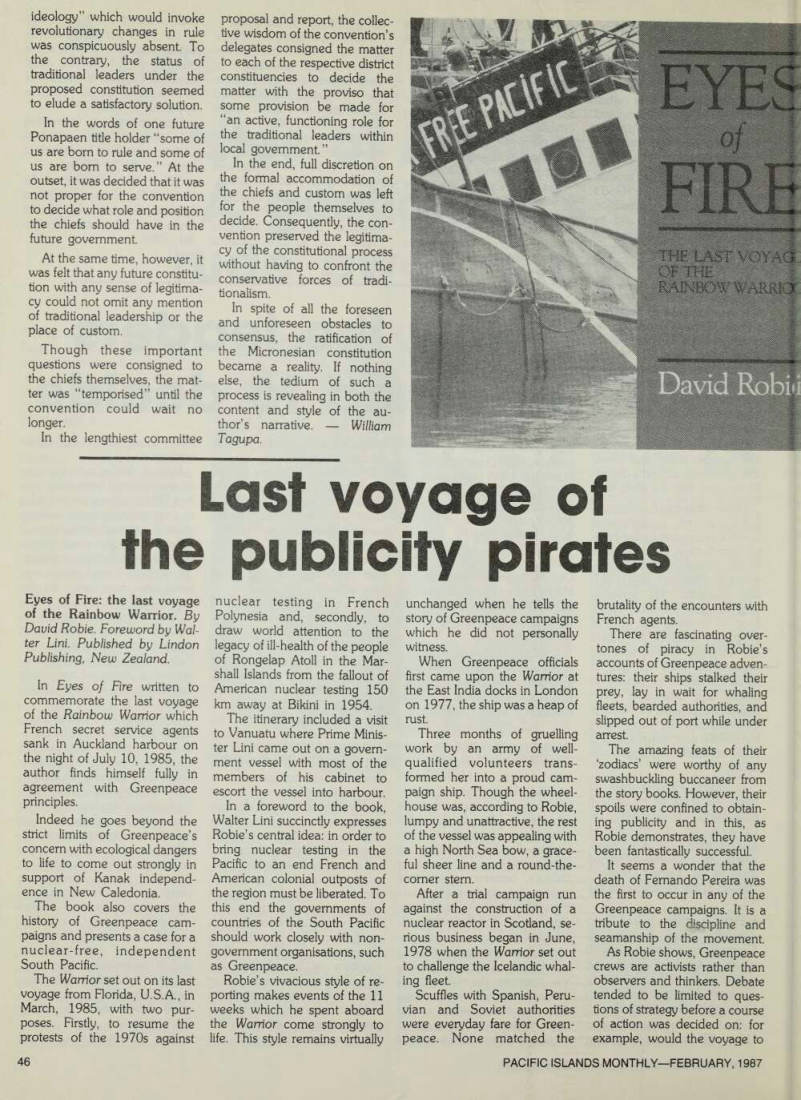
Eyes of Fire: the last voyage of the Rainbow Warrior. By David Robie. Foreword by Walter Uni. Published by Lindon Publishing, New Zealand.
In Eyes of Fire written to commemorate the last voyage of the Rainbow Warrior which French secret service agents sank in Auckland harbour on the night of July 10, 1985, the author finds himself fully in agreement with Greenpeace principles.
Indeed he goes beyond the strict limits of Greenpeace’s concern with ecological dangers to life to come out strongly in support of Kanak independence in New Caledonia.
The book also covers the history of Greenpeace campaigns and presents a case for a nuclear-free, independent South Pacific.
The Warrior set out on its last voyage from Florida, U.S.A., in March, 1985, with two purposes. Firstly, to resume the
protests of the 1970 s against
nuclear testing in French Polynesia and, secondly, to draw world attention to the legacy of ill-health of the people of Rongelap Atoll in the Mar shall Islands from the fallout of American nuclear testing 150 km away at Bikini in 1954.
The itinerary included a visit to Vanuatu where Prime Minis ter Lini came out on a govern ment vessel with most of the members of his cabinet to escort the vessel into harbour, In a foreword to the book, Walter Lini succinctly expresses Robie’s central idea: in order to bring nuclear testing in the Pacific to an end French and American colonial outposts of the region must be liberated. To this end the governments of countries of the South Pacific should work closely with non government organisations, such as Greenpeace.
Robie’s vivacious style of re porting makes events of the 11 weeks which he spent aboard the Warrior come strongly to life. This style remains virtually
unchanged when he tells the story of Greenpeace campaigns which he did not personally witness.
When Greenpeace officials first came upon the Warrior at the East India docks in London on 1977, the ship was a heap of rust.
Three months of gruelling work by an army of well qualified volunteers trans formed her into a proud cam paign ship. Though the wheel house was, according to Robie, lumpy and unattractive, the rest of the vessel was appealing with a high North Sea bow, a grace ful sheer line and a round-the corner stern.
After a trial campaign run against the construction of a nuclear reactor in Scotland, se rious business began in June, 1978 when the Warrior set out to challenge the Icelandic whal ing fleet.
Scuffles with Spanish, Peru vian and Soviet authorities were everyday fare for Green peace. None matched the
brutality of the encounters with French agents.
There are fascinating over tones of piracy in Robie’s accounts of Greenpeace adven tures: their ships stalked their prey, lay in wait for whaling fleets, bearded authorities, and slipped out of port while under arrest.
The amazing feats of their ‘zodiacs’ were worthy of any swashbuckling buccaneer from the story books. However, their spoils were confined to obtain ing publicity and in this, as Robie demonstrates, they have been fantastically successful.
It seems a wonder that the death of Fernando Pereira was the first to occur in any of the Greenpeace campaigns. It is a tribute to the discipline and seamanship of the movement.
As Robie shows, Greenpeace crews are activists rather than observers and thinkers. Debate tended to be limited to ques tions of strategy before a course of action was decided on: for example, would the voyage to
the Pacific take precedence over a campaign against oil spillage in the Persian Gulf?
Once a line of action was decided everyone was too busy to express doubts. On occasion crewmen could be surprisingly ready with their fists, but only in self-defence, as when some of the crew ran into a group of rowdies in a bistro in Jackson ville, Florida.
After sticking to their tasks through thick and thin, a wild party was often a popular way of winding down.
Greenpeace’s evacuation of the entire population of Ronge lap is one of the highlights of the book as it represented a new type of venture for the organisation, completely differ ent from the symbolic evacua tion which it had originally planned and with unknown consequences for the islanders.
Robie, who took part in the operation, conveys the uneasi ness of Greenpeace leaders about the future of the 320 islanders who forsook their beautiful atoll to settle on a small island on the rim of Kwajalein Atoll, across the la goon from the American missle range.
But the Warrior did the job well and then resumed its voyage.
It is possible that the author over-estimates the effectiveness of Greenpeace campaigns.
While there is no doubt that governments have much to fear from the publicity that Green peace can generate, one sus pects that the campaigns have not always been as determining a factor in provoking a change of government policy as Robie believes.
Evidence is available, for ex ample, that the French govern ment had decided to terminate atmospheric testing in Polynesia, long before the Greenpeace campaigns got under way in the 1970 s and, incidentally, before Australia and New Zealand took the case against France to the Internatio nal Court of Justice.
Both these steps reflected world revulsion against the con tinuation of French atmospheric testing long after the superpow ers had stopped. There is no doubt that this widespread feel ing acted as a spur to the
French to switch to under ground testing.
Robie’s assessment of the problems that the nuclear poli cies of France and the United States cause the South Pacific tends to be simplistic.
His chapter, The Nuclear Blackmailers, would perhaps have been more effective if he had emphasised the differences between the defence policies of these powers.
Like Russia, the United
States is a super-power with territories bordering the Pacific and must be conceded legiti mate defence interests within the region.
On the other hand, France’s principal defence projects in the Pacific are part of a strategy which is entirely centred on the defence of Europe, and there is little justification for their pre sence in the Pacific. Robie’s criticism of America and France would have been more tren
chant if such differences had been borne in mind.
Notwithstanding such objec tions, David Robie’s book is likely to become very popular reading among supporters of Greenpeace.
It should also fascinate read ers interested in voyaging in the Pacific as well as contributing to the rapidly growing literature dealing with what the author calls the French ‘blunder-
Watergate’.
Barry Shineberg.