investment famine
pp. 37-40 · Read in the full issue

Farmers field investment famine
T hough small industry and manufacturing are receiving a lot of attention, agriculture re mains the economic lifeblood of Tonga between 1975 and 1984, agri culture accounted for at least 80 per cent of the kingdom’s total exports. In six of those seven years, it was at least 90 per cent. Nine of every 10 house holds were engaged in some form of farming activity in 1979.
However, the sector’s growth has slowed. In real terms, export income has declined in the past five years. That is no news to agricultural officials who acknowledge a transfusion is needed to pump life into this vital sector.
There is no clear consensus in gov ernment circles of the right path to follow. The Government of Tonga has attempted to boost agricultural produc tion by establishing a more modern infrastructure with the multi-million dol lar wharf complex and improved ship ping links.
However, Sebastian Hurrell, director of The Commodities Board, which exports most of the Kingdom’s agricultural produce says this may be putting the cart before the horse.
“More resources should be injected into the productive sectors of the economy. It’s important to diversify as we have been doing, but the trend seems to be away from agricultural investment. Enterprising farmers should be given all the encouragement pos sible,” he said.
Dr Kevin Makin, who worked as agricultural economist with the Central Planning Department, said that while agriculture contributed 49 per cent of the gross national product in 1984, it received less than 10 per cent of the gross capital investment.
In 1979, a South Pacific Agricultural Survey funded by the Asian Deve lopment Bank recommended increased crop production on the main island of Tongatapu aimed at export markets.
Such a system would include large and small growers producing on contract for a central marketing and processing organisation.
The report’s authors viewed such a development as essential because the larger holdings would provide a more
The shift from subsistence to com mercial agriculture is never easy. But for small island nations, it is seen as a necessity for progress. MIKE LANE in Nukualofa has looked at the Tongan experience which may hold lessons for other island states travelling the same road.
stable base of production not normally found on smaller farms.
Aleki Sisifa, acting Director of the Ministry of Agriculture, Fisheries and Forests, said that some growers are already beginning to cultivate large acreages that balance the smaller farms.
However, Tonga still relies on a smallholder system with coconut as the centrepiece for the foreseeable future.
Agriculture officials have been frus-
trated by their inability to devise a strategy that improves nut production while allowing farmers to make better use of the land under coconuts.
“We consider coconut a priority crop, but we don’t want to put too many resources into its development,” Sisifa said, “that is in relation to other crops. ”
Because of the great swings in coconut prices, the ministry wants to hedge its bet. That contrasts with other governments in the region that have invested substantial sums in coconut research and development.
Bananas, vanilla, coffee, ginger, black pepper and cocoa are compatible with coconut cultivation. However, only bananas and vanilla have been culti vated extensively beyond the research level.
Ministry officials maintain that these intercrops should enhance nut produc
tion and also improve the income of farmers tending the coconut groves.
These palms suffer from both neglect and abuse. Farmers burn them when clearing land or plough them under when preparing to plant a crop.
Smallholder commercial farming can succeed as demonstrated by the sugar cane industry in Fiji and to a lesser degree banana and vanilla farming in Tonga. However, there is room for improvement.
To help this sector, a farming systems research project funded by the Austra lian Centre for International Agricultural Research is currently underway in Ton ga. By collecting data from the three main island groups, ministry officials hope to answer questions about land use, cropping patterns and costs of production that will improve future planning.
The shifting cultivation, multi-crop Tongan system is based on the premise that people can grow enough to feed themselves and sell the surplus. How ever, traditional subsistence is being squeezed by the attractions of cash cropping and increased demand for land.
This situation has reached a near critical level on Tongatapu because of the influx of people from the outer islands. As the pressure for land has increased, the fallow period has de creased.
Subsistence agriculture falters when there is not enough land for fallows of necessary length or fertilizers are not added. Without either of these compo nents, the fertility of the soil suffers.
The people moving to Tongatapu are the new poor. Without easy access to land, their salary is barely enough to buy food for the family.
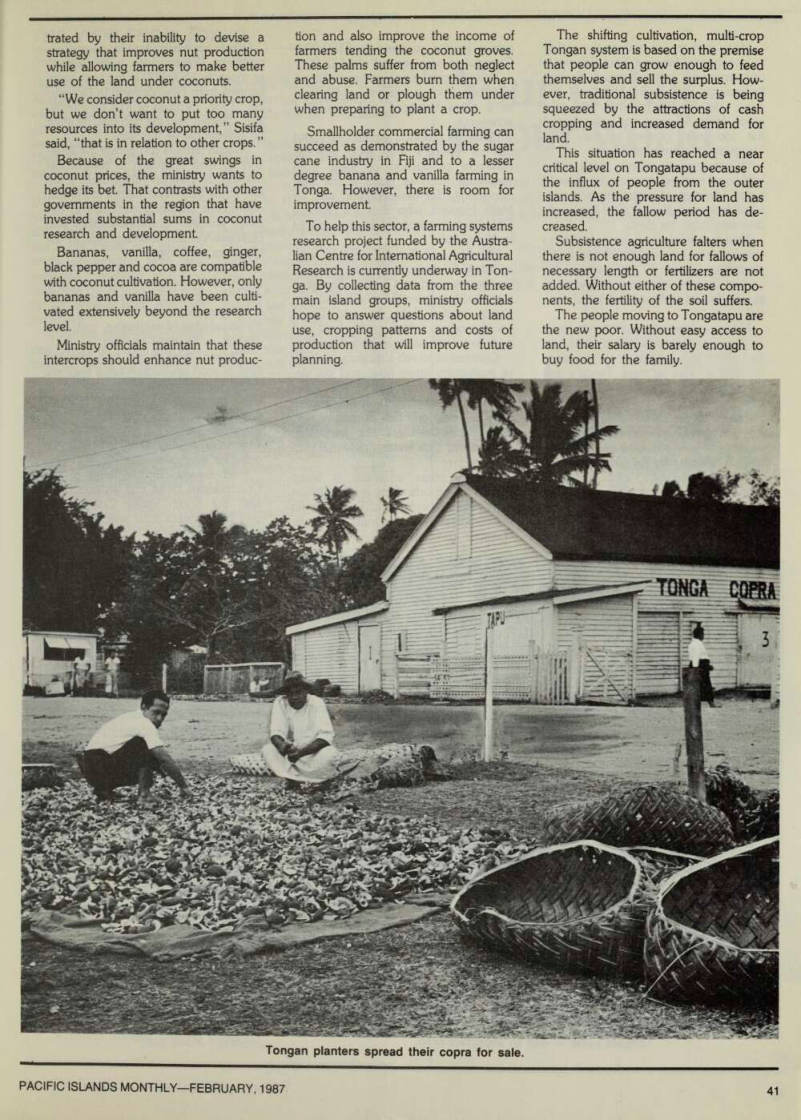
Tongan planters spread their copra for sale.
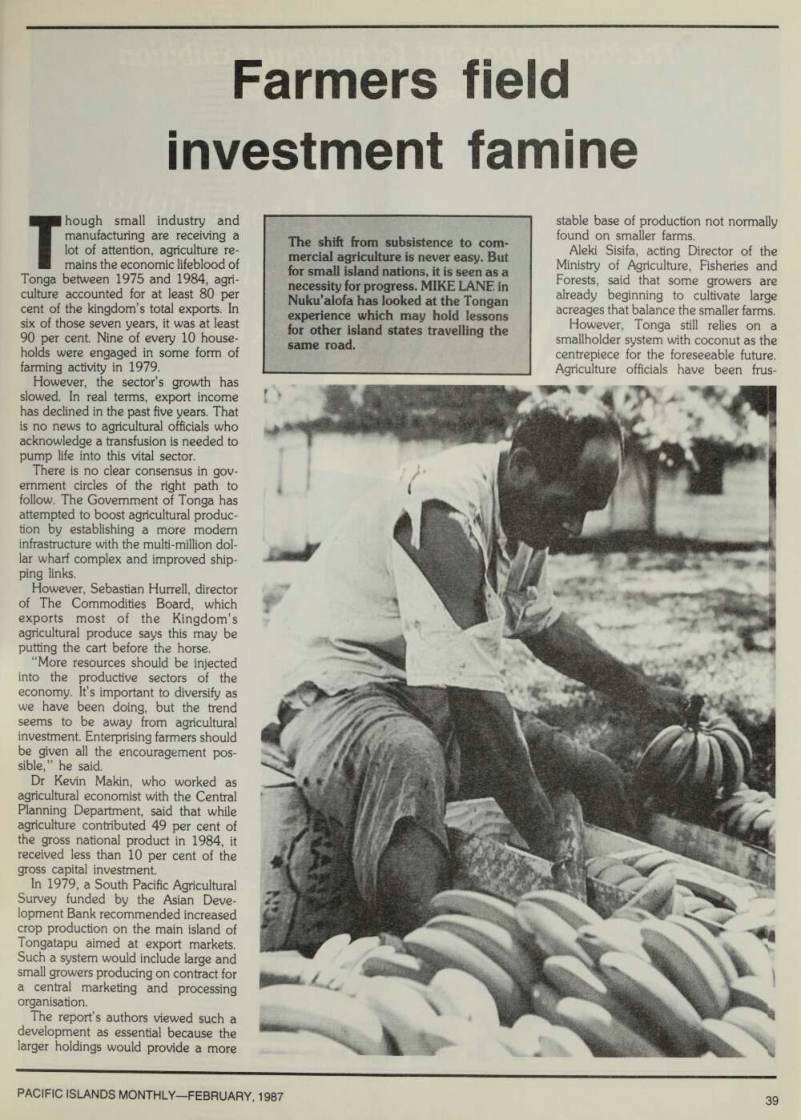
Many farmers are making the switch to commercial farming. Siua Sekona is one man who has embraced modem technology and new methods of farming. He exports bananas and root crops, farms 40 acres and was selected the top yam grower at the 1986 Tongatapu Agricultural Show.
“What used to take a week using traditional methods can now be done in a day,” he said. He clears his land with a bulldozer and uses a tractor to plough, disc and ridge his fields.
This farmer doesn’t leave much to chance. He ensures good yields by ploughing about 30 per cent of his annual income into land preparation, application of fertiliser and weed con- However, imports continue to grow as does Tonga’s trade deficit which can be attributed partially to currency fluctuation. The pa’anga, Tonga’s unit of currency, is tied to the Australian dollar.
The Kingdom’s trade deficit for Janury last year was $5.7 million, an increase of 24 per cent according to figures released by the Department of Statistics. Goods and services amounted to $6.3 million compared with $600,000 for exports and reexports.
Bananas were the leading export
earner for the quarter with $lBO,OOO.
Coconut oil was second at $132,000.
This is typical for countries making a transition from subsistence agriculture to a more balanced and diversified economy.
Livestock products account for about half of Tonga’s total food imports.
Low-cost production of meat from ruminants such as goats is the best opportunity for development, said Dr Malik Hussain, who directs a regional FAO livestock program headquartered in Nuku’alofa.
Hussain said Tonga could be self sufficient in meat production provided that feed is produced locally. Though it is probably impossible to substitute for cheap mutton flaps, he said Tonga could produce a high quality beef and pork to substitute for imported protein, Constraints to self-suficiency are lack of husbandry know-how, and the de mand for suckling pig in the social customs. These animals are killed when they are only one fifth of mature size, Breeding females are also frequently slaughtered thus limiting potential pre duction.
Though more emphasis is being placed on exports, there is competition within the region for all of Tonga’s main commodities coconut products, bananas and vanilla.
Others have been huit by quarantine problems. Watermelons, which earned as much as $500,000 in the past, were banned from New Zealand in Novem ber, 1985, because of fruit fly infesta tion. Officials said the ban may be lifted by the middle of this year.
Tongan farmers complicate the situa tion by their approach to commercial farming. S. Deacon Ritterbusch, a fel low at the East-West Centre in Hawaii, offered the following comment in her thesis entitled “Entrepreneurship and Business Venture Development in the Kingdom of Tonga.”
She said “. . . Farmers should be taught to be better managers so they don’t rush into any kind of commercial farming operation in which they have no knowledge of marketing, crop pro duction or financial backing.
“Instead, they all just rush into any kind of crop production once they see other farmers making money at it.
Often the quality of food they produce is poor, but it still takes up precious space on planes or ships and floods Talamahu Market thus lowering the price for everyone.”
Fred Sevele, former head of the Commodities Boad and an economist with the South Pacific Commission, said Tonga needs to be selective in how it uses its resources.
“Agriculture would be better served by concentrating on certain commod ities both for import substitution and exports and on identifying and assisting enterprising and productive farmers who could be depended on to provide much of the production required for both domestic consumption and ex port,” he said.
Agricultural leaders are pinning big hopes on agro-based industries embo died by Golden Passions Tonga (Ltd.), a company that processes passionfruit and other tree crops. The Commodities Board is considering adding several products to its line and another venture is being pondered.
Within the next decade, Sisifa said, Tongan farmers should be able to meet the challenges of markets in Hawaii and North America provided shipping links hold together, and quarantine regula tions can be met.
He said coffee, black pepper and kava should all develop a niche in the export trade.
But unless a series of agricultural incentives and better access to market ing information is distributed to farmers and government allocates more re sources to this sector, agriculture may never realise a potential that is this country’s greatest national resource.
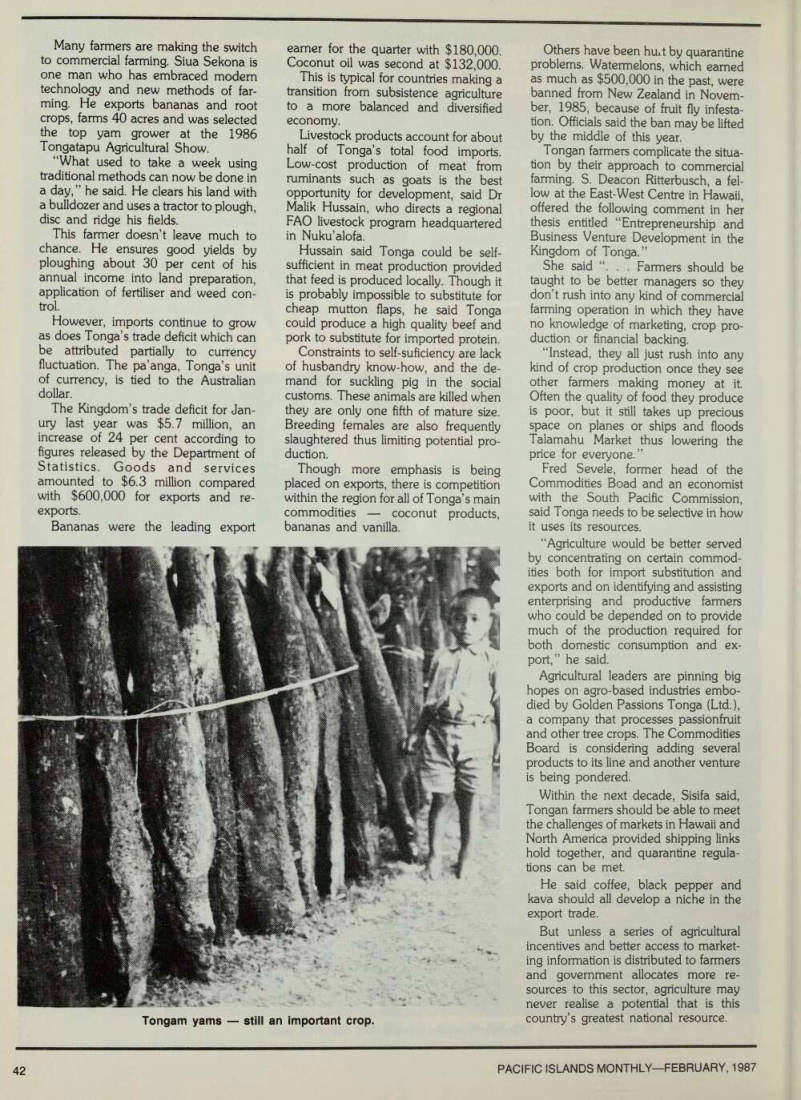
Tongam yams - still an important crop.