Petite bananas set
p. 30 · Read in the full issue
for small success
A revolutionary fruit marketing campaign is being tested in the Paci fic islands as part of a three-pronged effort to stimu late banana production.
Fruit Distributors Ltd of New Zealand marketed a trial ship ment of small bananas from Tonga in late December.
Two containers of specially packed small bananas were in tended to test the New Zealand market for a different style of fruit.
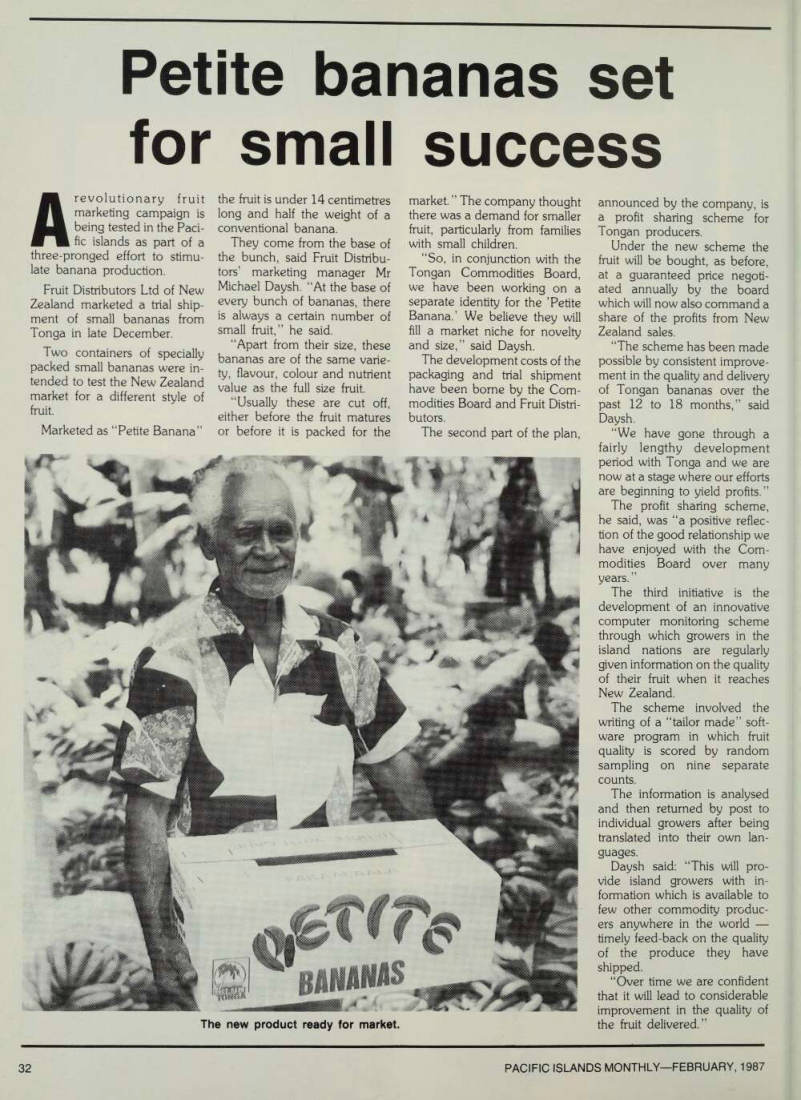
Marketed as “Petite Banana”
the fruit is under 14 centimetres long and half the weight of a conventional banana.
They come from the base of the bunch, said Fruit Distribu tors’ marketing manager Mr Michael Daysh. “At the base of every bunch of bananas, there is always a certain number of small fruit,” he said.
“Apart from their size, these bananas are of the same varie ty, flavour, colour and nutrient value as the full size fruit.
“Usually these are cut off, either before the fruit matures or before it is packed for the
market. ” The company thought there was a demand for smaller fruit, particularly from families with small children.
“So, in conjunction with the Tongan Commodities Board, we have been working on a separate identity for the ’Petite Banana.’ We believe they will fill a market niche for novelty and size,” said Daysh.
The development costs of the packaging and trial shipment have been borne by the Com modities Board and Fruit Distri butors.
The second part of the plan,
announced by the company, is a profit sharing scheme for Tongan producers.
Under the new scheme the fruit will be bought, as before, at a guaranteed price negoti ated annually by the board which will now also command a share of the profits from New Zealand sales.
“The scheme has been made possible by consistent improve ment in the quality and delivery of Tongan bananas over the past 12 to 18 months,” said Daysh.
“We have gone through a fairly lengthy development period with Tonga and we are now at a stage where our efforts are beginning to yield profits.”
The profit sharing scheme, he said, was “a positive reflec tion of the good relationship we have enjoyed with the Com modities Board over many years.”
The third initiative is the development of an innovative computer monitoring scheme through which growers in the island nations are regularly given information on the quality of their fruit when it reaches New Zealand.
The scheme involved the writing of a “tailor made” soft ware program in which fruit quality is scored by random sampling on nine separate counts.
The information is analysed and then returned by post to individual growers after being translated into their own lan guages.
Daysh said: “This will pro vide island growers with in formation which is available to few other commodity produc ers anywhere in the world timely feed-back on the quality of the produce they have shipped.
“Over time we are confident that it will lead to considerable improvement in the quality of the fruit delivered.”
The new product ready for market.