may be higher than expected
pp. 25-28 · Read in the full issue
trade winds
Tuna deal pay out may be higher than expected
There’s both good news and bad news for the islands regarding the pending U.S. tuna treaty.
The good news is that the islands may get more than the widely quoted SUS 2 million from the industry, and that they drove a considerably better bargain for fishing rights than did the Central American nations.
The bad news is that there are many hurdles to clear before any money changes hands, and that the islands, despite the use of lots of U.S. taxpayers’ money, will only get a tiny portion of the retail value of the fish.
The basic arrangement is that the industry will provide about $2 million and the U.S. Government $lO million a year for the fishing rights for the next five years.
The Government funds include $1 million in economic development assistance, and $9 million in cash, to be divided among the islands. The industry will pay a minimum of $1.75 million a year in boat fees, and a flat $250,000 a year in technical assistance to fishery-related projects.
There are two reasons why the industry may pay more than the anticipated $1.75 million in fees. These fees are based on a minimum rate of $50,000 per vessel, and if long-depressed tuna prices rise, the boat fees will rise proportionately. Similarly, it is sensed in Washington that more boats will seek licenses than the widely discussed total of 35. ($50,000 x 35 = $1,750,000.) There are 64 active purse seiners in the U.S. tuna fleet, and people in the industry sxpect that as many as 40 of them will seek the licenses.
Meanwhile, the tuna industry and the U.S. Government have been negotiating ■wth four of the Central American nations vhose waters contain abundant supplies of ;ellowfin tuna. This agreement, which is at about the same stage as the islands’ aegotiations, calls for a payment of (>36,000 per boat, about two-thirds of the igure secured by the members of the r orum Fisheries Association.
Should nearby Mexico join the Central American pact, with its ample fishery vaters, the basic fee will climb to $50,000, as in the islands. But whether the fee is
$36,000 or $50,000 there is no escalation fee in the event of price increases as there is in the islands deal.
Further, while there is substantial U.S.
Government cash accompanying the industry’s payments to the islands, there is no comparable arrangement in Central
America. (On the other hand, the U.S. is so concerned about the growth of a commun ist threat in the area, particularly in Nicaragua, that it has long had an active economic development program in Cen tral America.) As is often the case, the bad news is
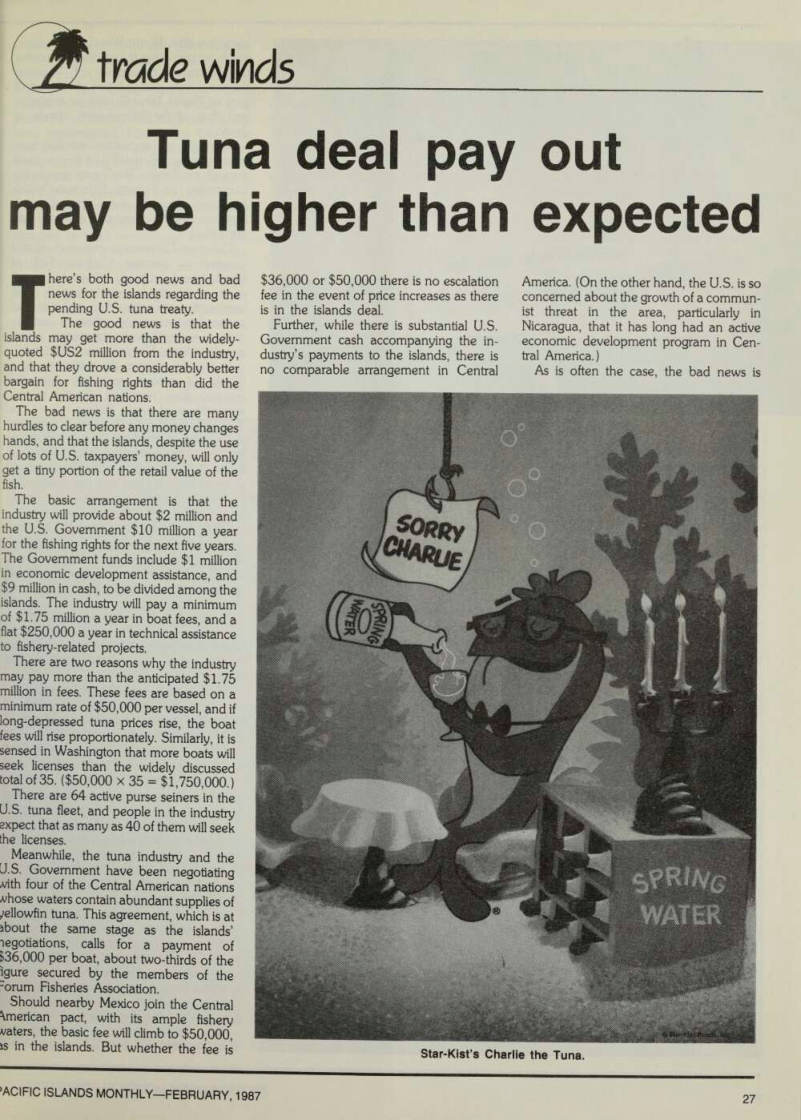
Star-Kist’s Charlie the Tuna.
more complicated than the good news.
The current status of the tuna treaty is that the central problem has been solved; the islands, the industry and the United States have come to an agreement regar ding the amount of money to move from the mainland to the islands. But before the money can start to move the following has to happen: • Some minor matters of substance such as defining areas where no fishing will be permitted must be settled; • The treaty must be signed by the U.S. and the 16 other jurisdictions (see box) • The treaty must be ratified by the United States Senate and ten other juris dictions. • Enabling legislation must pass both
Houses of Congress and be signed into law by the President. • The $lO million must be appropriated by the U.S. Congress.
As the islands will discover, it takes time to do business with Uncle Sam, even when he is feeling friendly, as he is now on this issue.
Once a text has been agreed to, the document must be signed by the parties.
While signing a treaty and ratifying it are essentially the same act in a parliamentary democracy, this is not the case in the U.S., where the Department of State, in effect, signs agreements, and then ships them over to the Senate for ratification.
And, sometimes in the past, what the executive branch wants the legislative branch denies. (The U.S. Senate, for instace, refused to ratify the Treaty of
Versailles after World War 1. That docu ment, among other things, transferred the once-German ownership of Western Samoa to New Zealand, that of Nauru and part of Papua New Guinea to Australia, and that of the Micronesian islands to Japan.) Although no opposition to the tuna treaty is expected, it will take time to get it through the Senate. The Treaty goes to the Committee on Foreign Relations, which has been showing every sign of being transfixed by the complex and messy Iran arms deal.
The new Democratic chairman of the Committee, Senator Claibom Pell of Rhode Island, probably will want to spend most of his time investigating it. Pell, incidentally, a wealthy man and a former career foreign service officer is not re garded enthusiastically by many career people in State. His nickname: “Stillborn”.
In the U.S. system the ratification of a Treaty (a process involving only the Senate) does not lead directly to the expenditure of funds. Before any of the $lO million can get to the islands authoris ing legislation must be passed, and then, later, an appropriation must be voted.
Both of these steps require the concurr ence of both houses and the president.
Though no major obstacles are antici pated, all of this will simply take time.
PlM’s analysis of the financial implica tions of the treaty suggest the following: • The retail price of canned tuna is about $1.70 to $4.50 in the U.S.; the islands will get about three cents a pound of this from the industry. • The U.S taxpayers will bail out the big tuna corporations, with the Govern ment contributing five times as much, or fifteen cents a pound, at retail, to the islands.
Tuna is a big, big business in the States.
American consumers love the product, annually buying the equivalent of nearly 2,000,000,000 cans of the stuff each weighing 6.5 ounces. That is about eight cans a year for every man, woman and child in the nation. When you visit an American grocery store you will find a few cans of mackerel (most Americans regard canned mackerel as food for cats), a few cans of canned salmon (an expensive delicacy), some sardines, and row after row of canned tuna. (Tuna dominates the canned fish market, but not the fresh or frozen fish markets.) In the large, efficient suburban super markets one buys 6.6 oz. cans of Western Pacific tuna at prices ranging from 73 cents to $1.39. The cheapest available (at 73 cents) are non-advertised brands, usually carrying the store’s own label. (People in the tuna industry say that such cans sometimes sell for as little as 59 cent) Next up the scale are advertised pro ducts packed by the U.S corporations
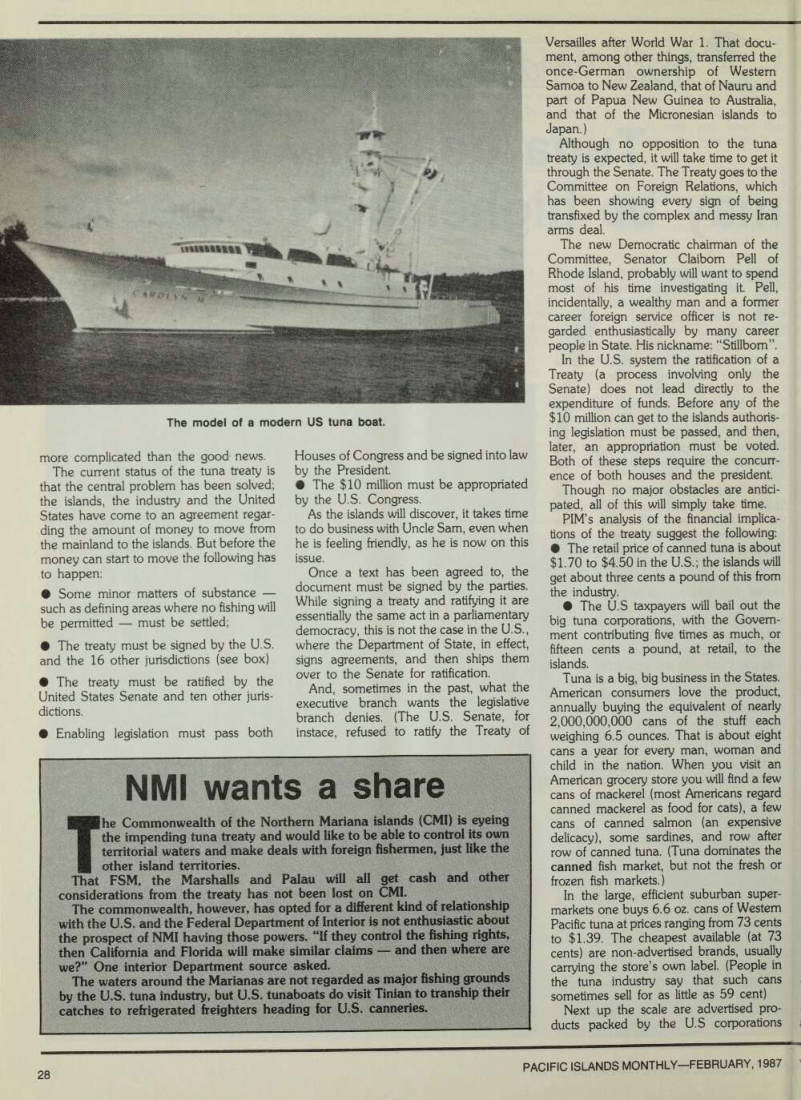
The model of a modern US tuna boat.
whose canneries stand side-by-side at the end of Pago Pago’s harbor, the Star-Kist segment of H.J. Heinz Co., and Ralston- Purina’s Van Camp operation. Both brands of chunk light (not white) tuna packed in oil were priced at 88 cents in my local supermarket. Further up the scale was Star-Kist’s solid light tuna packed in spring water and bearing a gold label (to distinguish it from the chunk light in a green label.) This came to $1.39.
The most expensive tuna available was Van Camp’s Chicken of the Sea fancy albacore (a solid white tuna) for $1.79.
While albacore is sometimes caught in the islands, it is a temperate zone, rather than a tropic zone, fish, and it is much more likely to be caught by Asian long-line boats than by the American tuna fleet. For all practical puposes albacore does not play a role in the pending fisheries agreement.
In order to compare what the consumer pays to what the islands receive, we accepted a State Department estimate that the American tuna fleet harvests about
100,000 tons a year in island waters. (This is about a quarter of the world-wide catch of the American fleet.) Since 100,000 tons is equal to 200,000,000 pounds, the $2 million from the industry comes to one cent per pound for the raw fish. But since about two thirds of the harvest is lost in the cleaning and canning process, the islands are going to receive about three cents for each pound of island harvested tuna in American stores.
Using the same approach, and the $lO million a year from the Government, we find that the U.S will pay the islands about 15 cents a retail pound for the fish. (See box.) Although Americans spend more than $1.5 billion a year (if average retail prices are about $2.00 a pound) on canned tuna the industry indicates that there are major problems: the price to the canneries has declined in recent years, and there is major competition from low-cost canneries else where in the world, notably in Thailand.
U.S. Department of Commerce statistics
indicate that total sales of the U.S. tuna canneries have dropped from $B5B million in 1983 to $B2l million in 1985. (These are cannery prices, not retail prices; these canneries buy about half of their fish from U.S. boats such as those covered by the treaty, and half from foreign-flag vessels, The tuna industry is struggling with a peculiar tariff structure which raises higher barriers against foreign oil-packed tuna than it does against water-packed tuna, which is growing in popularity as the nation grows more concerned about both weight and health. The tariff on the oil-packed product is 35 per cent, and it varies from 6 per cent to 12.5 per cent in the water packed tuna, depending on the volume of imports.
Last year about 10 million of the 39 million cases of canned tuna consumed in the States were imported. (Japan and the European Community also have tariffs protecting their tuna industries; the current levels are about 24 per cent), The tuna agreement reminds us that
these migratory fish often migrate more after they are caught than they they do while alive though they are long distance champions.
America has eight tuna canneries, two in American Samoa, one on Terminal Island, California, near the home base of most of the fleet, and five in Puerto Rico. It is not unusual for tuna caught in the Federated States of Micronesia, or near Papua New Guinea, to be carried (frozen) up to Tinian in the Northern Marianas, and transhipped there to a refrigerated ship on its way to either American Samoa or (via the Panama Canal) to Puerto Rico.
Then, once canned, it goes to sea again, say to New York harbor. This voyage, from FSM to Tinian to Puerto Rico and on to New York is more than 14,000 miles, or more than half way around the globe. I asked Ed Ryan of Star-Kist how often this occurs. “Happens every day,” he said cheerfully.
Why are not more of the tuna canned closer to the site of the catch? Such as in the islands? One needs five raw materials to put together a fish cannery: in addition to the fish (which are easily transportable), there must be ample supplies of fresh water for processing, adequate and nottoo-expensive labor (it is not attractive work), managerial skills and lots of capital.
Canneries use expensive machinery and
the cost of a new one runs in the tens of millions of dollars. The water factor apparently makes it unlikely that a major cannery can locate on one of the atoll islands. The recent price problems of the American industry suggest that no one is anxious to build a new cannery in the near future.
There is another variable in building a tuna cannery to serve the American market, and that is the U.S. tariff structure.
One of the reasons why the tuna migrate so far after they are caught is that they must reach an American-flag tuna cannery or else face the barriers of the U.S. tariff system.
The four former trust territories (FSM, Northern Marianas, Marshalls and Palau) collectively have an option of producing as much as ten per cent of America’s canned tuna market without being affected by tariffs. That would be an attractive, if somewhat elusive, prize for an island nation with sufficent water.
The conclusion of the tuna negotiations brings to the end a long round of island-hopping that was a mild stimulant to the tourist industry; before the last session in Nukualofa there had been nine previous meetings, in Raratonga, Port Moresby, Suva (two), Apia, Kona (Hawaii), Honolulu, Canberra and Wellington. About six people represented the United States at
each of the sessions, with Ed Wolfe, Deputy Assistant Secretary of State for Oceans and Fisheries leading the delega tions.
Another six from the U.S. tuna industry, (including David Bumey of the U.S. Tuna Foundation among others) and one or two representatives from each of the sixteen Pacific jurisdictions were also present. Thus it was a floating conversation, bringing some 40 people together ten times in the course of two and a half years. As this is written the basic distribution of funds among the islands has yet to be negotiated, a process in which the U.S. plays no role.
The tuna industry (and those working on the matter in the State Department) have heaved a collective sigh of relief. The industry finally secured its goal (as it has in the Central American region) of working out a regional fishing licence for what it regards as an acceptable fee.
No more worries about seized ships or difficult negotiations with single nations each seeking to impose its own (one nation) licence. These were regarded as too expensive by the industry. At one point the fee for a single boat, issued by a single nation, became as high as the $36,000 now set for the Central American region, And, it is, of course, to the industry’s benefit that Uncle Sam is picking up most of the bill.