The View From Tokyo
pp. 23-41 · Read in the full issue
Japan has turned its attention to the Pacific.
Alerted to the Russian overtures to island na tions, the world’s foremost eco nomic power has moved to fill the commercial and, perhaps, strategic gap left by the years of western neglect But it won’t be all plain sailing for Japan.
Australia, stung by Tokyo’s refusal to relent on home mar ket access, has declined the role of southern hub in a north south Pacific axis of influence.
Nevertheless, Japanese fore ign minister Mr Tadashi Kura nari’s major policy speech in Suva was welcomed in the islands.
His remarks foreshadow a
major Japanese aid and di plomacy initiative.
He assured his Suva audi ence, for example, that Japan
“fully recognises the political significance that the South Pad fic Forum bears and I would like to announce today that Japan
will invite the head of govern ment of the chair country and the director of SPEC to visit Japan immediately before or after the annual meeting of the Forum. ”
He stressed Japan’s desire to preserve political stability in the region —though he carefully avoided any mention of the Soviet Union.
But he did say: “However much one may wish it other wise, peace and stability cannot be maintained without ade quate thought being given to global security considerations.
“This principle does not allow of any exception for the Pacific region despite its being far from the world’s areas of heightened tension.”
continued overleaf
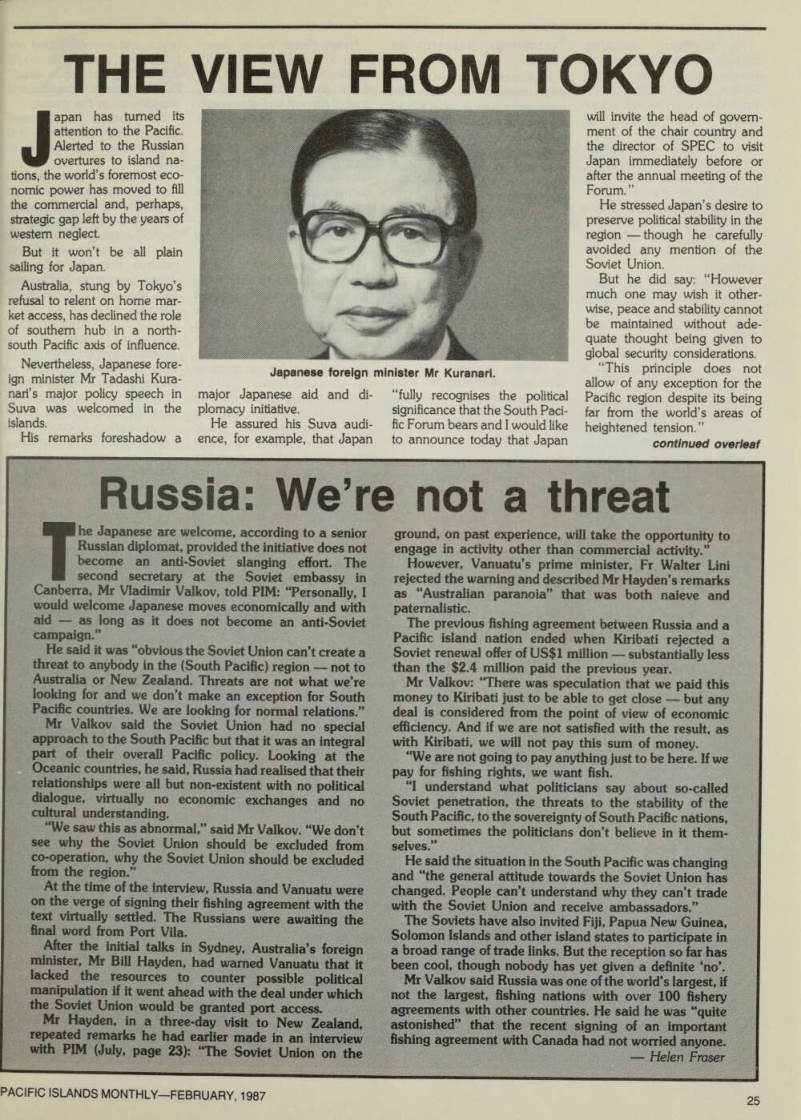
Japanese foreign minister Mr Kuranari.
Mr Kuranari, speaking through an interpreter and still avoiding direct mention of the Soviets, added: “Japan cannot support the introduction of new tension into this peaceful and untroubled region.”
He said Japan would, subject to parliamentary approval: • Provide SUS 2 million to the UNDP to be earmarked for development projects in the is an s, . Provide US$l million for appropriate technology re- T . .. , • Increase visits by young islanders to Japan for training and experience.
Mr Kuranari noted that Japan’s aid to the region had grown five times in ten years, “but I have ordered a study of ways to expand Japan’s cooperation yet further.”
The UNDP money would go mainly to transport and telecommunications, he said, while the research grant was earmarked for the project, “Open Cycle Ocean Thermal Energy Conversion at the Pacific International Centre for High
Technology Research in Hawaii, Mr Kuranari also met the Fiji prime minister Ratu Mara and inspected a new nursing school that had been built with Japan ese a id.
He met j a p aneS e volunteers who are spending two years working in Fiji’s Mineral Re sources Department, Qn m {and mQSt island nations’) trade imbalance with j Mr Kuranari , inter . on his arrival> was in encouraging mood. , , , hoped that Fiji enterprises would make every sell aoods to Japan, which government in Tokyo was to encourage, Tourism, he said, was one area with great potential. More flights into Fiji (Air Pacific had just announced a regular week ly service in partnership with JAL) would attract more Japan ese tourists, And Japan, he said, would be willing to buy more of Fiji’s sugar provided quality, price and delivery were right.
Helen Fraser writes: Japan plans to move into the South Pacific as a significant aid donor, though without the de gree of support and encourage ment that had been sought from Australia.
At the two day Australia- Japan Ministerial Committee talks held in Canberra relations between the two delegations suffered severe strain when Japan failed to make the eco nomic concessions expected by Australia.
The Japanese sought Austra lian participation in an alliance to thwart the growing Soviet presence in the South Pacific but Australia would not agree to a strong political relationship in the face of fundamental divi sions between the two countries on economic issues.
After talking for two days Mr Kuranari said it was agreed that Japan and Australia would “hold close bilateral discussions on the theme of co-operation with the island states of the Pacific”.
Mr Kuranari said he had a deep personal interest in the
region and wanted to find out for himself what Japan could do, adding that Japan would call on Australia’s “wisdom and experience” in the matter.
But Australia has indicated that it may just keep that “wisdom and experience” to itself.
Mr Kuranari acknowledged that no actual mechanism had been established to allow con sultation on this use of Austra lian experience in South Pacific aid - a step which would have resulted from the talks had Japan been more forthcoming with economic concessions for Australia.
Australian ministers had pointed out to Japan that unless Australia received more favour able treatment from Japan on access to their markets, particu larly iron ore, coal and beef, then Australia’s ability to ad vance western interests in the region would be hampered.
While Japanese ministers stressed that Japan would not seek to solve its economic prob lems with third countries at
continued on page 43
Australia’s expense, and agreed to discuss the next beef quota earlier than planned, the con cessions did not go as far as Australia had hoped although they did steer the meeting’s close away from a near disaster.
Australian Foreign Minister Bill Hayden said in a short closing statement after the talks that Australian experience in the South Pacific was largely a result of learning from past mistakes, implying that the Japanese could follow this path in developing their new aid initiatives.
While his Japanese counter part described Japan and Aus tralia as “forming a north-south axis in the Asia-Pacific region” with “shared values of demo cracy and free trade”, Mr Hayden was more restrained, noting that as Western coun tries the two ’’accordingly had shared objectives”.
Differences between the two countries will be given a further airing when Mr Hayden visits Japan before the middle of the year.
Referring to fisheries agree ments between the Soviet Un ion and Pacific island states Mr Kuranari said this “did not necessarily constitute a threat”
but that he thought it was important for these nations not to be affected by international tensions.
Mr Hayden pointed out that Japan already had a South Pacific presence, referring to the major harbour installations begun in Kiribati last year by Japan. He added that Australia had already helped Japan to play a greater role in the region with the suggestion that Papua New Guinea seek more Japan ese aid after Australia cut its aid budget last year.
Australia is to give an extra $l6 million in aid to the South Pacific this year, of which $8 million will be put into a trust fund for Tuvalu, to be matched, it is hoped, by the UK and New Zealand, with the remainder to be spent on development pro jects in the region.
Mr Hayden said: “What we talked about was the need for countries of the region to be able to conduct their economic development successfully where it was appropriate with aid from both of us.”
Mr Kuranari had taken pains to stress at all times the inde pendence of the sovereign states of the region, Mr Hayden said.
Japan’s prime minister Mr Nakasone meets Ratu Mara during his 1985 South Pacific tour.